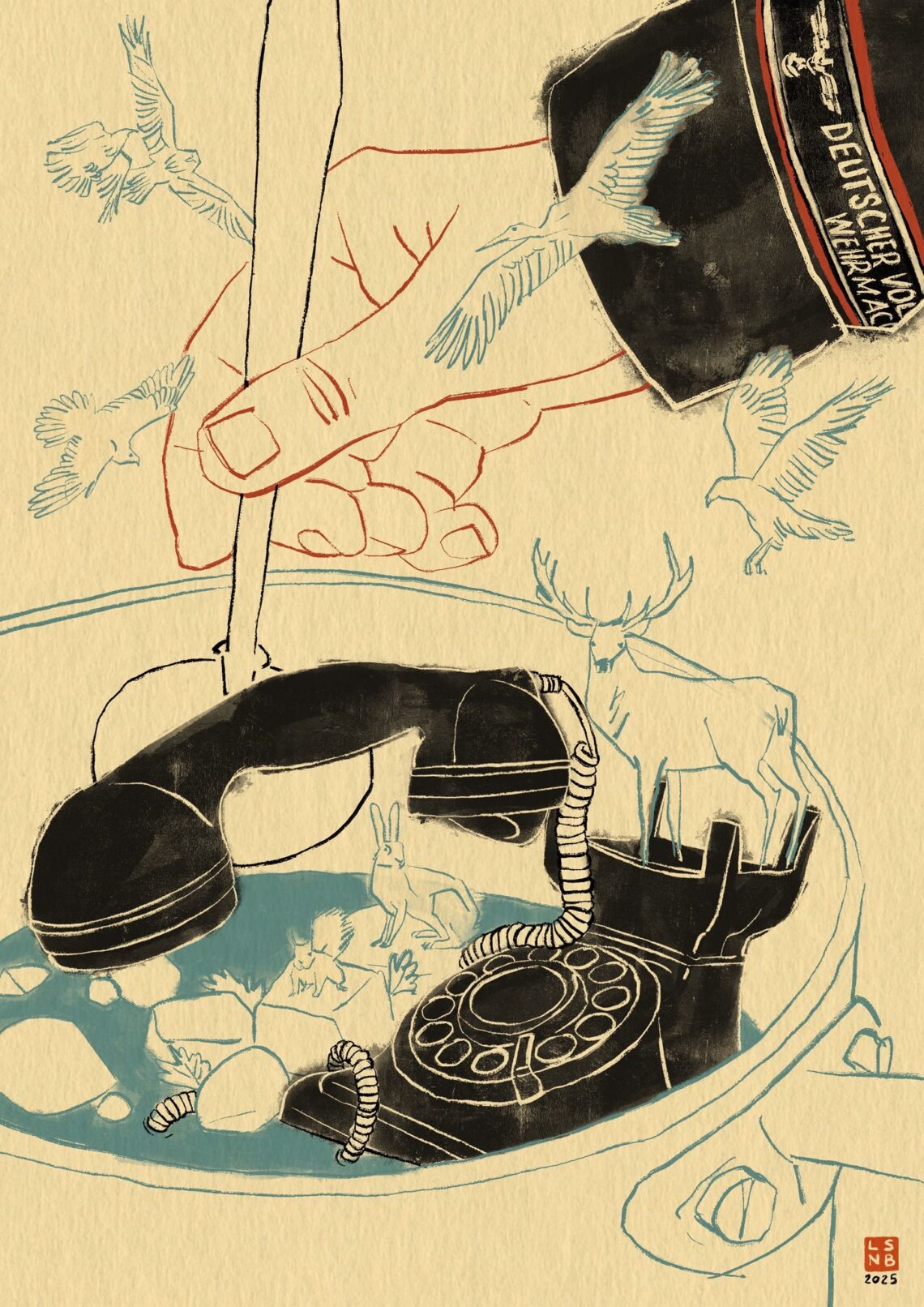
A Stranger in the Woods
art by Roberto Biadi
Written and translated from the Italian by Livio Milanesio

As soon as I turn my phone back on, after landing at Berlin Schönefeld Airport, it notifies me of five missed calls. All from my father. I call him back immediately, fearing the worst.. He answers, with his usual calm voice. He’s surprised I’m already in Berlin—people from his generation never really considered flying an option. He urges me not to tell anyone why I’m here. He’s afraid, he says, that this time the Germans will come after me. He knew the Germans, admired them, and they treated him quite well. But trusting them is another matter: the ones he knew always reminded him he belonged to a lower rank, a “sacrificial” element.
My father was a lucky foreign worker, a Gastarbeiter—well, if a deportee can really be called lucky. Arrested for partisan activities in the last summer of World War II, he was sent to Germany to “voluntarily” contribute to the war effort—a fate shared by thousands of Italians. Unlike the others, who often returned emaciated and broken, he came back stronger and healthier, and—as he often repeated—“without a shadow on my conscience.” A bizarre circumstance to imagine in those times of annihilation. So when I discovered that the place where he had survived during the war still existed, I decided to go see it for myself. I wanted to verify the singular and incredible story of the deportee who had prospered in a little piece of paradise—in the heart of twentieth-century hell.
The region I travel through, along the Berlin–Dresden route, is clean, prosperous, and welcoming. This territory, once part of Soviet-ruled Germany, bears no visible traces of the Iron Curtain era—let alone of the Nazi period. Reunified Germany has erased them under a thorough wave of reconstruction. My destination is Königsbrück, a town of 4,500 inhabitants about thirty-five kilometers north of Dresden.
In the shadow of the town hall, in what was once Adolf Hitler Platz, a Chinese restaurant, an Italian one, a Turkish eatery, a travel agency, a few shops, and a graphic design studio all sit nestled in colorful little houses—like the perfect backdrop of a northern European picture postcard.
In that square my father had arrived by coach in September 1944.
At the Italian restaurant, I’m the only customer. The owners’ entire family is having lunch at a round table. The empty dining room is lit by the hazy afternoon light filtering through the too-small windows. I try asking a few questions about the Lager that once stood on the outskirts of town. The restaurateurs glance at each other, confer, and whisper among themselves, switching between German, Italian, and a southern Italian dialect depending on their generation.
The owner, a few years older than me, tries to explain—in his rusty Italian—that there’s no Lager here, only an old training camp abandoned by the Russians. That it’s verboten, off-limits, not open to visitors.
That’s the place I’m looking for.
The Truppenübungsplatz Neues Lager lies a couple of kilometers north of Königsbrück. It was one of the largest military training centers in the country. Founded in 1906 amid the heaths and forests of eastern Saxony, it was expanded during the resurgence of German military power. The area was so vast that several villages were expropriated and their inhabitants relocated — villages whose names echo the mythical geography of Günter Grass’s The Tin Drum: Bohra, Krakau, Naundorf, Rohna, Sella, Steinborn, Zochau. Neues Lager was a fully autonomous military town, housing a tank crew school, a firing range, barracks, training fields, hospitals, and all the buildings necessary for military life. Here, units were trained for the Eastern and Southern fronts.
During the war, Ukrainian, French, and Italian men and women worked here as tailors, carpenters, nurses, bricklayers, waiters, and general laborers—either having answered the call to migrate to Germany to replace the local workforce sent to the front, or having been rounded up during the various occupations.
During the war, Ukrainian, French, and Italian men and women were employed here as tailors, carpenters, nurses, bricklayers, waiters, and general laborers. They had either responded to the call to migrate to Germany to replace the local workforce sent to the front, or had been rounded up during various occupations.
Thanks to the inflexible and efficient German bureaucracy, my father was employed in the Lager with the title of Kellner—a waiter and kitchen hand in the Officers’ Club. The kitchen, staffed with chefs, sous-chefs, a pastry cook, and waitresses, was equipped with a well-stocked pantry and wine cellar. For the nineteen-year-old boy, it was a promotion. The dishes prepared there—refined and sumptuous compared to his mother’s boiled tripe—barely showed signs of wartime rationing. The pantry was well supplied, often enriched with fresh products from the surrounding farms. The cellar boasted a fine collection of Mosel wines, along with bottles from conquered Reich territories: French, Italian, Greek wines and liquors from every corner of occupied Europe. There was also a generous supply of coffee, tobacco, and cigars—all precious commodities at the time.
Meals were prepared for officers returning from the Eastern Front and for those stationed in one of the many facilities within the camp. It was an exclusively male environment—except for the waitresses. One of them, in particular, featured prominently in my father’s memories. But she was of pure German blood, and therefore, for the young Italian, fatally verboten.
I leave the town heading north and shortly afterward turn off the main road onto a path that winds into the forest. The narrow lane still retains its old cobblestone pavement. Among the trees, I immediately glimpse the gray perimeter wall that still surrounds the camp area. I reach a clearing within the dense undergrowth, where the entrance gate once stood. Two ruined buildings lie nearby—the Guardhouse and the camp’s Post Office, which I had seen in postcards dating back to the 1930s. I park beneath a weathered tourist sign, written in German and worn down by countless storms. It depicts the wildlife inhabiting this place, long separated from the outside world: storks, hares, birds of prey, foxes, deer, reptiles, wild boars, and various rodents — all species that have thrived under the protection of military secrecy.
In April 1945, after a futile attempt at defense, the camp was occupied by units of the Red Army’s Central Group of Forces and resumed its military activity under a new flag. In 1990, the year of reunification, the local civilian population organized protests against noise pollution from military maneuvers and the suspected presence of nuclear or chemical weapons within the camp’s borders. The Russians began demobilizing and finally abandoned the area in 1992.
In September 1992, following pressure from local residents, the Bundeswehr, the unified German armed forces, announced that the Neues Lager training camp would be repurposed for civilian use. The initial joy of the administration and the surrounding communities soon faded. By October, the area was secured and access was prohibited. Despite glasnost—the policy of transparency introduced during Gorbachev’s era—it turned out that the Soviet army had left no documentation about what remained in the camp. It is suspected that enormous quantities of various munitions, countless scrap materials, and an unspecified amount of hazardous substances were left behind in the depots.
It quickly became clear that restoring the area for development would require a complex and costly cleanup. The solution was simple and ingenious: to abandon the area and designate it as a nature reserve. Protected by the fence for over eighty years, the land had avoided urban and industrial development, preserving an extensive, pristine natural environment.
Smaller buildings were demolished, 4.1 million artillery shells were detonated, 30,000 tons of scrap were disposed of, and part of the detected chlorine gas was cleaned up. In 1996, all plans for reinhabitation were definitively abandoned: the area, renamed Naturschutzgebiet Königsbrücker Heide (Königsbrück Heath Nature Reserve), became the largest contiguous natural reserve in Saxony. Later, some safe bike trails were mapped out for visitors. For once, nature beyond the fence was allowed to take its course.
In the clearing where once stood a gate flanked by concrete sentry posts, the fence and entrance have vanished. No facilities, no ticket office, no renovations, no educational interventions—only the weathered wildlife information board. A little further on, an iron bar blocks access to Mittelstraße, the road that runs through the entire camp. What strikes me is that on either side of the bar there is nothing—no low wall, no barbed wire, no barrier of any kind. I imagine that this obstruction, which isn’t even locked, is enough to deter a German citizen from violating the entry ban. But I was raised in a culture intolerant of rules, and I’m here on a mission more important than obeying an old rusty bar. So instead of walking around it to bypass the prohibition, I climb over it to assert my disobedience. After all, I am the son of a deportee, and I am here for a kind of redemption.
A few hundred meters from the entrance, a smaller road climbs a rise that would be generous to call a hill. Halfway up, the roof of a two-story building emerges from the thick canopy of trees. It is the pointed roof of the Officers’ Club, the setting of my father’s adventures.
As I walk upward in total solitude, trespassing on public property, the road sinks into the forest and the landscape fades into twilight. The weather is overcast; it’s late July but the temperature is low, and a light mist veils the valley behind me. Suddenly, a mural appears before me. At least four meters tall, it is painted over what was once a massive window. It depicts a Soviet officer, bareheaded, dressed in a gymnastyorka—the traditional Russian shirt—and cloak. Striking a heroic pose, he cradles a young girl in one arm, while holding a medieval-style broadsword in the other. I imagine it’s meant to convey the socialist knight’s resolve and tenderness—rather than to glorify the alleged Communist taste for eating children, a myth quite widespread in my country’s postwar years.
I stand before the left wing of the Offizierkasino, a perpendicular extension of the main structure that gives the building a T-shaped footprint. This section alone housed the imposing dining hall, of which my father remembered the brilliant chandeliers adorned with Bohemian crystal pendants. The facade of the main wing faces south, where a series of French doors open onto a stone terrace overlooking the camp. The terrace spans nearly the entire length of the facade, except for the final stretch where the main entrance is located. The entrance, reminiscent of an old-fashioned post office, is marked by a plain solid-wood door beneath a small white stucco portico. From here once flew the banner with the swastika—and later, the one bearing the hammer and sickle.
When I had shown my father a vintage postcard of the building, he had struggled to recognize it. He turned the hand-colored photograph over, and when he finally nodded, reading the printed caption identifying the place, I had the impression he did so more to reward my efforts as a researcher than out of any true recollection of his gilded captivity. Now that I stand before it, I understand why. Surrounded by forest, the building is more sprawling than the image had suggested—it’s impossible to take it all in at once. As usual, when you look too closely at history, you lose sight of the whole picture.
Despite the autumn weather muting the broad panorama, I can understand the nostalgic air in my father’s wartime stories. Back then, he was just a boy spared from tragedy, housed in a sort of resort among the hills of one of the few places in Europe where the conflict had not yet arrived (Dresden would only be bombed in early ’45), surrounded by cooks, delicacies, and young waitresses. They had even granted him the use of a car, an Auto Union powered by a gas generator, to visit farms in search of eggs, milk, and fresh meat.
Who can blame his singular view of the Germany that once was Nazi?
Like all the other buildings slowly sinking into the forest, the Officers’ Club is a ruin: broken glass, open doors, and a roof sagging or collapsed in places. Exploring an abandoned building sharpens my senses. Some signs point to a distant, almost mythical past; others are more recent, the aftermath of a slow decay. The air is thick with the smell of mold. Torn newspaper pages litter the floor, graffiti covers the walls. I move through it all, searching for unlikely traces of my father. I try to match his memories to what remains.
My father’s stories had always been fragmentary. They surfaced unexpectedly in the middle of a meal, or during a remark about the weather or how a roast had been cooked.
Still, some things are recognizable: the sliding door to the kitchen, the shadowy entrance where he once hung his coat, the cellar stairs that used to lead down to shelves of provisions and bottles.I would like to find traces of the atmosphere of that sumptuous kitchen that had enchanted him—so unlike the practical, rustic meals of his mother’s home—nothing like his mother’s plain, rustic cooking. But all I come across are a few ledger pages filled out in Cyrillic, some old German newspapers, and an empty juice box.
My hope fades when I realize that forty-six years of Soviet occupation have completely buried the remnants of the Second World War—starting with the large dining hall. The Soviets, pragmatic and methodical, bricked up the grand window overlooking the valley (on the outside of which they painted the mural of the Soviet knight) and transformed the space into a cinema with, by rough estimate, two or three hundred seats. At the far end of the wall, the slots for the projector are still visible. Propaganda triumphs over gastronomy.
In the attic rooms, I look for what had been his bedroom—a room of his own, a luxury he hadn’t even enjoyed at home. In the end, I settle. I choose a small room with a sloping roof that more or less matches his description, and I do one of those things that pretend to be memorable. I call my father.
When the thunder of artillery from the Eastern Front became clearly audible, everybody packed and fled. My father, the Officers’ Club managers, and a Ukrainian worker drove off toward Prague. Everyone feared the Russians. Dad, who had spent over eight months in paradise, was well-dressed and looked healthy enough to be suspected as a collaborator—or even a fascist ally. During his “captivity,” he hadn’t held back. Born in a kitchen, he quickly made himself useful in the Officers’ Club kitchen. Although he was subject to the rationing laws for foreign workers, he never went hungry. Having earned the cooks’ trust, he was often consulted about the cooking, and through constant tasting and testing, his belly was well filled. He lived in the storage of one of the most valuable treasures of any conflict: the abundant pantry and winter clothes made by Italian tailors working in the camp.
Prague was under siege by the Soviets. It would be the last major battle of the war in Europe, ending twelve days after Adolf Hitler’s suicide. Even there, my father worked as a waiter in a hotel near the station. Dressed in a white jacket, he served the few clients with the scarce supplies of the besieged city.
Then, one of the last trains to escape the Prague pocket took him to Nuremberg, where he was stopped by soldiers of the First Infantry Division—the Big Red One. The soldiers had fought all the way from Omaha Beach to Czechoslovakia, passing through the Ardennes.
Even then, he made a living by dealing with food: he was assigned to rehabilitate concentration camp survivors, teaching them how to eat again. By the end of September 1945, he managed to return to the family tavern. In the late postwar years, the German government granted him a small pension, around five dollars a month, for the time he had worked as a foreign laborer. He never thought of returning.
It takes him a while to respond. “Guess where I am,” I say. My father, who never liked surprises, stays silent. “I’m at the Officers’ Club. I’m in your old room.” He doesn’t react with the astonishment I had imagined. Instead, he asks if they made me sign a logbook to get in—just as if no time had passed for him, as if this place had remained untouched, preserved in his memory exactly as it was in the spring of the war’s final year, with guards, inmates, dinners to prepare, and waitresses to smile at. I explain that the guard post is gone, the sentries long absent. He tells me to stay warm—the forecast calls for rain—and to come visit him soon.
And then he hangs up.
That’s how he wraps up my great adventure into his past.
I wander a little longer through the empty rooms, aimless, hollowed out myself. In the attic, I find a warning painted in sharp German script on the wall, cautioning not to place too much weight on the floorboards. Just before I step back over the bar blocking access to Mittelstraße, the phone rings again.
“I should have come with you,” he says. “Maybe I could’ve met someone I used to know.”
I remind him that I spent over a month trying to convince him to come along. I showed him the perfectly planned itinerary—every detail mapped out: taxis, flights, rental car, hotels in Berlin and Dresden. But he found every excuse to say no, even something as simple as needing to feed the dog.
I don’t know how to tell him that here, apart from a few lost ruins, everything’s new and forgotten, and very little remains of those times. Yet I’m certain those few crumbling bricks would stir memories in him—memories that are quickly fading around here.
I promise we’ll return together. He agrees.
It’s a promise we made year after year, but never kept—until the day he died.
Because no matter how well he was treated there, no matter how much that stroke of luck saved his life, he always remained a stranger to it all.
Straniero nel bosco
Appena lo riaccendo, dopo l’atterraggio all’aeroporto di Berlino Schönefeld, il telefono mi avverte di cinque chiamate non risposte. Tutte di mio padre. Lo richiamo immediatamente immaginando il peggio. Risponde lui stesso, con la solita voce tranquilla. Si stupisce di trovarmi già a Berlino, dato che nel suo immaginario il viaggio aereo non è contemplato. Solo alla fine della telefonata mi rivela il vero motivo delle chiamate: si raccomanda di non raccontare in giro il motivo della mia visita. Ha paura, dice, che questa volta i Tedeschi se la prendano con me. Lui i Tedeschi li ha conosciuti, li ha ammirati, lo hanno anche trattato bene. Ma fidarsi è un’altra cosa: quelli che ha conosciuto lui gli hanno sempre ricordato di appartenere ad un rango inferiore, un elemento “sacrificabile”.
Mio padre è stato un lavoratore straniero fortunato. Sempre che un deportato lo si possa chiamare lavoratore. Arrestato per attività partigiane, nell’ultima estate della Seconda Guerra Mondiale, è stato spedito in Germania per contribuire “volontariamente” allo sforzo bellico. Un destino comune a migliaia di Italiani negli ultimi anni del conflitto. A differenza degli altri però lui ne è tornato cresciuto, rafforzato e anche un po’ ingrassato, senza per questo aver nulla che pesasse sulla coscienza. Una condizione difficile da concepire in quel tempo di annientamento. Quando ho scoperto che esisteva ancora il luogo dove è sopravvissuto e ha prosperato durante il conflitto ho deciso di andare a vedere di persona. Volevo verificare io stesso il racconto singolare e incredibile del deportato che nello specialissimo lager ai cui fu destinatoha scoperto un pezzetto di paradiso e che, alla fine della guerra, ha lasciato con un po’ di rimpianto.
La regione che attraverso, lungo la direttrice Berlino-Dresda, è linda, prospera, accogliente. Non ci sono tracce del passato oltre cortina e tanto meno di quello del periodo nazista. La Germania unita del dopo-muro le ha fatte sparire sotto una consistente ristrutturazione. La mia destinazione è Königsbrück, una cittadina di quattromila cinquecento abitanti a trentacinque chilometri a nord di Dresda. All’ombra del municipio, in quella che fu la Adolf Hitler Platz, si affiancano un ristorante cinese, uno italiano, uno turco, un’agenzia viaggi, qualche bottega e uno studio grafico incorniciati in casette multicolori, come in un perfetto set da cartolina illustrata nordeuropea.
In quella piazza mio padre ci era arrivato in settembre, in corriera, come gastarbeiter – lavoratore straniero. Al ristorante italiano sono l’unico cliente. Tutta la famiglia dei proprietari sta pranzando ad un tavolo rotondo in una sala deserta e in penombra, molto più adatta alle cene illuminate dai rustici lampadari che alla luce caliginosa del pomeriggio che entra dalle finestre troppo piccole. Provo a fare qualche domanda sul lager che sorgeva alla periferia della cittadina. I ristoratori si guardano, si consultano, confabulano alternando tedesco, italiano e un dialetto del sud Italia a seconda della generazione di appartenenza. Il proprietario, che ha qualche anno più di me e un italiano piuttosto arrugginito, prova a spiegarmi che qui non c’è nessun lager, che c’è solo un vecchio campo di addestramento abbandonato dai russi, che è verboten e non si può visitare.
È il posto che sto cercando.
Il Truppenübungsplatz Neues Lager sorge a un paio di chilometri a nord di Königsbrück. È stato uno dei centri di addestramento militare più grandi della nazione. Fondato nel 1906 tra le brughiere e le foreste della Sassonia orientale, venne ampliato durante la rinascita della potenza militare tedesca. L’area è così grande che diversi villaggi furono espropriati e gli abitanti trasferiti, villaggi con i nomi che riecheggiano la geografia mitologica del Tamburo di latta di Günter Grass: Bohra, Krakau, Naundorf, Rohna, Sella, Steinborn, Zochau. Il Neues Lager era una vera e propria città militare autonoma, nella quale trovavano posto una scuola per carristi, un poligono, caserme, campi d’addestramento, ospedali e tutti gli edifici utili alla vita militare. Qui vennero addestrati i reparti per il fronte orientale e quello meridionale, qui venne battezzato il corpo dei legionari della Indische Legion, volontari indipendentisti indiani, SS di colore che combatterono in Francia e Italia indossando il turbante.
Durante il conflitto vennero impiegati uomini e donne ucraini, francesi, italiani. Sarti, carpentieri, infermiere, muratori, camerieri, uomini di fatica che avevano aderito all’invito ad emigrare in Germania per rimpiazzare la manodopera locale finita al fronte, e i rastrellati durante le diverse occupazioni.
Nell’ultimo anno di guerra mio padre vi fu impiegato con la qualifica di kellner, cameriere e sguattero nella cucina del Circolo Ufficiali. Lo avevano strappato a diciannove anni, dall’osteria di famiglia, una sorta di regno incontrastato della madre autorevole e autoritaria, talmente innamorata del suo lavoro di cuoca da averlo praticato fino agli ultimi mesi della sua lunga vita. Le Osterie d’Italia non era che una trattoria di campagna dal menù breve, le opzioni ridotte, rigorosamente scandito dal cambio delle stagioni e dalle bizze degli approvvigionamenti. La cucina del Circolo Ufficiali, con il suo staff di chef, sous chef, il cuoco per i dolci, le cameriere e un’importante dispensa e cantina, si poteva considerare una sorta di promozione. Si preparavano piatti che al confronto della trippa in brodo della madre erano raffinati e sontuosi, che poco risentivano del razionamento. Il Circolo disponeva di una dispensa generosa, spesso arricchita dai prodotti freschi delle fattorie del circondario. La cantina vantava una importante collezione degli immancabili vini della Mosella ma anche bottiglie che provenivano dalle terre conquistate del Reich: francesi, italiane, greche e liquori da ogni angolo dell’Europa occupata. Non mancava una abbondante fornitura di caffè, tabacco e sigari, che in quel periodo erano molto preziosi. Si cucinava per gli ufficiali di ritorno dal fronte orientale e per quelli che lavoravano in una delle numerose strutture del campo. Un ritrovo rigorosamente maschile, tranne che per le cameriere, una in particolare protagonista delle memorie di mio padre, ma tedesca di pura razza, quindi per il giovane italiano mortalmente verboten.
Il Circolo era gestito dalla famiglia di Herr Willi Kohl, un capitano della Volkssturm, la milizia popolare fondata nei giorni in cui il giovane italiano arrivava a destinazione. Un’altra cucina, un’altra famiglia ma, agli occhi del deportato, di tutt’altro livello rispetto a quelle dove era nato e cresciuto.
Esco dalla cittadina in direzione nord e poco dopo abbandono la strada statale per una via che si infila nel bosco. La stradina ha conservato la vecchia pavimentazione a pavé. Raggiungo uno spiazzo di fronte a qualche villetta dimessa, costruita durante il periodo della Repubblica Democratica. Dall’altra parte della strada, tra le fronde di un ricco sottobosco sorgono due costruzioni in rovina. Sono la palazzina della Guardia e quella dell’Ufficio postale del campo, che ho visto in cartoline risalenti agli anni Trenta. Parcheggio sotto un cartello turistico, redatto in tedesco, consumato da troppi temporali. Vi è rappresentata la fauna che popola questo luogo per lungo tempo separato dal mondo. Sono cicogne, lepri, rapaci, volpi, cervi, rettili e cinghiali, roditori di molte specie che hanno goduto della protezione del segreto militare.
Nell’aprile del 1945, dopo un velleitario tentativo di difesa, il campo viene occupato da elementi del Gruppo Armate Centro dell’Armata Rossa e ricomincia la sua attività militare sotto un’altra bandiera. Nel 1990, anno della riunificazione, la popolazione civile organizza una serie di manifestazioni contro l’inquinamento acustico a causa delle manovre militari e la probabile presenza di armi nucleari nei confini del campo: l’enclave sovietica ha smesso di fare paura, I sovietici cominciano la smobilitazione e abbandoneranno definitivamente l’area nel 1992, quando non saranno neppure più sovietici. In settembre, a seguito delle pressioni della popolazione locale, le Forze Armate Federali annunciano che il campo di addestramento Neues Lager sarà destinato all’uso civile. La gioia del Land e degli abitanti del circondario si spegne presto. A ottobre l’area viene messa in sicurezza e vietato l’accesso. Risulta che l’esercito sovietico, alla faccia della galsnost’, non ha lasciato alcuna documentazione su ciò che ha abbandonato nel campo. Si sospetta che nei depositi sia rimasto un enorme numero di munizioni di ogni genere, innumerevoli rottami e una quantità imprecisata di sostanze pericolose. Dal 1984 il campo ha ospitato missili SS22 in grado di trasportare una carica nucleare tre volte più potente della bomba di Hiroshima, la cui sorte non è del tutto chiara. Ci si rende rapidamente conto che, per restituire l’area al progresso, sarebbe necessaria una bonifica complessa e molto costosa il cui progetto rimbalza tra le autorità locali e nazionali. La soluzione, infine, è brillante: abbandonare l’area e chiamarla riserva naturale. Protetta dal muro di cinta per oltre ottant’anni, l’area non ha subito sviluppi urbanistici e industriali e ha conservato un esteso ambiente naturale intatto.
Si abbattono gli edifici più piccoli, si fanno brillare 4,1 milioni di pezzi di artiglieria, si smaltiscono 30.000 tonnellate di rottami e si bonifica parte del gas di cloro individuato. Nel 1996 si decide di abbandonare definitivamente ogni velleità di riantropizzazione: l’area battezzata Naturschutzgebiet Königsbrücker Heide diventa la più vasta area naturale contigua in Sassonia. In seguito si tracceranno alcune piste ciclabili “sicure” entro le quali passeggiare. Per una volta si è lasciato che la natura oltre la recinzione faccesse il suo corso.
Nello spiazzo dove un tempo c’era una porta affiancata da garitte di cemento per le sentinelle, il muro di cinta e l’ingresso sono scomparsi. Nessun impianto, nessuna biglietteria, nessuna ristrutturazione, nessun intervento didattico, a parte il cartellone faunistico. Poco più avanti una barra di ferro impedisce l’accesso alla Mittelstraße, la strada che attraversa tutto il campo. Mi colpisce che a destra e a sinistra della barra non ci sia niente, né un muretto, un filo spinato, una barriera di qualsiasi genere. Immagino che quella ostruzione, per altro non lucchettata, sia sufficiente a bloccare l’intenzione a violare il divieto d’entrata di un cittadino tedesco. Ma io sono stato allevato in una cultura insofferente alle regole e sono qui per una missione più importante dell’obbedienza ad una vecchia barra arrugginita. E quindi, invece di girarle intorno per aggirare il divieto, la scavalco per rivendicare la mia disobbedienza. In fondo sono figlio di un deportato e sono qui anche per una sorta di riscatto. A qualche centinaio di metri dall’entrata una strada più piccola si arrampica su una altura che sarebbe generoso chiamare collina. A metà dell’altura sbuca il tetto di una palazzina a due piani. È il tetto ogivale dell’Offizierkasino, il Circolo Ufficiali, protagonista delle avventure di mio padre.
Mentre salgo in totale solitudine, in violazione di una proprietà pubblica, la strada affonda nel bosco e il paesaggio si scolora nella luce del crepuscolo. Il tempo è piuttosto bigio, è fine luglio ma la temperatura è bassa e una leggera foschia vela la valle alle mie spalle. All’improvviso mi appare di fronte un murales alto almeno quattro metri, dipinto sulla superficie murata di quella che era stata un’enorme finestra. Rappresenta un ufficiale sovietico a capo scoperto, in gymnastyorka e mantello. L’ufficiale in posa plastica tiene in braccio una bambina, nell’altra mano uno spadone di foggia medievale. Immagino voglia significare la determinazione e la tenerezza del cavaliere socialista invece che glorificare i presunti gusti culinari in fatto di bambini da parte dei comunisti.
Sono di fronte all’ala sinistra della palazzina dell’Offizierkasino,un’ala trasversale a quella principale che fa assumere alla pianta dell’edificio una forma a T. Quella parte conteneva da sola l’imponente sala da pranzo, di cui mio padre ricorda i brillanti lampadari con pendenti in cristallo di Boemia.
La facciata dell’ala principale è esposta a sud, una serie di porte finestre si aprono su una terrazza di pietra che guarda sul campo. La terrazza occupa quasi tutta la facciata, tranne per un ultimo tratto dove si trova l’entrata principale.
L’ingresso, simile a quello di un ufficio postale d’altri tempi, è rappresentato da una semplice porta di legno massiccio sormontata da un portichetto in stucco bianco dal quale hanno sventolato la bandiera con la croce uncinata prima e quella con la falce e martello poi.
Quando ho mostrato una cartolina d’epoca a mio padre ha stentato a riconoscerla. Ha rigirato per un po’ la fotografia colorata tra le mani ma quando ha annuito leggendo la scritta che la identificava, ho avuto l’impressione che lo facesse più per premiare i miei sforzi di ricercatore che per un reale riconoscimento della sua prigionia dorata. Ora che me la trovo davanti capisco il perché. Oltre ad essere circondata dal bosco, la palazzina ha una certa estensione: comprenderla tutta quanta in una sola occhiata non è possibile. Al solito, a guardare la Storia troppo da vicino se ne perde la visione globale.
Malgrado il tempo autunnale che mortifica l’ampio panorama della terrazza, riesco a capire l’aria nostalgica dei racconti di guerra di mio padre. In quei giorni non era che un ragazzo sfuggito alla tragedia, ospitato in una specie di resort tra le colline di uno dei pochi luoghi in Europa nel quale il conflitto non era ancora arrivato (Dresda sarà bombardata solo all’inizio del ‘45) tra cuochi, prelibatezze e giovani cameriere. Gli avevano persino concesso l’uso dell’automobile, un’Auto Union a gasogeno, per recarsi nelle fattorie alla ricerca di uova, latte, carne fresca. Chi può biasimare la sua visione singolare della Germania che fu nazista?
Come tutti gli altri edifici rimasti ad affondare nella foresta il Circolo è un rudere. I vetri rotti, le porte aperte, il tetto ingobbito in qualche punto crollato. L’esplorazione di un edificio abbandonato da relativamente poco tempo, ma anche protagonista di un tempo che sembra lontanissimo, mi mette in allerta. Tra gli odori di muffe, pagine strappate di giornali, scritte sui muri cerco improbabili tracce di mio padre. Mi aiuto a definire punti di riferimento ripassando i suoi ricordi. Ecco la porta a scomparsa della cucina, l’ingesso scuro dove appendeva il cappotto, le scale della cantina che fu piena di vettovaglie e bottiglie. La speranza si affievolisce quando mi rendo conto che i quarantasei anni di soggiorno sovietico hanno del tutto ricoperto il sedimento della Seconda guerra. A partire dalla grande sala da pranzo. I sovietici, prosaici e didattici ne hanno murato il grande finestrone che si affacciava sulla valle (sul quale all’esterno hanno dipinto il murales del cavaliere sovietico) e hanno trasformato lo spazio in un cinema da, calcolo approssimativo, due o trecento posti. Sul muro in fondo si vedono ancora le feritoie per il proiettore.
Cerco ancora di orientarmi all’interno delle stanze vuote ricordando i suoi racconti sempre frammentari, che scaturivano casuali nel bel mezzo di un pranzo o di una considerazione sul tempo o sulla cottura di un arrosto. Mi piacerebbe trovare tracce di quella cucina sontuosa che lo aveva stregato, un luogo imparagonabile alla mensa concreta e contadina della madre ma trovo solo quale pagina di registro compilato in caratteri cirillici, vecchi giornali tedeschi, la confezione vuota di un succo di frutta. Nelle stanze del sottotetto cerco quella che era stata la sua stanza da letto, una stanza tutta sua, un lusso che non aveva neppure a casa. Alla fine mi accontento. Scelgo un locale abbastanza piccolo, dal tetto spiovente che in qualche modo risponde alle descrizioni e faccio una di quelle cose che hanno la presunzione di essere memorabili, cercando di aggiungere un po’ di enfasi ad un momento che di enfasi ne ha già abbastanza. Chiamo mio padre.
Quando i colpi delle artiglierie del fronte orientali erano diventati ben distinguibili avevano fatto i bagagli ed erano scappati. Mio padre, i gestori del Circolo e un ucraino che lavorava con loro si erano diretti in auto verso Praga. Dei Russi avevano paura tutti. Papà, che aveva passato più di otto mesi mesi in quel paradiso, aveva gli abiti a posto e un aspetto florido che lo avrebbe denunciato come collaborazionista se non proprio come alleato fascista. Durante la “prigionia” non si era risparmiato. Era nato in una cucina e nella cucina del Circolo si era subito reso utile. Sebbene dovesse sottostare al razionamento che per legge era riservato ai lavoratori stranieri, non soffrì mai la fame. Guadagnatasi la fiducia dei cuochi gli veniva chiesto spesso un parere culinario sulle preparazioni e a forza di assaggiare e di testare le pietanze la pancia si riempiva. Viveva nel deposito di uno dei tesori più importanti di qualunque conflitto: la ricca dispensa. Disponeva di uova, pane, burro e altri generi con cui acquistare generi di conforto, compresi gli abiti per l’inverno dai sarti italiani che lavoravano al campo.
Praga era ancora assediata dai sovietici. Sarebbe stata l’ultimo grande scontro della guerra, terminato il 12 maggio, diciotto giorni dopo la proclamazione dell’insurrezione generale in Italia, tredici giorni dopo il suicidio di Adolf Hitler. In quel periodo di attesa, mio padre lavorò come cameriere in un hotel nei pressi della stazione. In giacca bianca serviva i pochi avventori con le riserve della città assediata. Ancora cameriere, ancora straniero. Uno degli ultimi treni che riuscì ad uscire dalla sacca di Praga lo portò verso Norimberga, dove venne fermato dai soldati della Prima Divisione di Fanteria americana: quel Big Red One che aveva fatto tutta la strada da Omaha Beach alla Cecoslovacchia, passando per le Ardenne. Anche in quel frangente sbarcò il lunario trattando col cibo: fu messo a riabilitare i sopravvissuti dei campi di concentramento insegnando loro a mangiare di nuovo. A fine settembre del ‘45 riuscì a tornare all’osteria di famiglia. Il campo era rimasto in mano sovietica, all’interno dei confini della Repubblica Democratica, oltre la cortina di ferro. Nel tardo dopoguerra il governo tedesco gli riconobbe il diritto ad una pensione di pochi euro per i mesi passati come lavoratore straniero. Lui non pensò mai a tornare.
Ci mette un po’ a rispondere. Indovina dove sono, dico. Mio padre, che non ha mai amato le sorprese, tace. Sono al Circolo. Sono nella tua stanza. Papà non reagisce con lo stupore che mi ero immaginato. Mi chiede, invece, se per entrare mi avevano fatto firmare un registro. Gli spiego che il posto di guardia è scomparso, le sentinelle assenti da tempo. Si raccomanda di stare coperto, le previsioni danno pioggia e di andarlo trovare presto.
E riattacca.
Così liquida la mia grande avventura nel suo passato.
Gironzolo ancora un po’ tra le stanze vuote senza una meta, io stesso svuotato. In soffitta trovo una scritta in tedesco, dipinta sul muro con la calligrafia puntuta, che si raccomanda di non aggiungere troppo peso alla soletta. Prima di riscavalcare la barra che impedisce il passaggio alla Mittelstraße il telefono suona di nuovo.
Avrei dovuto venire anche io, dice. Avrei potuto incontrare qualcuno di quelli che conoscevo. Gli ricordo che ho insistito per più di un mese affinché mi accompagnasse. Gli avevo mostrato la perfetta organizzazione del viaggio, tappa per tappa senza sorprese, taxi, aereo, auto a noleggio, gli alberghi a Berlino e Dresda. Lui aveva accampato ogni sorta di scuse per declinare l’invito, compresa quella della necessità di dar da mangiare al cane. Non so come dirgli che qui, a parte qualche rudere ormai irrecuperabile, è tutto nuovo, tutto dimenticato e che di quei tempi è rimasto ben poco. Eppure sono convinto che quei pochi mattoni pericolanti gli risveglieranno una memoria che, da queste parti, sta svanendo molto in fretta.
Gli prometto che torneremo insieme. Lui accetta.
È una promessa che ci siamo rinnovati ogni anno, senza mai onorarla, fino al giorno della sua morte. In fondo per quanto si sia trovato bene laggiù, per quanto quella fortuna gli abbia salvato la vita, lui ne è rimasto per sempre straniero.
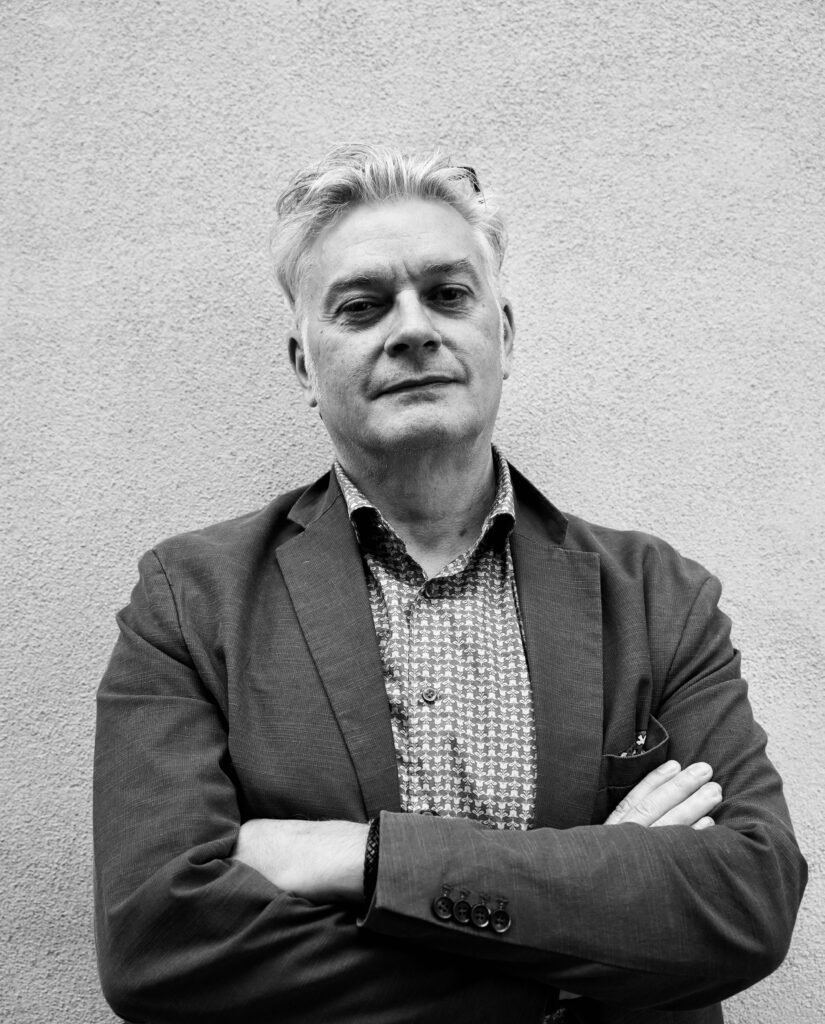
Livio Milanesio is an author and theatre director, who transitioned through animated cinema before moving into digital storytelling for major companies. He has taught storytelling at the Istituto Europeo di Design and digital languages at Alessandro Baricco’s Scuola Holden. He is currently the coordinator of the Bachelor’s Degree in Communication Design. He has published numerous short stories in Italian and French in Nuovi Argomenti, Crack Rivista, Narrandom, Lunario, Carie, Atman Journal, and Marginales. His debut novel, La verità che ricordavo (Codice Edizioni), was a finalist for the Neri Pozza National Prize and selected as Book of the Day by Fahrenheit, a program on Italy’s national public radio Rai Radio Tre. His second novel, L’uomo nel fango (Autori Riuniti, 2019), won the Premio Zeno. In 2023, he was awarded the FuoriMano Prize.