Cyborg Fever: An Interview with Laurie Sheck on her Third Novel
Interview by Mal Ward
In Laurie Sheck’s, Cyborg Fever, she transports readers into a meditative state of profound thinking, focused on humanness and its complexity in the age of technology and AI. The novel centers around Erwin, an orphan named after the physicist, Erwin Schrödinger. After a year-long fever dream, he experiences hallucinatory-like visions that begin by observing Funes (of Jorge Luis Borges’s story, “Funes and the Memorious”) meticulously researching on a computer.
The array of facts that Funes discovers introduces us to Austrian physicist, Ludwig Boltzmann, and the theory of entropy, a central theme throughout the novel.
“Entropy is the degree of measure of randomness and disorder in a closed and changing system” (pg. 8).
In his dream, Erwin learns information about scientists like Einstein, Heisenburg, and Konstantin Tsiolkovsky as well as stories of space travel. Later, Erwin hears the voice of Sister Gudrun (a nun and director of the orphanage) explaining why she stopped reading to him and how scientists came to the orphanage to look for children to use for experiments. He goes on to meet the Cyborg (recently escaped from a lab involved in covert medical intervention) who seeks understanding of his personhood, and tells of his interactions with Deadpool (of the X-Men comic universe), but eventually develops into a machine of emotionless data.
Sheck challenges her graduate students to explore the opportunity to curate work that challenges the rigid, and slightly outdated, expectations of a novel. Her work is a living practice of those principles that respond to the question, “Why can’t a novel do that?” Combining scientific facts, memorable prose, and speculative fiction, Sheck creates a journey where Erwin considers loneliness and empathy in a time when humans are more connected than ever before.
LIT: In Cyborg Fever it is striking and unusual how your characters can often hear another speak to them but be unable to speak back. Erwin, the orphan who is the book’s narrator, can hear but not reply, the Cyborg, who has been an experimental subject in a lab, has been prohibited from speaking in that environment, etc. Can you comment on this form of interaction and whether you planned it from the beginning?
Laurie Sheck: That’s an interesting question. In my first novel, A Monster’s Notes, in which I adapt the monster from Mary Shelley’s Frankenstein and bring him into the 21st century, living in an abandoned building in NYC, I made him fall mute very early on in his story. It was an intuitive choice, but one I have thought a lot about since, given that, as you point out, it is a characteristic that has persisted into this new work. I think the muteness functions on many levels—it creates a character who has to deal with a certain amount of loneliness, separateness, isolation. Who feels attachment, tenderness and love but cannot express it. I think it also relates to an idea made vivid in a famous essay by Gayatri Spivak, “Can the Subaltern Speak?” In that essay she writes about how the powerless and marginalized are not heard, and the consequences and violations involved in that. I am interested in the powerless and marginalized. In fact, in Cyborg Fever, one of the important characters in the second section of the book is Laika, the first dog to be sent into outer space. I find her story very moving. She was a Moscow street dog who was picked up off the street by the Soviet space program. She was rigorously and many would say cruelly trained—kept in an isolation chamber for as long as 20 days—the chamber would mimic a space capsule— and at other times strapped to a mechanical arm and spun in circles. The technology to return to earth had not yet been invented, so Laika would die in space. At that time, no human had ever gone into outer space so there was the question and mystery of what would happen to a mammal in that situation. Laika was a test case before a human could be sent up. She was an experimental subject without a voice, without volition. Of course as a canine she had no human language, only barks, whimpers, silence. There is an aspect of human experience that also mirrors this muffling of communication. It is an aspect I have been interested in exploring. On a more personal level, when I was a child I was often afraid to speak to the point where at times I could not. I’m sure that experience found its way into my characters as well.
LIT: Your recent books, though labeled novels, bend genre, mixing nonfiction and fiction, and making generous use of white space and other techniques that stretch the minds of readers to think outside their preconceived ideas about storytelling. Can you talk about this aspect of your work?
LS: I never thought I would write a novel. I never thought of myself as a storyteller. I had written five books of poems that were not particularly interested in narrative. But a series of crises in my life, both personal and artistic, led me to a reading of Mary Shelley’s Frankenstein and then to writing prose connected to that experience. A few years and 500 plus pages later I had my first novel. It was a surprising and exhilarating experience. What I do in the prose works is identify areas of fascination I would like to learn about and explore. At the same time, I have found that if I have characters to speak through and care about I have a vessel—psychological, intense– for those explorations—I can think feelingly through those characters and their various plights. I care deeply about my characters. So the books become a mixture of fiction and non-fiction. I am interested in the writer as curator—how I, as a writer, can gather facts for myself and my readers that I find resonant, beautiful, thought-provoking, sometimes even ugly, and create a context in which they resonate. I learned from my intense immersion in the work and life of Dostoevsky that nothing is more radical than the real. I like to think of my books as investigations. I am interested in reality, not in realism. How does one capture the real, which extends far beyond realism? My books implicitly address this question.
LIT: In the opening section of Cyborg Fever, the reader is immersed in the world of astrophysics—physicists, entropy, black holes, and much more. Can you talk about your process in delivering this information and backstory in a way that is digestible and yet still magnetic for readers?
LS: It was a real challenge and one I enjoyed. I knew very little about all of this when I began, but as I mentioned above, it was something I wanted to learn about and that seemed fascinating to me. The basic facts and nature of our universe are so much a part of our reality and yet something most of us know little about. Just imagine—in billions of years, if the earth still exists our descendants will see no stars in the night sky – it will be completely black. Maybe they will think we were delusional, or that we made those sparkling things up! This is because the way the universe is structured, everything is very slowly moving away from everything else. So, bit by bit, the stars are moving away from our planet, and one day they will be completely out of sight. I consider it part of my task and privilege as a writer to gather and curate facts such as these and to present them in a way that is resonant, not dry, and connected to depths of feeling and thought. The astronauts, when they went up in space, expected to feel most compelled by the moon, but many of them found instead that they felt most compelled and moved by the view of the earth, their home planet, so small and blue and vulnerable, alone in the darkness. They felt a protective tenderness toward their fragile home. And the astrophysicists found themselves confronted with truths that seemed counterintuitive and not visible in the material world—I found their strivings very beautiful and in many ways not so different from artistic strivings. Many of them said very beautiful and memorable things. Arthur Eddington, for instance: “When you disturb the smallest petal of a flower, you trouble the most distant star.” That’s pretty much a poem in itself.
LIT: It seems you wanted the reader to feel a mix of emotions when thinking about technology. Can you talk about your own feelings about how you approached technology in the book?
LS: Technology is such an intrinsic part of our lives now—computers, bioengineering, etc. and I wanted that imagery to be central to my work, part of my investigation. So when the narrator, Erwin, has visions in his fever-dreams, he sees a young man, Funes, whose legs are paralyzed– he’s in a white room somewhere looking at a computer screen. Erwin can read whatever appears on Funes’ screen. The screen becomes both an image of isolation and connection, of distance from the outer world and a way of bringing the outer world close through access to information—but not to physical touch. In the book’s second section, the Cyborg has been kept in a lab as an unwilling experimental subject in a project having to do with ways of strengthening fighting forces for the military by altering human bodies. So his life is inextricably wound up with technology. But this is not just science fiction. In the book, I quote the former Director of DARPA, (the Defense Advanced Research Projects Agency) of the US government, Michael Goldblatt: “Soldiers having no physical, psychological, or cognitive limitation will be key to operational dominance and survival…Is having a cochlear implant that helps the deaf hear significantly different from having a chip in the brain controlling thoughts?” You can’t make this stuff up! I myself was exposed to a synthetic drug before I was even born, one that was harmfully administered to my mother and millions of other pregnant women between the 1950’s and 70’s (now banned), that caused significant birth defects and other problems, some fatal, in their unborn children, so the issue of technology and how it relates to benefit and harm and often the mixture of the two, is pretty much embedded in my consciousness as it affected me from the start. But once again, the challenge is to feel these images deeply, to engage with them with all your heart and mind, so that they are not dry ideas but experiences. A book is, for me, like a nervous system, a vibrant and active experience, an adventure, an investigation into the manifold, radiant and perplexing troubles and beauties of the real.
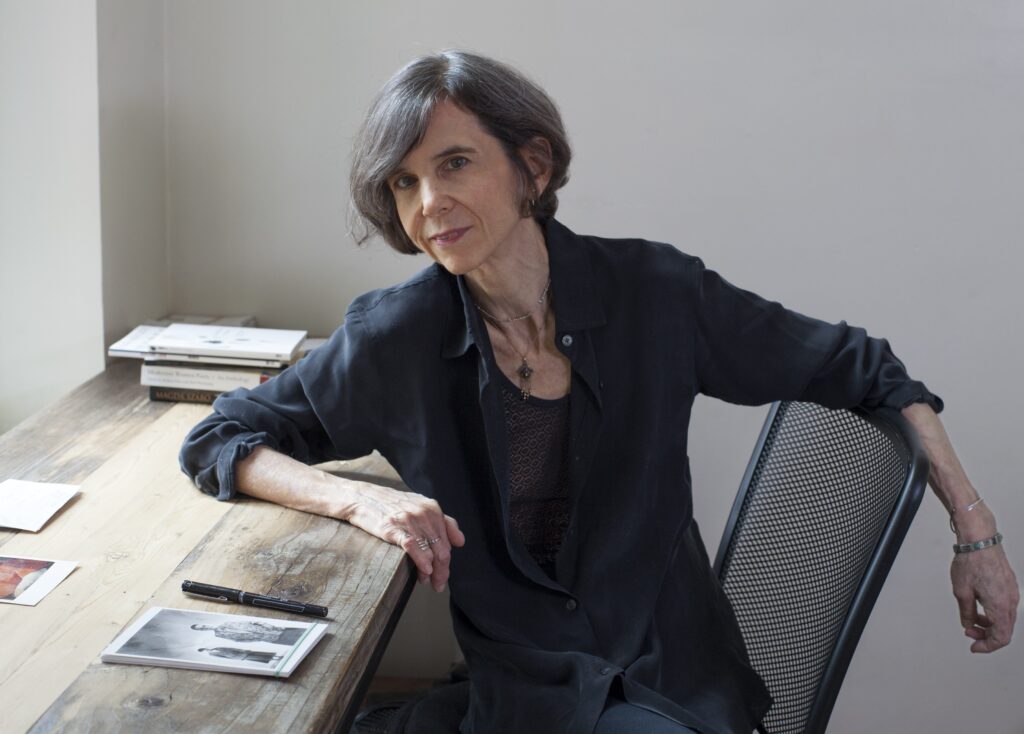
Laurie Sheck is the author of the hybrid works Island of the Mad (Counterpoint) and A Monster’s Notes (Knopf), as well as five books of poems. Her work has appeared in numerous publications including the New Yorker, the New York Times, and the Paris Review. She has been a recent fellow at the Radcliffe Institute for Advanced Study at Harvard and the Cullman Center for Scholars and Writers at the New York Public Library, and has been the recipient of fellowships from the Guggenheim Foundation, the National Endowment for the Arts and the Ingram Merrill Foundation, among others. Her work has been a finalist for the Pulitzer Prize and the Dublin International Impac Award. A Monster’s Notes was named one of the 10 best works of fiction of the year by Entertainment Weekly. In spring 2012, she was the Sidney Harman Visiting Writer at Baruch College and has also taught in the graduate programs at Columbia and The New School, where she is a member of the core faculty.

Mal Ward is a Kentucky-bred, Brooklyn-based fiction writer and poet. Her work explores complicated family dynamics and how place and memory intertwine in shaping the human soul. She is starting her second year at the New School’s MFA program, but knows the best comedy comes in threes, so she will graduate with a dual concentration in 2027. Recently, Mal was recognized as the second-prize winner for the Paul Violi Prize in Poetry. When she’s not reading or writing on the F train, Mal works as a Software Instructor and writes scripts for learning videos. She is a running coach, charity mentor, and a 12-year volunteer veteran at The Sundance Film Festival.