If I am An Antelope
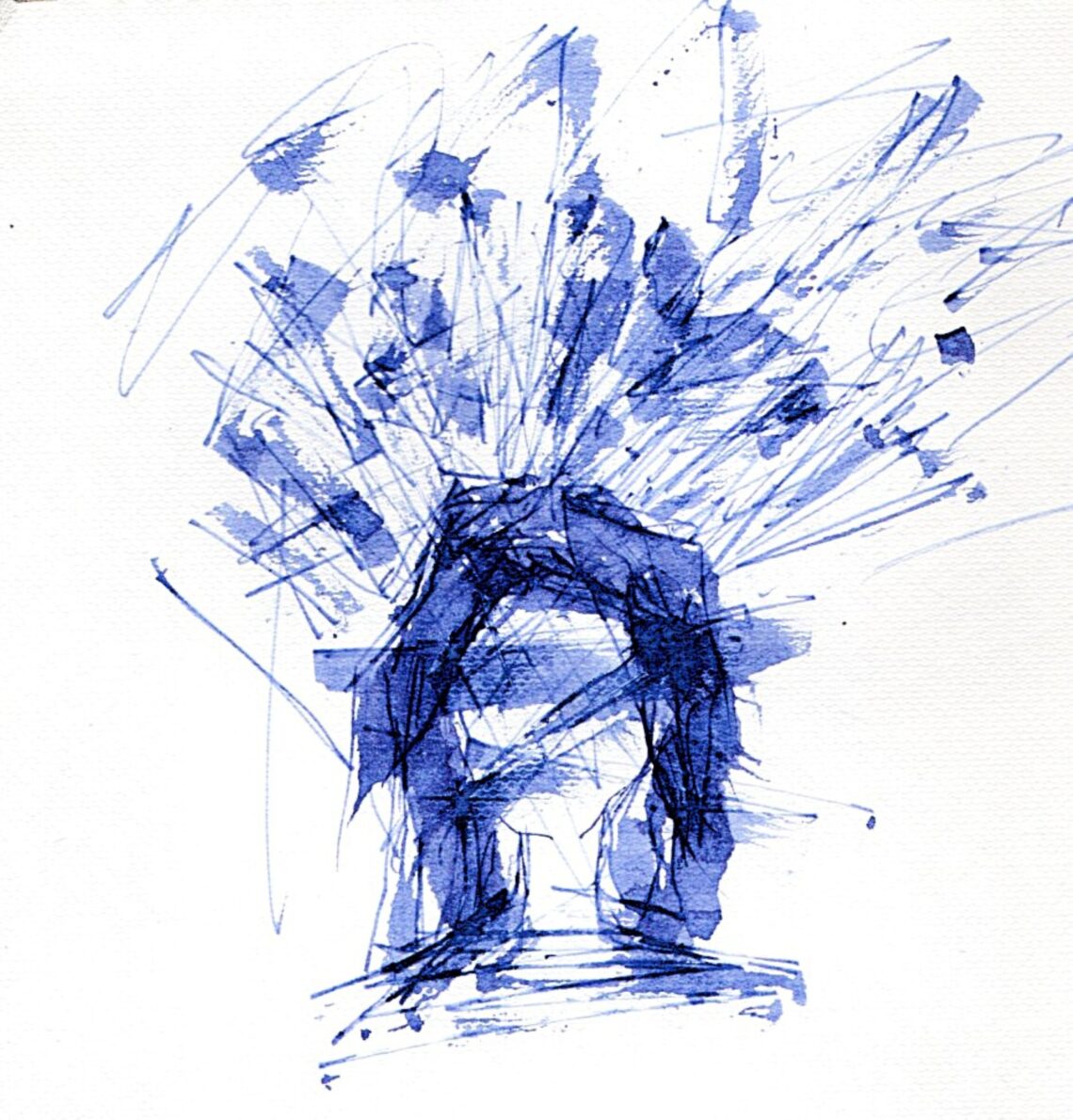
art by Nawmi Manaam
by Elizabeth Wagner
Nan goes to the grocery store every morning to buy frozen meals for lunch and dinner. Usually, she’s in and out in five minutes, tops. She walks past the self-checkout kiosks, down the popcorn/peanut aisle, over to the freezer section. She stays focused on her main criteria for each meal: under three dollars, at least two servings of vegetables, won’t stink up the break room at the clinic. Today, however, the popcorn/peanut aisle is full of stopped carts and people stand beside them, staring at various boxes and bags. A woman on a cell phone is holding up one clenched fist, shaking it toward the ceiling. “Please listen to me,” she says into the phone, “They don’t have that kind today.”
Nan takes a detour, swerving into the next aisle, remembering too late that it’s the baby aisle. She’s momentarily transfixed by the pastel color palettes, the lotions and the squishy toys for teething, but it’s the jars of food that really get her. It’s happened before. All she has to do is find Gerber’s chicken and rice, and her plan for the day, for the rest of her life, is destroyed.
It happens because, looking at those little jars, all she can think about is her son, Daniel. As a baby, he was obsessed with Gerber’s chicken and rice. “Whose kid are you?” they asked him. Both she and her husband, Sasha, were disgusted by the idea of liquefied meat. She remembers holding the plastic-coated baby spoon out straight, as far away from her nose as possible, making a face that Daniel found hilarious. He would kick his feet into the high chair’s plastic tray, smack his lips together like someone who’d misplaced their false teeth, and deftly position his mouth to meet the spoon. “If you can do that,” Nan used to say, “you should be feeding yourself.” And soon enough he was.
The baby on the jar still looks the same, a charcoal sketch of fuzzy roundness and wide eyes, observing the audience in the way only a silent person can, someone who can’t speak, or has resolved not to. When Sasha got sick and couldn’t eat because of the chemo, Daniel marched Nan to this aisle of the store and pointed to a jar like the one she’s holding now. The glass is warming in her hand, and she can imagine the pop that comes when you first twist the lid.
“You want this?” she asked him and, for a moment, panicked, afraid that under the stress of everything he would regress.
But Daniel only made a sound like he might laugh, like he was suddenly much older. He said, “Dad can eat it.”
Nan put her hand on Daniel’s shoulder and read the label. “Definitely worth a shot,” she told him, hoping that there would be something therapeutic for him, something empowering about going home and climbing into their big bed, feeding his father tiny spoonfuls.
Sasha made a joke of it, demanding airplanes, pretending to fall asleep and snore like a giant between bites.
“Wake up,” Daniel said in a quiet shout whenever his father’s eyes closed, picking up another game where they’d left it off, weeks ago, when things were better, “Wake up! They’re still after you.”
Sasha threw his arms up, flailing them around. “I’m up, I’m up. I’m up.”
Nan remembers how Daniel glanced over at her then, flashing her a smile so open and sincere that she can still feel it in her body: the strangest, sharpest kind of pain. She remembers how Sasha ate most of the jar and then snuck away to vomit quietly. “I love that spoon, though,” he told Nan when they were alone, trying to laugh about the extraordinary unpleasantness, the ridiculous predicaments, of parenting, cancer, life. She had forgotten to tell him that they made spoons like that for adults, regular-sized plastic-coated spoons, because certain drugs made the metal taste so terrible. She gave them to her patients at the clinic all the time, but she had forgotten to bring one home to her own husband.
“Does your baby actually eat that?” a woman says to her now.
Nan startles, hadn’t noticed anyone beside her. The woman is younger than Nan, her hair a perfectly highlighted and lowlighted blonde. She’s dressed like a lawyer, maybe an expensive accountant. “I don’t have a baby,” Nans says and then she lies, “No kids.” It’s something she’s never said before, and as the words come out, her mouth dries; a throb begins at her temples. She knows it’s wrong to say this, but it feels somehow accurate: as though everything about the past has disappeared completely, even Daniel, even though the past is also the only thing that’s real. She puts the jar back into its space on the neatly blocked shelf and looks at the charcoal sketch of the baby again. That’s when it happens, the idea like a crack of white light through the center of her head: she can try again, she can get him back.
“Baby food diet,” the woman says in a tell-me-about-it voice. “It’s easier than thinking.”
Whatever Nan would have said to this woman is now replaced by something else. She only looks at her smooth skin, her glossy lips. “What do you mean?” Nan asks.
“The baby food diet,” the woman says, more slowly this time. “It’s, like, a cleanse.”
“Oh,” Nan says, smiling, stretching out the word. “You eat it.”
The woman smiles back, starts laughing. “I thought you were doing the same thing.”
Nan waves her hand toward the freezer section. “I eat frozen meals.” Then she points to the jars on the shelf. “It’s kind of icky symbolism, don’t you think?”
The woman tips her head back, so that her chin is jutting forward, so that her eyes are thin slits under black lashes. “What do you mean, exactly?”
“You know, the infantilization of women?”
It looks like the woman is thinking about what to say, but then she shakes her head, like she’s trying to stop the thoughts. She turns away and starts filling her basket.
Nan is surprised to realize that she feels terrible. The woman actually looks smaller now, as if Nan has lanced her, deflated her lungs, compacted her ribcage into something slight and insignificant. “You should eat whatever you want,” Nan says, stepping forward, making her voice as generous as possible. She starts pulling jars off the shelf. A bright pink one, a warm orange. Then she sees it again, that familiar beige jar. “Have you ever tried this kind?” she asks, holding out the chicken and rice.
The woman glances over at it.
“My kid used to love it,” Nan says.
The woman shifts her basket to the crook of her other elbow. It’s heavy now. “You just said you don’t have any kids.”
“I lost him. I didn’t understand what was happening. I didn’t know how to be a mother.” Nan realizes that she’s been waiting to answer this question. It’s the one that no one ever asks her. All around her she sees labels displaying tiny farms in super-saturated colors. A goldenrod sun, a blood-red barn. The sky is a deep teal, the way it sometimes actually is. “But he’s my child. I’m supposed to figure it out.”
The woman has stopped moving now and turned to Nan with her basket braced against the side of her leg. Nan can feel her assessing details, calculating whether Nan is dangerous, whether the store manager should be alerted and the authorities called. Nan is careful not to look at the woman’s face as she turns away and walks out of the store quickly.
In the parking lot, the light seeps up yellow and cloudy from the tree line, from behind the low buildings. Parents hold open car doors and shout about sitting down, putting seatbelts on, being late. Nan hears a woman’s voice say, “If you miss that bus again,” and then the threat trails off. It’s early enough that there’s still a bit of time left, a wisp of coolness before the air gets sucked, once again, out of the day. A young man in an orange safety vest and a store uniform sails by Nan, driving a short column of grocery carts. A woman on a cell phone passes also: “Bon Voyage, Loraine?” she says, “What’s wrong with, ‘Happy Retirement’? She’s not really going anywhere.”
Out on the street, workers are opening a pothole; a man in a hard hat holds a sign that says, “Slow,” urging the traffic on with a pointed thumb that makes Nan think of a hitchhiker she saw once in Vermont. It was the first trip she and Sasha ever took together, to Montreal, her first trip out of the country, the summer before they started medical school, and they joked about ditching the car, following in that hitchhiker’s footsteps. By the time they reached Canadian passport control, they had a plan for their new life. Instead of practicing medicine, they’d have a farm, maybe on the coast. Don’t people raise oysters up here, they asked each other. Or clams? “We’ll live off our hidden talents,” Sasha said, pulling up close to the car ahead of them in line.
Nan worried he was going to get too close, but he didn’t. He stopped just in time. She looked out at the lush trees that seemed to lean longingly toward the border, and laughed, “I have no hidden talents whatsoever,” she said.
“Oh,” Sasha said, as if hearing her say that broke his heart. He took both hands off the wheel and put them, softly, on the sides of her face, smiled at her like he knew she was mistaken, like he was prepared to put the full force of his faith behind those talents, the hidden ones alone.
Sasha’s reaction made Nan laugh even harder, and she laughed while she kissed him. It was relief she felt, that she was fooling him, that he believed there was something else to her, something aside from the desperate drive to succeed, something beyond outrunning her childhood. Every degree, every accomplishment was another step away from it, a step that nobody could take back. Nan feels the buttery leather of her steering wheel and thinks about lying on the couch where she slept when she stayed at her grandmother’s apartment, the night she graduated from high school, the deep breaths she felt herself take, her own self, the one thing she could control. It was the first hurdle of many, but she had cleared it, and it taught her to focus only on the next hurdle ahead. Maybe the problem was that, at some point, Nan had run out of hurdles. At least the kind she understood.
Having a baby was a hurdle, or it had seemed that way when she first decided to go through with it. But during the weeks after she’d had Daniel, she realized it would be an entirely different kind of thing. There were no answers you could be certain of, no tests you could ace. Having Daniel was more like an invasion, the arrival of a creature who would have happily eaten Nan alive, who wouldn’t stop until the only things she could focus on were the very things she had been trying to escape. So, Nan went back to work as soon as she possibly could. Of course, she could do this because Sasha was a natural. He seemed to have an endless well of inner resources, patience and humor and faith. She remembers her astonishment: he knew all of these songs to sing to children, weird songs about donkeys and babbling brooks. He’d been thrilled to be the one staying home.
Nan thinks about this as she drives to the bakery, the place she stops at for coffee every morning, on her way to the clinic. She goes to the clinic or one of the hospitals every day, even on the weekends. Because, of course, cancer doesn’t take weekends off. She’s been telling herself this since she started her oncology residency, but it really became her mantra after Sasha got sick.
A driver coming out of the parking lot waves Nan in unnecessarily. “Just go,” Nan mouths to the driver and presses her foot down harder on the brake. She realizes that helping Sasha survive cancer was a welcome project, a usefulness she could manage, a hurdle that made sense. But now she’s thinking about how weird that was. Cancer isn’t really anything. It’s just cells, innocent cells that don’t know how to stop, that can’t remember what the point is. Really the blame lies with the proteins. She stares at a parked car whose body is pieced together from different colored panels. A matte black one, a rusty orange one, a single cream-colored door. She likes the way it looks. She likes the sticker on the bumper that says, “Blessed Be, Earthlings.”
On the coffee shop’s door, there’s a sign: “Wanted—a joyful, hard-working individual who’s ready to learn.”
“How much do you make an hour?” Nan asks Lela, the young woman who works the espresso machine.
“Nan,” Lela says, “It’s rude to ask that.”
“I’m not asking out of idle curiosity,” Nan says.
Lela looks down at the soy milk she’s steaming for Nan’s latte and cranks the knob on the steamer. She raises her voice over the garbling sound. “You would laugh.”
Usually they talk about nutrition. For example, whether or not soy products cause breast cancer. There’s no strong evidence for that, though Nan isn’t sure young people like Lela are convinced by evidence. “No, I wouldn’t. I need a new job,” Nan says, raising her voice also.
When Lela sees Nan’s face, she says, “Oh my god, you’re serious.”
Nan leans closer to her, toward the frothing hiss that keeps getting louder. “I have to get my son back.”
“Wait,” Lela says, turning off the steaming wand, wiping it down with an automatic gesture that reminds Nan of milking a cow. “You have a kid?”
Nan crosses her arms in front of her chest. Maybe this is too much information. Her own mother doesn’t know that Nan has a child, but, to be fair, Nan doesn’t know where her mother is, if she’s still alive. “Almost five years old. Lives with my ex-husband.”
“Carrie,” Lela calls, suddenly turning away, taking three large steps to the wide doorway that Nan assumes is the entrance to the back rooms where they bake. “Somebody’s here to see you.”
After a moment, a woman about Nan’s age comes through the doorway. She’s got long hair and thick, hip-looking glasses; for some reason Nan suspects that the lenses are fake. “What’s up?” Carrie says. “I’m trying to finish the schedule.”
Nan walks from the end of the counter where the espresso bar is back to the center, near the cash register. “I’m interested in applying for the position.” With her thumb she points back to the door, where the notice is hanging.
Carrie pauses for a moment, shuts her eyes. She opens them again, as if she’s made a costume change inside herself. “Great,” she says, her voice enthusiastic now. “Can you come back this afternoon?”
Nan has to take a deep breath, feels like she’s flinching. As usual she has patients scheduled all day. When she closes her eyes, she sees Lindsay Turner, a mother of three, an actual mother. Lindsay’s lost almost twenty pounds from cachexia in the last month alone. She’s on the schedule. Nan sees William Hurston, a grandfather who worked for the city for over fifty years. Finally gets to retire and then the lump some bozo told him was nothing turns out to be a rare kind of prostate cancer, already spread to his nodes, his kidneys. He’s on the schedule, too. The schedule is so clear, so certain. Can she really abandon it? Them? Nan feels Carrie shift. She opens her eyes. “Sorry, I’m trying to visualize my calendar.”
“Take your time,” Carrie says, and Nan unlocks her phone. She pulls up a picture of Daniel on Christmas day the year before last, about six months after Sasha went into remission, around the same time that they separated. It had felt, when Sasha recovered, like Nan’s purpose with him had been fulfilled. In the picture, Daniel is smiling, posing on the scooter he got from Santa Claus. It was snowing, so Sasha let him ride around the kitchen. “He wants to try it out,” Sasha said when Nan came downstairs from answering patient emails and objected. And what was the harm in that, she asks herself. She makes herself think of Daniel the way things are now, only seeing him every other Sunday. She plans fun things for them to do together, activities that she would have been absolutely overjoyed to participate in as a child, no matter who she’d been with. But, even at the kid’s museum or the park with the little train and the fancy popsicle stand, Daniel is distracted, slow to smile and speak. When he sees Sasha again, he runs toward him without saying goodbye, like she’s something he needs to escape, like he already understands things about himself and his emotions that she’s only aware of at the dimmest edges of her own consciousness. “This afternoon is fine,” she says. “Would four-thirty work for you?”
*
Four-thirty is an arbitrary time, but it gives Nan something to organize around. If she can get a new job by the evening, Sasha will see that she’s serious. He’ll have to negotiate in a way he didn’t the first time, when she was too ashamed to ask for anything. Nan’s trying to explain all of this to Langston, her partner at the clinic, but he’s squinting at her.
“This is why I asked you to tell me what was happening when all of this was going down,” he says, moving the pen in his hand back and forth between the side of his mouth and the arm of his desk chair like he’s smoking a cigarette.
That was the confession Langston made to her when they first went into business together nine years ago. “I smoke sometimes,” he said, and she shook her head, imagining the free-radicals and the random cell damage that she had learned to imagine instead of imagining her mother in front of the television in the middle of the night, lighting one off the end of another. “You can never predict,” Nan said to Langston, and he leaned forward, put his hands on his temples. He said, “That’s exactly it. That’s why I can’t quit.” She hadn’t understood what he meant then, but now, of course, she’s finally got it. You can’t predict either way. There’s a decent chance you’ll be fine. And then what?
“I didn’t know what I was losing,” Nan says, though she isn’t sure if that’s entirely true. How are you supposed to know? “Or I didn’t really want to. But now I do.”
Langston puts the pen down, straightens up. “So you’re quitting?”
She straightens up, mirroring him the way she would a patient, hoping maybe he will understand. “We can find someone to buy me out, someone you like. And in a year or so maybe I can come back, part-time.”
“Why not go part-time now? We could manage something.”
“That won’t work,” she says, because the sound of it frightens her. She wouldn’t be able to work only part-time. She knows that.
“Sasha’s not an unreasonable person, Nan.”
“Sasha’s not unreasonable,” she says and then she smiles at him. Maybe like she’s never smiled at him before. “I am.”
*
After she leaves the clinic, Nan moves on to her next task. She needs to find a place with a room for Daniel, preferably close to Sasha’s house. It used to be her house, too. Sasha and Daniel stayed and she moved to a new apartment closer to the clinic. It has granite countertops and an open floor plan, a small balcony. Extremely clean, no unnecessary objects, just enough space for herself. She spends almost no time taking care of it, thinking about it. But in the neighborhood where Sasha and Daniel live, there are beautiful old trees and messy, gorgeous yards filled with yarrow, Queen Anne’s lace, giant lantana bushes. There are pairs of house finches who chatter and serenade each other, mourning doves weighing down the powerlines. Now she hears them ruminating, echoing themselves, through her open window. At a stop sign, she sees a robin with a big clump of dry grass in its beak. Building materials, she says out loud, pretending that she’s talking to Daniel, and watches the bird take off and waver unevenly in the air, like an overloaded plane. She imagines how Daniel would look up at it, tipping his head back.
When the bird is gone, Nan hears the rumble of a child’s big wheel ahead on the next block. She drives through the intersection and sees a child through her window in a shady patch of sidewalk. It takes her a moment to realize it’s Daniel. There’s a short-haired woman following behind him, taking long steps. Her hands are in her pockets, like she’s out strolling, just to see what she will see. The babysitter. Sasha asked Nan, a while back, to come and meet the new babysitter, but she’d had a conference and then a board meeting and then an overcrowded schedule, and then several weeks went by. By that point Nan wasn’t sure if the invitation still stood. She felt too embarrassed to bring it up. Daniel and the woman are headed away from the house. Nan waves, but he doesn’t see her; he’s too focused on steering, on pedaling, his little legs pumping like the pistons of an old-fashioned machine. Somehow she feels too shy to call out to him. The woman smiles at Nan and waves back, but she doesn’t stop or do anything to suggest that she knows who Nan is. Nan watches the light that swims and wavers over them, like they are all floating under the surface of a sparkling pool.
As Nan passes Sasha and Daniel’s house, she can’t resist stopping; she wants to see them come back from their walk and go into the house. At first she pulls the car over on the other side of the street, but then she feels uncomfortable, like she’s trying to go unnoticed, so she turns the car around, parks right out front. The landscaping is different than when she lived there, lots of evergreen shrubs and milkweed for the monarch butterflies. Also, the front door might be a different shade of blue.
Nan realized Sasha had cancer on Daniel’s second birthday, at his party. She’d come inside to get more ice. Sasha was coming out of the downstairs bathroom. When he walked past her, she ran her fingers down the inside of his forearm, over his hand. His forearm had a small patch of lymphoma bumps on it. It was hard to say how she could be so certain but she was. Her eyes got wide then, but he didn’t understand and laughed at the look on her face. “Partied out?” he said and she pretended to laugh with him. It was true in its own way: she’d never had a party in her to begin with. She remembers going back out into the yard carrying the ice, how all of the parents’ voices came together in a garbled murmur, a frustrating din that she would never be able to make out, and the shrieks of the kids running through the sprinkler, throwing water balloons, dropping cake on the grass, seemed blood-curdling and ominous.
Daniel and his babysitter come back in the opposite direction. He is walking next to her now, holding her hand and swinging it between them. They have walked all the way around the block, around two blocks maybe. What have they done with the big wheel, Nan wonders, until she gets distracted, realizes that they are playing some kind of game. Taking turns to call something out. “If I am a,” Nan hears the babysitter say, watches as she pauses, like she’s thinking carefully about what she will choose. “Watermelon,” she says, and Daniel starts to laugh, “You are a…”
“Popcorn kernel,” Daniel shouts, his voice brash and triumphant. He drops the babysitter’s hand and jumps forward, pretending to explode on the sidewalk ahead of her. He looks like a dancer on a stage. Then he stops, turns to look up at the babysitter’s face.
The babysitter nods as if she’s impressed and then she says, “Your turn.”
“If I am a,” he says, his voice triumphant again, but only at first. He slows down, stops walking. He presses his index finger to his lips, just like Sasha does when he’s thinking hard. There were so many nights studying at that diner on Franklin Street, Nan sitting across from Sasha, watching him do that, waiting for him to answer. In her mind now she can remember how beautiful he was, though at the time she only wanted him to hurry up. “If I’m a manatee. Which is the same as a sea cow,” Daniel says, looking up at the babysitter again, “then you are a…”
“Sailboat,” the babysitter says, reaching out her arms, stretching her fingers wide. Like she’s floating. An open flower, Nan thinks, though she can’t really tell what the point of this game is. She has a perfect view of Daniel’s face, his stubby nose, his round cheeks. His hair sticking up in several places. She feels things she hasn’t felt in years. She wants to touch him, smooth his hair, kiss his forehead. She tells herself she can open the door and run to him. She tells herself he will forgive her, imagines how it will feel to see his face light up, how much fun they will have playing the game together. He can teach her how. If I am an antelope, she thinks, but then she changes her mind. Antelopes are herd animals. If she is an antelope, then she would want Daniel to be an antelope too.
Nan puts her hand on the inside of her car door, near the unlock button. She glances up and sees that he is watching her. Their eyes meet, and she feels it again, that strange, sharp pain. She smiles without even trying to, but he doesn’t smile back. In his eyes something changes. It feels like she’s meeting him for the first time. Not as her child, not as any child, but as a person made of the same stuff she is. She recognizes the expression on his face because she can feel it from within her body. He is watching to see what she will do. He is hoping that she will leave him alone, that she will let everything stay the way it is.
Nan keeps her hand on the car door, holds her breath. She should get out. She should call to him, be the adult, begin the work of repairing their relationship. But his eyes stop her. Her private damage has already been passed down, like poison seeping across the placental barrier. It’s all she can do to try and breathe normally again, but the air inside of her is stuck. Like her lungs are broken. Like this is finally the end.
And it is the end. Daniel looks away from her, his mother, and back up at the babysitter. He pretends he has seen nothing, that he doesn’t know who Nan is.
“If I’m a giraffe,” the babysitter says, “you are,”
Daniel pauses for a long moment before he speaks. “A river?” he says finally. “A river with a lot of fish.”
They turn toward the house then, and something in the way they walk, at ease, in no hurry, does make Nan think of a river. A slow river, a sleepy river. She’s never walked that way in her life, but she begins to imagine how it would feel. Nothing like this steering wheel, this cold key. She waits until they’ve gone inside before she starts the engine.
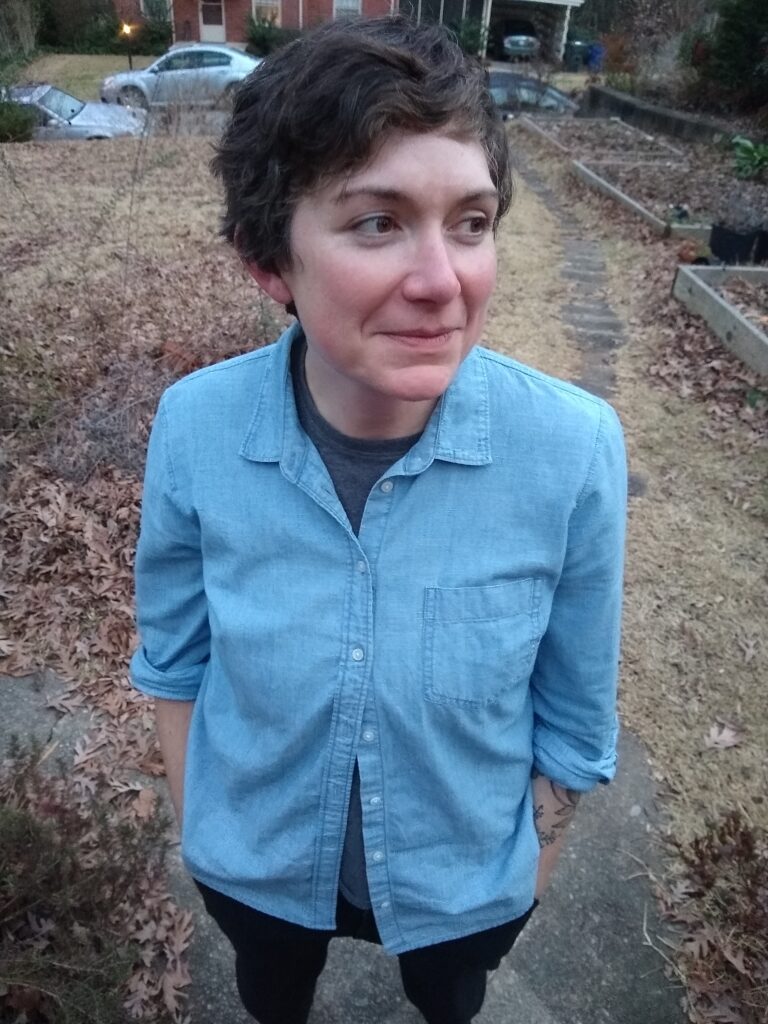
Elizabeth Wagner lives in Raleigh, North Carolina. Previous work has appeared in Quarterly West, New World Writing, Mississippi Review, and Action/Spectacle.
Nawmi Manaam is a self-taught artist from Bangladesh. She likes to capture her thoughts in her artworks. She is a style hopper. She does not like being constrained in one medium. Her artworks have been published in The New York Times: Growing up with AI contest, Grub Street Online Literary Journal, and 3Elements Review.