Rumors, Threats & Biased Scuttlebutt
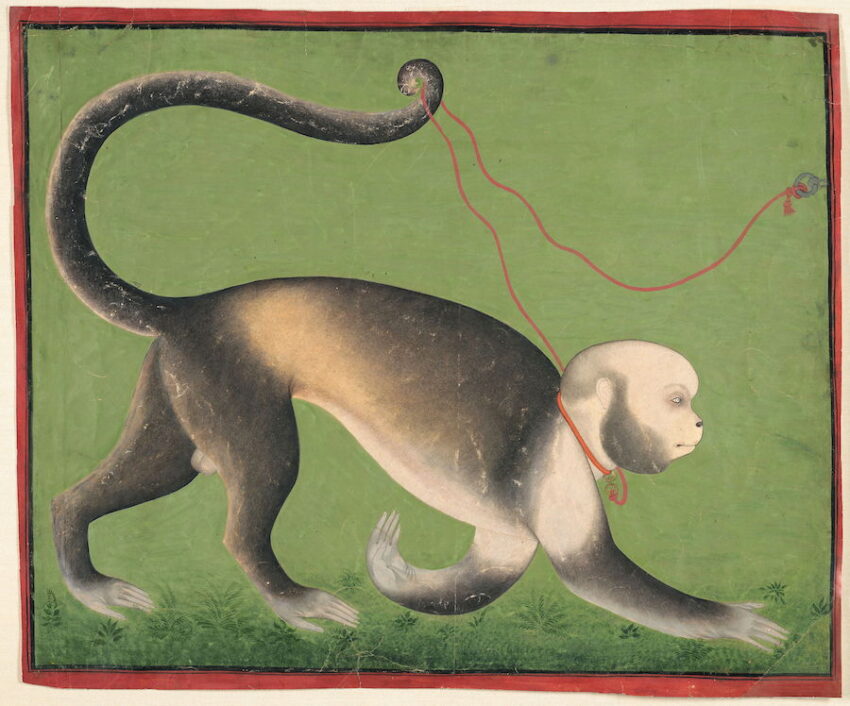
image curtesy of The Public Domain Review
by Brandon Christopher
Wilbur didn’t act like a real monkey. A real monkey would never let himself be dragged down a dirty sidewalk on its back, or wear a leash of yellow satin ribbon around its neck without a fight. And a real monkey would never put up with a heart drawn in permanent ink across its own chest, bordered on each side by a W and an E. This was because Wilbur was not a real monkey—at least not a living, breathing, pink-assed kind of real monkey. He was a sock monkey, constructed from ribbed cotton fabric and filled with fluffy material. Even still, Wilbur was all too real for little Emma. He was all the monkey she could ever ask for, even with his sad, drooping arms that didn’t take well to nail polish, and those tattered legs stained gray by sidewalks. Wilbur was her companion, her sidekick, and the only best friend she ever needed.
Emma and Wilbur would take long walks around the neighborhood every day after school, filling the hours between three and six with deep conversation, playground philosophizing and neighborhood reconnaissance. Most other twelve-year-olds mistakenly assumed sock monkeys preferred being carried as opposed to being pulled along by a ribbon around the neck. And they would be wrong. That was mother and baby stuff, being carried around. Wilbur had seen a whole lot in his young life—with the journey from Africa and all—he was no baby. Emma knew that he, that sock monkeys as a species, wanted nothing more from life than to be treated the same as everyone else. She knew he loved to feel that warm, summer-soaked concrete grating away at the back of his legs when she dragged him along. He must have cherished those moments. She imagined that’s how Wilbur’s mother had done it back home, before some hunters nabbed him and sold him to a toy store not too far from her school.
The two arrived at their usual dining location beside the empty parking lot of the old Chrysler factory. Emma used her hat to sweep away the cigarette butts and leaves from the wooden crate they used as a table before throwing a bath towel over the top. She evened out the hems to equal length and ran her palm over the top to clear away any creases.
“Where do you think we go when we die?” she asked Wilbur, helping him onto a bucket. She rested his flopping, pink-streaked arms onto the table to keep him upright. “Mom says we go to a big place just like Texas, but Dad’s pretty clear about it being all clouds and stuff.”
She pulled a silver thermos from her backpack, unscrewed the top and filled two small teacups with cocoa. She placed one cup in front of Wilbur and the other in front of herself across the table. From a sandwich bag, she produced four vanilla wafers and divided them equally.
“I saw two deaf people sitting at the park yesterday. They looked like they had butterflies attached to their arms instead of hands. It was funny. You should have seen it.”
Wilbur wasn’t interested. His button eyes stared past her, barely acknowledging her presence at the table. Emma had been sensing some distance between them lately, but she’d assumed the vanilla wafers would restore some of that spice to their relationship. Her dry observational humor—self-proclaimed as “both zesty and witty” to no disagreement from any of her other plush or plastic lodgers in the bedroom—had always sparked more interest than this. Perhaps she had to step it up a notch. Maybe it was time for some of her new material, the dark chocolate stuff.
“I’m not sure about you, but I certainly thought the word ‘fudge-packer’ would have had more longevity than it did. I’m barely twelve and it’s already passé.”
Again, Wilbur didn’t respond, didn’t even smile. His cocoa had cooled; he hadn’t even touched it. She knew he wasn’t happy with the way things were going. He had started staring at other girls on the playground during recess. Sure, maybe they were better at hopscotch and more adventurous on the slides, but none of those other girls had the zesty and witty observational humor she had. Lively conversation was the foundation of their relationship, after all. Not running around a hot, sunny park and doing those silly jump-roping games. Wilbur and Emma’s total-best-friendship came from deep in the heart, which was also why she felt the need to emblazon it across his chest in black ink.
“I saw you staring at Becky at school today, Wilbur. And I can’t say I’m shocked, but I am disappointed. Drink your goddamned cocoa. It’s not free, you know.”
Wilbur continued gazing into the distance even when Emma plucked one of the vanilla wafers from his saucer and ate it. He could be so condescendingly removed sometimes that it bordered on cruelty.
“She thinks she owns the slide. And that’s a terrible quality in a person. I wouldn’t give her one second of my sight, not one hot blink of an eye. You probably didn’t notice it, but I was actually drawing an amazing picture of what I think space looks like. Right next to you. But you probably didn’t notice it.”
Having had enough of his silent routine, Emma stood with a huff, rested both hands at either side of the table and stared directly at him. “You’ve got a lot of nerve ignoring me! If it wasn’t for me, Mom would have put you in the washing machine and flushed away your soul. I’m the one who stopped her. I’m the only one standing between you, her, and your stupid soul. So, let’s see some goddamned gratitude.”
Wilbur wanted no part of this argument. His eyes were fixated on the clouds above her in a conspiring sort of way. Obviously, he was constructing mean insults about her in his head but not saying them.
“Oh! Oh, really!” she feigned a gasp and put her palm to her cheek. “You’re still going to ignore me? You know who else ignored me this much? Ms. Pretty Peggy ignored me this much, and you remember what happened to her. You must remember Ms. Pretty Peggy’s grand demise once she met the mean end of Mom’s lighter.”
The entire bedroom would always remember the horrific passing of Ms. Pretty Peggy, from the doll folk on the nightstand to the teddy bears on the bed. Each and every one of them would always remember the way Emma butchered Peggy’s beautiful blonde locks, humiliating the poor girl, before cooking her face into a bubbling mess of pink plastic hues. She had even snipped off Peggy’s left hand and worn the little cupped fist around her neck for a week. A sole teddy bear had foolishly attempted to stand in the way of Emma’s savage rampage, but teddy bears burn quicker than plastic dolls do.
“Yeah, that’s right, you remember now. An ugly day, and I regret what I did to Peggy. But I’d do it again in a heartbeat, pal. In a heartbeat.”
Emma took a sip of cocoa and crossed her legs the way pondering Englishmen do. She was going into what her mom called “overdrive”—the reason she could no longer be in the house unsupervised. She took Wilbur’s last cookie, bit off half and threw the rest to the ground. She decided to hum the first few bars of America the Beautiful to collect herself, just like the therapist had suggested, but her muffled hum continued to grow louder and louder until it reached an almost deafening peak at the “sea to shining sea” part. She took a deep breath and finally swallowed the mouthful of cookie that she had been gnawing on for over a minute.
“I’m well beyond a timeout, Wilbur. Well beyond that. You used to be my loquacious compass during times like these. Used to be. Now it’s like you’re just a customer sitting at my cocoa table. A simple squatter set up in my residence…and my heart. You were top shelf all the way. I never would have thought that you could fall so far from grace and be this close to being banished to the garage. I mean it. I really mean it this time. You don’t even know how close I am.”
She glanced at Wilbur halfway hoping to escalate the argument and seal the deal on the garage, just so she could move on with her life and find a new number one best friend, and put all this unpleasantness behind her. But when she looked over she discovered something she wasn’t expecting to find: that big white oval shape around his tight-lipped red smile was revealing more affection than his cold button eyes ever had. She saw a spark of the Wilbur she remembered from when they first met nearly three weeks ago, when Dad had brought him home accompanied by the story of his losing his mother and needing a home and a family. She remembered all those happy times and fun days they had. The tea parties in the backyard; their hushed, under-the-door correspondence from when he was quarantined in the closet his first week; the time he spilled a whole bowl of soup then soaked it all up so nonchalantly. And then like a marionette, the puppeteer that was Emma’s own anxious mind tugged on the strings of sentiment and nostalgia, and a faint smile stretched open between those rosy cheeks of hers.
“Listen. There are times when I want to keep walking, too. Keep walking and walking forever. You’re not alone in those feelings. But we don’t. We just don’t. People like us, we have obligations. Like, who would take care of my bedroom if I left? Who would play with Mr. Pickles and Danny the Dino and Angry Andy? Who would water the plant? You know who could just walk away and leave all those hungry mouths? I’ll tell you who. Two-Fingered Freddie, that’s who. That’s why I had Dad remove him from the bedroom. He’s the kind of cold-hearted jerk that could just up and leave. The type that deserves his stay in the garage. I know that’s not you, Wilbur. You’re no Two-Fingered Freddie. You don’t want that kind of life.”
She leaned over and retrieved the half a cookie she had thrown onto the ground and gingerly placed it back onto Wilbur’s saucer. She flicked away some dirt and a thumbtack that had stuck to the vanilla filling.
“We’re not going home until we can both agree to start over, like the way it was, before all this Becky stuff. To quote Cultural Carlos, ‘You are my amigo and I te amo you.’ I mean that, Wilbur. I only want to draw on the walls with you. I only want to dance in the bathtub with you. And you are the only number one best friend I’ll ever let inside my blanket fort. I promise. I promise this to you, Wilbur, if we can just make things magical again.”
Emma stared at Wilbur for quite some time before running a hand over the red tuft of hair atop his head and parting it to the right. She tossed out the remainder of the cocoa from their cups then huddled all of the kitchenware together at the center of the tablecloth towel. With a huff, she shoved the clanging mound inside her backpack and slipped it on over her shoulders.
“Are all sock monkeys this charming?” she asked Wilbur jokingly, tracing the heart drawn on his chest with her finger. Then she kicked out the bucket underneath him, sending him flailing to the ground several feet away. “Haha, got you on that one! Come on, Mom’s making meatloaf!” She picked up the end of the yellow satin ribbon and gave it a little tug to put him onto his back. “I’ll race you!”
And just like that, Emma and Wilbur were besties again, and racing home to see who would get the first steaming slice of Mom’s famous meatloaf. Emma won the race. Wilbur won a few more days.

Brandon Christopher is the author of the memoirs The Middle Kid and The Job Pirate, the short story collection Catawampus, and the novel Nightville. His short stories have appeared in Slice Magazine, Pacifica Literary Review, Talking Soup, LAist, Transfusions, and UCLA’s Westwind. Christopher is also an advertising copywriter, red wine connoisseur, and survivor of more than one hundred and forty bad jobs and three pretty good ones. Born and raised in Los Angeles, he now resides in Portland, OR. He can be found on Instagram at @brandonliterary.