An interview with Alexa Yasemin Brahme (MFA ’22) on her debut novel “Good News”
by LIT Interviews and Books Editor Jonathan Kesh
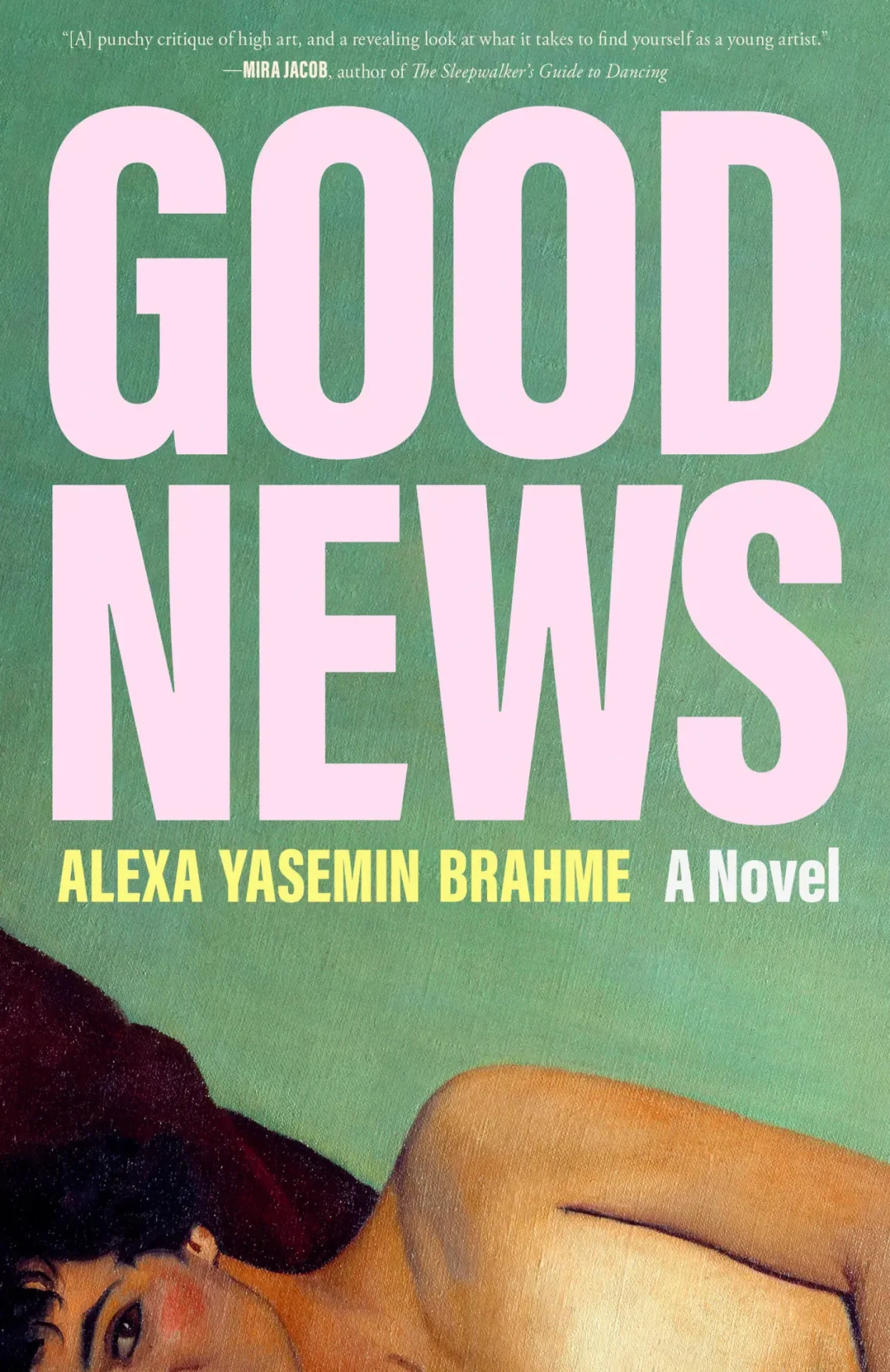
Good News, the debut novel by Alexa Yasemin Brahme, weaves a web of many different topics from art to immigrant families to dissections of womanhood, but the title reflects the central focus of a young artist waiting for things to get better.
The novel follows a struggling painter named Maggie — although her family and a certain ex-boyfriend know her by her Turkish name, Müjde — as several points of stress in her life converge at once. Her studio art MFA is reaching its end, and Maggie is nowhere near finished painting an enormous canvas which could put her in the running for a lucrative grant (if this grant is awarded to anyone else, she has no backup plan for the future). At the same time, she’s near a breaking point with her somewhat friendly but distant boyfriend, as a charismatic art critic and old flame named Rakib — the aforementioned ex — returns into her life.
What follows is a complex, sometimes eccentric view into New York’s art scene and the life of a young woman from an immigrant family as she engages with it. Beyond a drive to complete her towering work, Maggie cannot express where she hopes to go next, and her family and boyfriend are frustratingly unhelpful. Her own painting feels juxtaposed with the successful shows put on by a performance artist who insists on being known only as The Artist. The novel opens with Maggie watching The Artist, nude, “giving birth” to fruits in the center of a gallery, setting a strong tone for Maggie’s offbeat corner of New York in between her battles with her canvas. Despite that, Good News is not a larger-than-life tale, and often makes a point that the people we exaggerate within our minds (or who exaggerate themselves) tend to be painfully, fragilely human underneath, for better or worse.
Good News comes out on May 5, 2026 from Algonquin Books. In advance of that debut, Alexa Yasemin Brahme sat down with LIT to discuss how her novel took shape.
LIT Magazine: I was able to read parts of an earlier draft of this novel back in the day. How did Good News evolve from when you first started working on it, as it moved into those final edits?
Alexa Yasemin Brahme: It had many evolutions. But some parts have really stayed strong and whole. I applied to the [New School] MFA with one piece of the opening chapter, and that has stayed pretty consistent throughout the hundred million drafts that have been written. But since you read it, I finished a draft and polished it and then sent it out to an agent, or agents. And when I got an agent, she and I went back and forth and polished it for a couple of months and then went out with it again to editors. That was a very humbling experience, and required more rewriting. I did another draft, and then we sold that version, which was very exciting, and then my editor was like, “Great! And now we’re gonna rewrite the whole thing!”
And so I rewrote it entirely, changing one of the main characters from being a friend to a brother. It was a total overhaul. But those are the many evolutions of the draft.
LIT: What was your vision for the novel when you first began working on it?
AB: I don’t think I was really working with a vision. For every submission in grad school, I thought, “Oh my god. I have to write 20 more pages.” I didn’t know what these characters were gonna do or where they were gonna go, ever. I would test things out, and it wouldn’t work, so I was like, “Well, obviously, they can’t go there or do that.”
Then, in working on it, I would have a realization of “Oh, this has to happen eventually.” Once I had a guidepost, I had to get there. I have to get to this event. I have to get to this dialogue. That’s how, eventually, a whole draft came into being.
LIT: Where does the title Good News come from, by the way?
AB: I don’t consider myself somebody who has a natural aptitude for titles. My manuscript was untitled the whole time I wrote it. Then, when I was sending it out to agents, I decided, god, it’s probably gotta have a name. You know? Good News felt like the only name for it really. I did try to noodle around with other names that were horrible. Everybody told me they were horrible, and that was good reassurance.
Good News, it’s what the main character’s name means in Turkish. She’s waiting on good news for the whole book, whether it’s waiting on her boyfriend not to be a jerk like she hopes, or she’s waiting on news from her mom that everything’s okay at home, or news from her sister that she’s also doing okay, or news from the world that she’s doing it right. And then ultimately, her grant, and news about whether or not she got it.
LIT: The main character, Maggie, or Müjde, is an artist. Her central focus throughout this novel is finishing this massive painting showing a group of about 20 women caught in the throes of suffering. What does this painting represent for Maggie? What does it mean to her?
AB: I think Maggie is suffering so much in her own way. Not in great big ways. Not physical suffering or torture or even intense emotional suffering. But as an artist, she’s very much like an open wound, or a channel. She saw her own suffering, and she saw the suffering of those women around her, even if it wasn’t so pronounced. And Maggie’s really trying to make sense of her situation and her place in the world, and her place in her family, and her place in the art scene.
She observes all this suffering — and in that first scene with the Artist, she watches the Artist suffer, and she seems to be the only one who notices. There’s such a casual abuse of women by themselves or others, in many ways — obviously, the Artist is participating in her own abuse in the first scene — so Maggie’s looking around thinking, why is nobody doing anything? Why is nobody saying anything?
LIT: Even though this painting and the impending possibility of the grant is always at the forefront of her mind — I’ll try not to get into spoilers — as the story progresses, there begins to be this sense that the painting or grant alone may not be what Maggie needs to fix her problems. While you were writing the character, what did you see Maggie as needing?
AB: What I think Maggie needs, she knows, which I love, it’s the way we we know ourselves without acknowledging it. I think people are like this all the time, and I think she says it. She’s sitting at her kitchen counter, and she’s looking at where she’s been laying down on the ground. And she’s like, “Someone’s gotta get that girl off the ground.” And then, “Oh my god. It’s gotta be me because I’m the only one in this house.”
She knows she needs to reach in and help herself and figure out her own problems, and I think that there’s a lot of diversion along the way. “I need my boyfriend to be present.” “I need to be recognized in the art world.” “I need my mom to take a break and stop calling one second.” “I need all these things,” but it’s not actually what she needs.
LIT: There’s a lot about New York’s contemporary art scene in Good News. Is that something you were familiar with before you started writing, or was it something you started digging into for the novel?
AB: It’s something I’ve been casually a part of since I moved here. When I first moved to the city, and I had no money and my boyfriend had no money, we would just go to the galleries on Thursday nights for our dates because they had free wine. That was how I got exposed initially. It’s always my favorite thing to do, to see what’s coming out of the galleries and what’s being shown in museums. We are such a hub for art and culture and eccentricity in general.
My brother was a clown. He went to clown college, and he is an artist. When he lived in New York City, he was always taking it to me very avant-garde shows. I would have never found, say, this cooking show in the basement of a bar that’s also burlesque that’s also a horror movie, otherwise. You know? I would have never found that. So my brother had a huge hand in showing me what New York is capable of and has to offer.
And then art school! We were at The New School. Just by how people dress, I would think, “Oh my god. What is going on in art school? What is happening?” And I’ve always been attracted to that. It’s very brave in a way where I tend to be more reserved.
LIT: Were there any specific artists you used as inspiration for what Maggie is painting?
AB: For Maggie, her art and beauty and excellence was in technical proficiency. I think of Picasso’s really early work when he was a teenager, and he could draw a perfect human form, but it was so boring to him.
It used to be the background on my phone, it was this drawing that Picasso had done when he was maybe fourteen, and it’s a perfect human form. He was just born with this gift, and he’s sick of it, and so he has to reject it for cubism. But that’s the skill Maggie has. She has proficiency, she focuses on minutiae and she’s a very careful person.
Whereas a character like the Artist is broad strokes, braver, bigger risks. If it fails, fail up. It’s more Marina Abramovic for her, or Christo, stuff like that.
LIT: Besides her art, Maggie also spends much of the novel dealing with these two very opposite men in the figures of Rob and Rakib. How did you design those two characters to work off of each other?
AB: I love the word design. How they work off each other is really funny. One of the first notes I got in workshop was “The men have to talk to each other. They have to be in the same room.” I was keeping them separate. Maggie talks to Rob, and then she talks to Rakib, and never the twain shall meet. But if you’re all at the same party, they all gotta talk. And her brother too, he’s there and he needs to talk to them.
I think I designed the men as these little individual entities, and then when I had to make them interact, they told me who they were. This is how these people talk to each other. I would have never known. My coworker, who’s read the book, put it in funny terms, I thought. He said, “Rob is who you think you need, and Rakib is who you think you want.” And ultimately, we’re doing too much thinking and they’re both wrong.
LIT: Throughout the novel, there’s this recurring idea of Maggie being an outsider who’s never fully treated as welcome in a lot of these primarily white spaces she’s navigating. At times, Maggie herself seems unsure of how white she is. How did you approach that kind of liminal space of being a Turkish immigrant who’s settled in New York but still feels this distance?
AB: Maggie’s definitely white. If she walks into a store, she’s treated a certain way. Just, there are subtleties to her appearance, like within the Middle Eastern communities. “Oh, I see your last name. I see the suffix. Oh, I see the eyebrows. I’m onto you.” And there’s a great belonging in that. But if you’re not privy to those subtleties, or what they mean, I think you can say some crazy stuff. People can be charmed by your ethnicity in these white spaces. Like, “Oh, how interesting and charming that you’re this different thing.” What’s interesting about Maggie’s otherness is how she wields it in certain spaces. Whether to try and belong and fail, or try and separate herself because she doesn’t feel safe, or try to assimilate in some ways just to survive. Those were the things I was thinking about.
LIT: I was going to ask about the character of the Artist, and you’ve already talked a bit about those bizarre art shows you were seeing with your brother. How did the Artist come into being?
AB: She was the first person I thought of when writing the book. I was waiting at a bar for my friend, and I thought of that fruit scene, and started thinking, “What if I wrote that, and what happens there?” It wasn’t even an idea for a novel. It was just, what if this person did this and what would that look like? And she’s just so delightfully surprising to me in having written her. Like I said earlier, I’m more reserved than the Artist, but it was very fun to let go of that and ask how big and obnoxious and self-involved and self-aggrandizing can I be, and what would that be like?
There’s this notion of the art monster, which was written about by Jenny Offill and Claire Dederer a lot. The idea of this selfish man who gets to be a monster for the sake of his art, and Picasso is one of them that they mentioned. And I thought, oh yeah, let’s make her a monster. But then also, she’s not. She’s a person. There’s kindness and empathy and quirkiness. and she surprises those subtle ways as much as in the big grand gestures, I think. I thought of her in terms of great artists, but also in terms of the deep wish fulfillment of ultimate selfishness and craziness.
LIT: Are there any specific writers or books that served an inspiration for Good News?
AB: This book took so long to write, so I read so many books while I was writing it. So there isn’t one which made me think “I’m gonna do this” or which speaks exactly to that. I love the book Mother Doll by Katya Apekina, and there’s this mother-daughter connection, there’s this immigrant connection in that story that is just so wonderful, and also it’s completely bizarre. One of the main characters in the story is a pet medium who speaks to the dead. I loved that sort of eccentricity.
And it’s not a book, but I always bring up the TV show Ramy, because it’s very exaggerated in some ways, but also so normalizing and just felt very descriptive of their Arab but Middle Eastern family. It’s a kooky experience, and I never saw it reflected back to me. When I saw Ramy, I thought that yes, it’s like this, which is obviously crazy because the show is nuts. So it’s obviously nothing like that.
And then I love how Sally Rooney writes relationships. You know, her tuning fork is to that. It just rings so true. I hope to get that fine keen sense over time.
Good News by Alexa Yasemine Brahme published by Algonquin Books, May 5, 2026
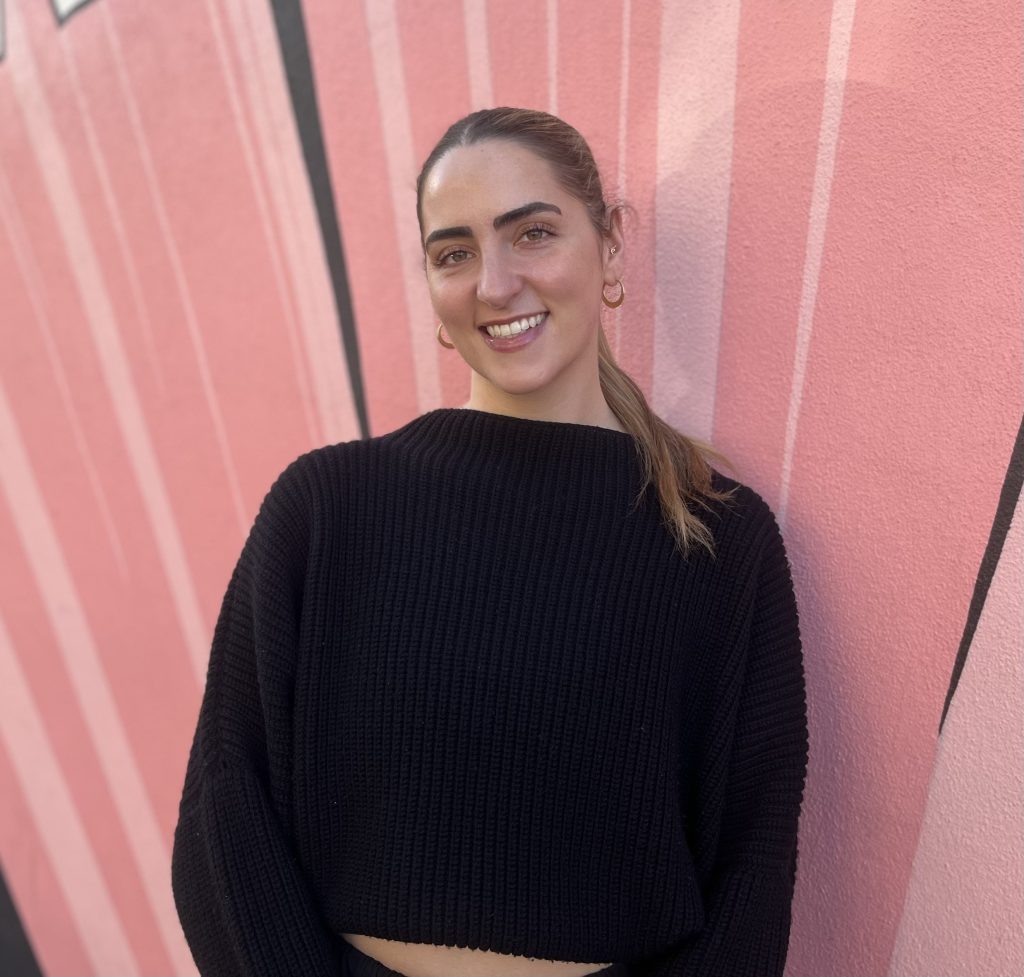
Alexa Yasemin Brahme is a writer from southern California. She received her MFA in fiction from The New School. Her work has been nominated for a Pushcart Prize, the Robert J. Dau PEN Award, and Best of the Net. She currently lives in Brooklyn. Good News is her first novel.