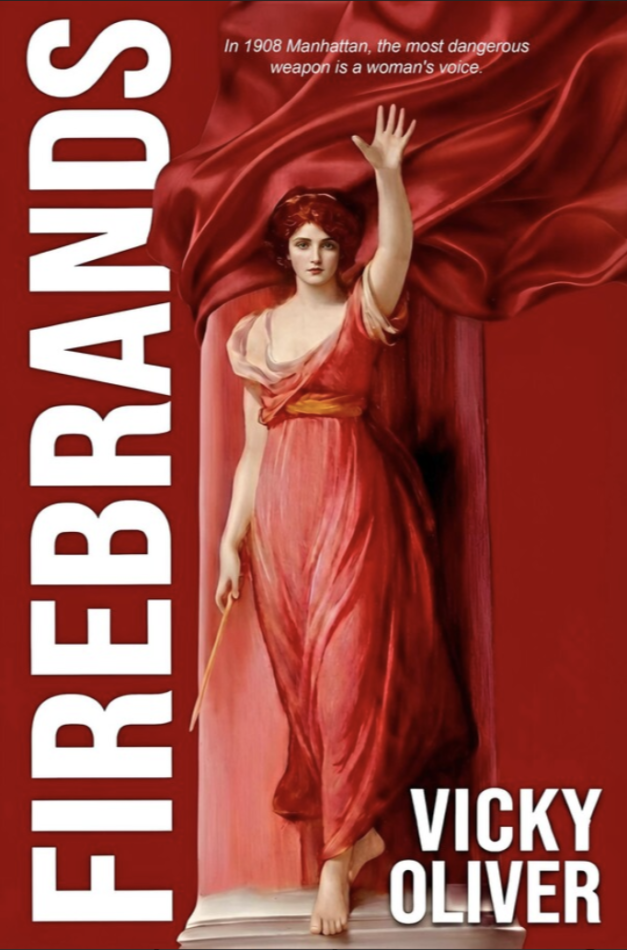
Firebrands: Alum Vicky Oliver’s debut novel of historical fiction
by Jonathan Kesh
Firebrands, the latest novel from fiction and and nonfiction writer Vicky Oliver, is a work of historical fiction, although this undersells how many genres are at play here.
In many ways, the novel is also something of an espionage thriller, and still more than that a family drama. Set in the heart of the suffragist movement in early 1900s New York, the novel follows Helena James, a politically active and unapologetic crusader who struggles to weave a thread through the causes she champions. Helena has high up connections in the suffragette movement, who often don’t share her interest in labor rights. Her sister’s engagement to a wealthy man of suspect means proves to be the thread she needs, although it begins to place her in more danger than she expects.
Firebrands came out on October 13 from Histria Books. Shortly afterward, she sat down with LIT to discuss the process of bringing the work together.
LIT: So, to excuse the pun, when would you say the initial spark for Firebrands started? When did the first idea of it start to form in your mind?
Vicky Oliver: I know exactly when it was. I was accepted into the New School MFA program with a different book idea. And then I said, “Oh my god. I don’t have anything to show.” So the day after I was accepted, I just started writing this book. I banged out a 100 pages in the next week or two because I wanted something to show. I remember that Luis Jaramillo — I was taking his fiction writing class — the first thing he said to people was, “This is really best for people who are on their second draft. Then I showed my work and he asked, what draft is this? I said it’s draft number one, which I later learned was really like draft zero. I was writing the book and researching it, everything all in one, together. I had no previous draft.
LIT: Did you finish the draft while you were still in the program, or did it finally come together afterwards?
VO: My thesis adviser was Zia Jaffrey, and I showed her 300 pages of what would become Firebrands and it wasn’t complete. I always overwrite, so I ended up probably writing about 450 pages, and then I cut it back to what it is today: about 320 pages. So I had shown her what I thought was three-quarters of the way through. And I always overwrite, and I have to cut and cut and cut.
LIT: This is a historical fiction novel. What was the research process for this book like?
VO: Well, I had read a nonfiction book about the Triangle Shirtwaist Fire. In my research, I also learned that Alva Belmont, who is this very rich dowager lady, who had a big interest in women’s rights, also stood with the striking shirtwaist factory workers in 1909. And I thought, wow. That’s really interesting, because there’s a big class difference between Alva and and the people who worked in those factories.
That became the impetus of the book for me. How did this extremely rich person who owned many mansions in both New York and Newport, Rhode Island — and probably other places as well — how did this person come to care about the factory workers? And that became the genesis of my plot.
And I always do a lot of nonfiction research. For example, there’s a piece in the book about how the Pinkertons operated. I found a firsthand account that was written by someone who used to work at the Pinkertons. And that person described, in great detail, how they would only refer to people by number and not by name. Even the staff who were working at the Pinkertons didn’t actually know their name. And I thought, I have to include this in my book. Sometimes, it’s just the historical research that sparks an idea.
LIT: My next question is specifically about that research into labor espionage, which is a big part of this novel. There are a lot of anti-labor tactics in this novel which almost seem stranger than fiction in regards to their intensity. Were a lot of those tactics true?
VO: They’re all true. When I stumble on one of those factoids that’s stranger than fiction, my first instinct is “how can I put this in the story?” How can I integrate it in? Another scene in the book that’s really ripped out of the headlines back then is this one moment — I don’t want to give away too much of the plot, but there’s a pretty intense anarchy scene in the beginning of the book. And that was a real scene. It was a real happening. It really took place that day in New York City. When I when I stumble on real facts, I’ll think that I’ve got to include this.
LIT: On that intersection of these real facts and the world of the novel, there are multiple characters in this book who are explicitly real people, like the suffragists Alva Belmont and Inez Milholland. How did you approach those interactions between them and your fictional characters?
VO: I always love finding real people who existed during that time, because there’s often a lot of information about that person out there. And then my task as a writer is to try to honor that person, and get their personality down — or, how I understand their personality to be.
LIT: How do you track down pieces of these people’s personalities, to turn them into a full-fledged character?
VO: Let’s take Inez. She’s one of my favorite characters in the in the novel. She was radicalized in the UK, and then she went to Vassar. So she was out there trying to import some of the techniques she’d learned and trying to rally other coed women around her towards women’s rights. But then the president of Vassar, at the time ,did not want a women’s rights rally to happen on Vassar grounds. So that rally ended up happening in a graveyard. To me, that’s one of those stranger than fiction events. It actually was in a graveyard, right? So that’s what I try to find. I try to find those pearls and work them in. Then somebody can Google it and say, “Oh my god, it’s true. It’s actually true.”
Also, Inez was a labor lawyer, and she really believed in free love, which is part of her character. I just thought that she’s a treasure. She’s so sparkly and fantastic. I just had to include her. But you can also see how, in real life, working with somebody Inez might be somewhat frustrating because of her proclivities. I wanted to add that in.
LIT: How much freedom were you giving yourself when you were creating these fictional scenarios for real historical figures? As in, how much were you willing to say, “I don’t know for sure that this person acted this way, but it works for the novel?”
VO: I try to keep it as true to the person as I possibly can, and I try to keep the facts of a person’s quest to be as true as I possibly can. But that said, I’m a storyteller. Sometimes people can hold things too closely to a particular event, and then it falls flat. There has to be some degree of imagination.
The way I looked at this story was: what would happen if I put somebody who cares about women’s rights together with somebody who cares about labor rights. What would happen if there were two sisters, and one really fell in love with a really terrible person and her sister was very morally opposed? What would happen? That’s how I look at plot and how I throw people together. And given that it takes place in 1908 Manhattan, which was just as congested as it is today, everyone’s living on top of each other. And paths cross. New York is a cauldron of all these different movements that were happening, and I wanted to throw these people together and see what happens.
LIT: Were there any major changes to the book, or the events you included in it, as it was shifting from first draft to published?
VO: Oh, yeah. My fiction teacher, at one point in his class, said, “Everybody take out your pens and write the end of your novel.” It was two months into the program. For me, only three months into generating this work, and I had a completely different ending. I did a lot of work on it after I graduated the program too, I took writing classes thereafter, lots and lots and lots of them, to get into shape. The thing I realized about the characters after leaving The New School was that the character Helena rubs off on her sister, Summer, and Summer rubs off on Helena, and that’s where they change. Helena develops more compassion for her sister and her sister develops more agency in the novel. I don’t want to reveal what happens, but I just want to say it was like a revelation to me. Originally when I was starting, I just had Helen being the main character, and what happens to Helen and her journey. But I realized she touches people. And they change as a result.
LIT: You’ve published some nonfiction as well as fiction, is that correct?
VO: I have published six nonfiction career primers targeting the stressed out corporate professional. One of them is Bad Bosses, Crazy Coworkers & Other Office Idiots. Since publishing that, a lot of people have come to me and said, “I have one of those. Do you wanna interview me about this?” And I say “Well, it’s already published.”
But I have always been in writing classes and also in writing groups. I was in several writing groups where every other person but me was writing fiction. And I always felt like, I think, I can do this too. I think I can do it. Also, I’m a native fourth generation New Yorker. I have a lot of stories in my family, who were all living here way before 1908. Both sides of my family were living in New York City. I would read other people’s stories that take place in New York — because a lot of stories take place in New York — and some of them would be historical fiction. I would say, “I can do this. I have this information.” In my family, I’m the person who gets all the stuff that nobody wants, letters that nobody want,s and photos that nobody wants. I’m the repository in my family for all the crap nobody wants. I have great, great research at my fingertips.
LIT: Does your writing process feel different for those nonfiction books versus this historical fiction? How did you approach the nonfiction?
VO: Yeah. Regarding those nonfiction books, I used to be in the advertising business. I started as a receptionist, and I grew to be a creative director. I was writing ads and also television commercials and radio commercials for big advertising agencies here in Manhattan. At one point, I had grown up to the point where I was hiring people for my creative team. And they would roll into my office twenty minutes late, and they wouldn’t know the clients, and they wouldn’t know me, and they wouldn’t know the agency. Their whole attitude was so poor. They would just show their portfolio and have this, like, really cool aspect to them and expect that their talent alone would get them the job. About 100 times, I would think to myself, “you are blowing this interview with me, buddy.” And then, about another 100 times, I thought, “I’ve got to write about this.” Then one day, I was in a job search myself, and I did write an article for Adweek magazine. At the end of the article, I put put my email and I asked if anybody else is experiencing this right now, saying to write to me and let me know. I got 120 responses to my article. I called Adweek and I said, “Is this normal?” They said no. Two responses is normal. 120 is not normal.
That’s how I got involved in the whole thing to begin with. Along the way, I just felt like I started taking a lot of nonfiction writing classes and they were teaching fiction techniques in the nonfiction writing classes, like scene setting and character development and approaches to dialogue. At a certain point, I felt like I was almost there. I think I can write fiction, but that said, it’s much harder to write fiction. Plot, I find very difficult. Ends need to be tied up, it’s much harder. Plus, with nonfiction books, I got mine published on the ideas of the books. You write a proposal. For 301 Smart Answers to Tough Interview Questions, I wrote a proposal and three chapters, and I turned in an outline and explained what to do about the marketing. It’s much faster and easier to write a proposal than to write an entire book. I’ve never really understood why fiction writers have to write the entire book before we can move into next steps. That’s a years long process.
LIT: Is there anything you’re working on next, now that Firebrands is almost out?
VO: While I was working on this novel, Firebrands, I also was working on the prequel to Firebrands. I’ve been working on both of them for years, but Firebrands was smoother and cleaner, and I felt like the writing was better. It was just ready to submit sooner. But the minute that I got a publisher for Firebrands, I started going back to the prequel. So I have a prequel, the prequel is 98 percent finished.
In addition to that, I am working on another book of historical fiction that has nothing to do with these characters at all. It’s a completely different story, and it takes place a few years earlier in Manhattan as well. They’re really different, but some of the research still spills over into these other books, which is helpful.
VICKY OLIVER graduated from Brown University with a double major in English Honors and Political
Science and received her MFA in Fiction from the New School in 2022. Her novel, Firebrands
(Histria Books, 2026), distributed by Simon & Schuster, was her New School MFA thesis.
Firebrands is a 5-star, 2026 Reader’s Favorite and was a 2025 Writers’ League of Texas award
and a 2024 Killer Nashville Claymore award finalist for Best Historical Fiction.
Vicky Oliver also writes nonfiction and has published six career books, including 301 Smart
Answers to Tough Interview Questions (Sourcebooks), which sold 100,000 copies. Vicky is the
Nonfiction Editor at LIT magazine, as well as an Art Editor.


You May Also Like

An interview with Robert Polito and an excerpt from “After the Flood: Inside Bob Dylan’s Memory Palace”
On Language, Connection, and Peculiar Literature: an Interview with Claire Donato