An interview with Robert Polito and an excerpt from “After the Flood: Inside Bob Dylan’s Memory Palace”
by Charlotte Slivka
Robert Polito’s After the Flood: inside Bob Dylan’s Memory Palace is encyclopedic in scope with a poet’s narration. It breaks down Bob Dylan’s career during the years 1991 – 2024 and conjures the shape of his resurgence from the underworld after receiving the Grammy’s Lifetime Achievement Award; an award intended to honor him and bury him under a monument to his past simultaneously. What should have happened next in the wake of acceptance was the convenient hush of a great musician who had had a good run, then relegated to the pasture of cultural history, someone who does the occasional summertime nostalgia tour, and instead what happens next is what is chronicled in this book: Bob Dylan’s reinvention as he tours relentlessly with new music, writes a movie, authors books, shows paintings and sculptures, and hosts a radio show; a resurgence into what Polito terms as the second thirty years of an epic sixty-year career. Oh, and there was a whiskey brand too.
Through extensive and detailed research, Polito spares no thread as he goes deep inside the songs and lyrics of this second thirty to track their roots and historical context, not only as the work of a great American artist, but the artist as chronicler, archivist, and medium. Through a collection of folk music and poetry of the American civil war, of minstrelsy, and of classic Greek literature to name just a few lines of inquiry and obsessions, Polito breaks down what Dylan has gathered into his memory palace and collaged into being as the songs that appear on the albums from this thirty-year period. From 1997’s Time Out of Mind to 2020’s Rough and Rowdy Ways, Polito treats readers to the full kaleidoscope of how truly rich, dark, necrotic, and weird America and the American soul (soil?) can be through the Dylan lens.
LIT’s Editor in Chief Charlotte Slivka scratches at the surface with Robert Polito on his monumental work.
LIT: I wonder if we might start by unpacking your title, After the Flood: Inside Bob Dylan’s Memory Palace? Why After the Flood? What is “the flood”?
Robert Polito: The book is titled after a poem by Rimbaud, “Après Le Déluge” — the first prose poem in Illuminations — a poem, as well as a poet, immensely vital to young Bob Dylan in the 1960s. As he wrote in Chronicles:
“….someplace along the line Suze [Rotolo] had also introduced me to the poetry of French Symbolist poet Arthur Rimbaud. That was a big deal, too. I came across one of his letters called “Je est un autre,” which translates into “I is someone else.” When I read those words the bells went off. It made perfect sense. I wished someone would have mentioned that to me earlier. It went right along with [Robert] Johnson’s dark night of the soul and Woody’s hopped-up union meeting sermons and the “Pirate Jenny” framework. Everything was in transition and I was standing in the gateway.”
As late as 1974 Dylan called a live album he recorded with The Band, Before the Flood. In Louise Varése’s translation, the opening line of Rimbaud’s poem runs, “As soon as the idea of the deluge had subsided….” For my book I was thinking about the situation that even now, some sixty-five years into his career, most books about Dylan still concentrate on the initial five years, with maybe a foray into the Rolling Thunder Revue of the 1970s, and a rushed coda for everything else. Those early years were the flood, and my book starts in 1991, when Dylan received a Grammy Lifetime Achievement Award, and to many it looked as though everything creative for him was finished. But strangely, surprisingly, he was about to start all over again.After the Flood probes how someone in his fifties reinvents himself with a brilliant, intensified collaged style of writing songs, extensive concert tours — as many as 120 live shows in a single year —writing books, creating a film, hosting a radio program, and exhibiting his sculptures and paintings. Hard work.
The dynamics of all that is where the subtitle arises —Inside Bob Dylan’s Memory Palace. For Cicero, Augustine, the Jesuit missionary Matteo Ricci, and the cognitive neuroscientist Eleanor Maguire, among many others, the memory palace is a mnemonic device, a spatialization of memory, and a mental structure that will house past and present, the living and the dead. Dylan after 1991 tracks what you might call a poetics of embodiment, as opposed to statements and disclosures. He’ll write about the Civil War through ingenious juxtapositions of phrases from 19th century American poets on both sides of the conflict; scrutinize empire, colonialism, and the legacies of slavery by way of Homer, Virgil, and the speeches and letters of integral American Presidents; and shadow alienation and exile through Ovid — and the Stanley Brothers. I know of nothing created over my lifetime that’s more sophisticated. With the hypothesis of the memory palace I was looking for an image that might concentrate how much knowledge — and memory — surges through these later Dylan songs.
LIT: At times this is a very spooky book, the dead and ghosts are a-drift throughout the lines of text. There are conversations with the dead, Ouija Boards, and there is mediumship, even the radio is a medium that seems to broadcast from the spirit world. Can you speak on the life/afterlife thread in the book and how it relates to the structure? What did the Abecedarium allow you to do? In the book you call it “an estranging device and a narrating ritual” can you say more about this?
RP: Oh, yes — this is very much an assembly of ghosts. The shape, the structure here is an abecedarium — twenty-six chapters; alphabetical order — a form I believe I originally encountered in “The Book of Ephraim,” the opening volume of James Merrill’s ouija board trilogy, The Changing Light at Sandover. From the outset I saw Dylan after 1991 as the medium for all these amazing, spectral voices, musical, literary, and historical. During a 1997 interview, he related his childhood and adolescent experiences with broadcast radio to Orpheus in the underworld, with an echo of Jean Cocteau’s Orphee. “Well, America was tied in with the radio when I grew up…Radio stations were all over. It was a large area and transmitters could transmit thousands of miles….The radio connected everyone like Orpheus or something….When I grew up, that’s what I listened to.”
An abecedarium allowed me to be chronological when I needed to be chronological, such as when I discuss Dylan’s albums, touring bands, and instrumentation, but also permitted me to deflect chronology and pursue topics and subjects that spanned or blurred the roughly thirty years of the book. The arbitrary nature of the alphabet, too, was a way of registering my own tentativeness and self-skepticism — the obvious, inevitable limits of what I know about Bob Dylan, can know. I don’t think there will be anything approaching a “definitive” — or “comprehensive” — account of him or his work for decades, until long after his family and musicians write their books.
LIT: In the book you generously share your very serious diagnosis during the pandemic, but it’s not just a share, it seemed like there was a parallel and juxtaposition your surgeries and your chemo treatments that shared with the borders of Dylan’s own journey. Can you talk about the connections and epiphanies—if any—that you made while writing and healing?
RP: I feel astonishingly grateful to be here talking to you, Charlotte, and astonishingly lucky and grateful I somehow got to write this book, and the two others I have coming out this year. That’s entirely due to my skilled doctors, and the attentiveness, support, and love of my wife, Kristine. Five, going on six, years ago, my statistics weren’t promising. I was writing the book during the rise of autocracy and the infiltration of COVID-19, while also teaching online — we were all online — through intricate surgeries and corrosive treatments, and I will always live from now on, for however long I live, scan to scan. As for connections and epiphanies, I’m fascinated by Renaissance notions of microcosm and macrocosm in Shakespeare, John Donne, Andrew Marvell, and Giordano Bruno, the ways we humans mirror the universe, and the body mirrors the body politic. Or in my case, the ways America, the world, and my body might have tracked multiple, interlocking crises.
LIT: You did an enormous amount of research. How many years were you collecting research for this book? Besides the days you spent in the Bob Dylan Archive in Tulsa, Oklahoma there was all the material and the thousands of hours of concert footage on the internet. Is this the book you intended to write when you started?
RP: I started writing the book seriously, chapter by chapter, instead of just notebooks, in 2020, although I was researching and trying to figure out how to write it for at least five years prior. From the start, I knew it was a story about his remarkable self-reinvention after 1991, but I couldn’t ever find a compelling way in, despite all I was discovering at his Tulsa archive. His 2020 album, Rough And Rowdy Ways, suddenly gave me that way in — at some point I recognized that here was his real Nobel Prize lecture, a lecture devised across his own forms and idioms, the artistry that had earned Bob Dylan the Nobel Prize. Every song, sometimes directly, often slyly, touches on his creative life, and the political, social, and cultural worlds he moved through from his origins in the 1950s and 1960s. Rough And Rowdy Ways was the pivot — and the framework — I needed to focus my inquiries and intuitions.
LIT: Very soon after the shutdowns of the Pandemic Dylan comes out with “Murder Most Foul,” dropping it in the middle of the night on the radio, it’s yet to be a commercial release. You point out in the book that Dylan did as he had not done since the 60s: he articulates the ineffable inside a bewildering collective moment. Only this time the media did not stick his head on a pike and parade him around as the face of the moment; he drops the track in through the back door and let it work its mysterious magic.
RP: I agree — Dylan after 1991 is political to a shrewd and devastating magnitude he ostensibly jettisoned decades earlier. His albums Love & Theft (2001), Modern Times (2006), and Tempest (2012) obsess over American history: Native American genocide; the Civil War and legacies of slavery; the convulsions of American empire; the dynamics of class and economics; crime, and violence.
“Murder Most Foul”? As I try to relate in the book, I know of no other music from that charged historical moment — no art of any strain, poem, movie, novel — that so infiltrated and permeated the furors of COVID-19, George Floyd, climate horrors, the descent into fascism, and death.
LIT: The 80’s were very cruel to Dylan as the bullet pointed list details in chapter C, do you ever wonder how he survived it? Why didn’t he become the “homeless person rummaging through the trash of his achievements”? How does survival play out in the alchemy of success?
Others might disagree, or cavil about the depths, but Dylan in the 1980s, and even on that night of the Grammy Lifetime Achievement Award in 1991, seemed a little lost as an artist— on occasion he might still dazzle, but couldn’t maintain it. His own diagnosis is poignant, and resonates. “It was important for me to come to the bottom of the legend thing, which has no reality at all,” he told Robert Hilburn in the Los Angeles Times in 1992. “What’s important isn’t the legend, but the art, the work.” Early on in this artistic and personal revival, Dylan saw his conundrums, though bottoming out and refocusing on “the art, the work” would demand toil and patience and time. “In the early ’90s, the media lost track of me, and that was the best thing that could happen,” he would later recount to Edna Gunderson for USA Today in 2001. “It was crucial, because you can’t achieve greatness under media scrutiny. You’re never allowed to be less than your legend. When the media picked up on me again five or six years later, I’d fully developed into the performer I needed to be and was in a position to go any which way I wanted.”
His summary, no doubt, makes his reinvention sound far easier — and inevitable — than I’m guessing it really was for him. Who else from the 1960s, for instance, managed to do anything approaching that? The night of his Grammy Lifetime Achievement Award he cast his artistic decline in the 1980s as a spiritual failing, a misappropriation of his gifts.
LIT: I was interested in an observation you made about how some of the unofficial anecdotal writing on Dylan you’d encountered on the internet can turn towards self-projections—I took this to mean in context to the experience of the self informing the topic. I run into this problem so often when I’m writing on something intimate, like family. I try to write objectively and it always comes back to the self like a magnet. Do you have any tips on how to rein in the impulse and when to know when helpful?
RP: What a terrific, and complicated question! I know what you mean — narcissism is the temptation, and the downfall. Yet doesn’t so much of the sharpest modern writing about the world also radiate from personal, even private cruxes? I’m thinking of writers as various as Robin Coste Lewis, W.G. Sebald, Michael Ondaatje, John Keene, Lucy Sante, Annie Ernaux, Claudia Rankine, Frank Bidart, Maggie Nelson, and Octavia E. Butler.
LIT: Is there a prescience in Masked and Anonymous to where we are in today’s America? The near future dystopian, the fiction and fracture of dissociative reality. Is it fair to say that Dylan saw this day coming when he began writing it before its 2004 release?
RP: Regrettably, yes — that prescience, I mean. I was looking at some clips from Masked and Anonymous the other night, and I might as well have been scrolling CNN or MS NOW: an aging, ailing dictator, the roving militia, a post-fact culture that mixes politics and variety shows, identity and spectacle. But America always was a strange place — our earliest canonical novel, Charles Brockden Brown’sWieland; or The Transformation (1798), concerns a man who believes he hears voices instructing him to kill his family. Our classical heritage. My noir definition of America is that we are a nation founded in genocide, sustained by slavery, but also infallibly convinced that this is God’s country.
LIT: This book unpacks Dylan enigma to such an extent, what is it you want people to know, what is urgent?
RP: I wanted to take a close look at the second thirty years, give or take, of an extraordinary, maybe even singular artist who is still among us, and — in fact — as we talk, is at the age of 84 about to resume his annual touring. He played over eighty concerts last year. But for all the unpacking you so kindly mention, Dylan was as much an enigma for me at the completion of After the Flood: Inside Bob Dylan’s Memory Palace as when I started. There’s no Rosebud sled tucked away in his Tulsa archive, or I never located it. Explaining is often code for explaining away. For me Dylan remains slippery, resistant, and mysterious.
*****
The following excerpt is chapter “Z” from After the Flood: Inside Bob Dylan’s Memory Palace Published by Liveright and is reprinted with their kind permission.
Z
. . . that’s my story . . .
Zero hour? Zero hour—Bob Dylan’s late albums tend to conclude on a song that hovers around death, a song often close by End Times, too. “The End begins before you are ever aware of it,” as Ling Ma starts her post-apocalypse novel Severance. “It passes as ordinary.” For me the starkest of these late Dylan zero hours is “Ain’t Talkin’,” on Modern Times, where “tonight in the mystic garden” ultimately will pulse and snake into “the last outback at the world’s end.” Almost as stark is “Tempest,” his sinking-of-the-Titanic coda to Tempest: “sixteen hundred had gone to rest” and “Love had lost its fires / All things had run their course.” For “Highlands,” on Time Out of Mind, the “gentle and fair” hills out of Robert Burns might refresh the singer’s ideal future afterlife, but for now, “The party’s over and there’s less and less to say.” Even on “Sugar Baby,” his warm codicil to “Love And Theft,” Dylan admonishes, “Look up, look up—seek your Maker—’fore Gabriel blows his horn.”
Zero hours, transience to cataclysm to doomsday, all through his ongoing artistic revival, and this astonishing second act as a writer and performer. But there we are. Or are we? For Rough and Rowdy Ways, “Key West (Philosopher Pirate),” originating in violence and civic turmoil with the 1901 assassination of William McKinley in Buffalo, obviously carries on his inclination to conclude with The End—carries this on at least halfway; and maybe literally halfway, as the song’s refrain, “Key West is on the horizon line,” positions him and us exactly halfway between sea and sky, earth and heaven. The agent of this horizon line, this eye-level reorientation, is paradoxically the radio, a presence in our midst, unknown, unseen, which Dylan dramatizes with the same mystic awe of his 1997 London press conference—“The radio connected everybody like Orpheus,” as he marveled. Radio here too is a force simultaneously outward and inner—“Like you were inside the radio,” he told Sam Shepard, and a way of dreaming, “Radio station dreams.” “Key West (Philosopher Pirate)” also correlates radio to eros and art, when Dylan sings, “I’m searching for love and inspiration / On that pirate radio station / It’s coming out of Luxembourg and Budapest.”
The song opens with his variation on Charlie Poole’s “White House Blues.” First, Poole:
McKinley hollered, McKinley squalled
Doc said to McKinley, “I can’t find that ball”
From Buffalo to Washington
Then, “Key West (Philosopher Pirate)”:
McKinley hollered—McKinley squalled
Doctor said McKinley—death is on the wall
Say it to me if you got something to confess
I heard all about it—he was going down slow
Heard it on the wireless radio
From down in the boondocks—way down in Key West
As Dylan echoes and transforms Poole, it’s as if he’s actually listening to the death of McKinley—except, of course, in 1901 there was no “wireless radio,” the debut public wireless broadcast occurring on Christmas Eve of 1906—although 1901 was the year Guglielmo Marconi first sent wireless signals across the Atlantic Ocean. Elegiac encoding. Dylan, moreover, is recreating a horrific event that no matter when wireless was invented couldn’t have been transmitted over the radio except through his memory and imagination; just as when later in the song he claims, “I heard the news—I heard your last request,” he can’t have heard McKinley’s dying song “request,” those whispered final words to his doctors in the operating room of the hymn, “Nearer, My God, to Thee,” the story of Jacob’s dream of heaven, also the last song the ship’s band performed on the Titanic.
In Chronicles, Dylan remembered that it was Izzy Young at the Folklore Center who introduced him to Poole’s songs. “He played me ‘White House Blues’ and said that this would be perfect for me.” For The Philosophy of Modern Song, he included a reading of Poole’s “Old and Only in the Way,” and associated him with his dear friend Jerry Garcia. “Poole’s lyrics are incisive and inclusive,” he writes. “It took a certain amount of wit for Jerry Garcia to name one of his side-projects, a long-running bluegrass band, Old and in the Way. One thing Jerry knew was his place in the universe.” During his official Nobel Lecture, he glanced at another Poole song, “You Ain’t Talkin’ to Me,” for his memoir of war and his early reading of All Quiet on the Western Front. Dylan’s introduction of McKinley—later Harry Truman, and even Richard Nixon by way of “I’d like to help you but I can’t,” a sour echo of Deep Throat in All the President’s Men—links “Key West (Philosopher Pirate)” to “Murder Most Foul” and the Kennedy assassination. When Dylan sings “I do what I think is right, what I think is best,” a paraphrase of a maxim proverbially ascribed to Truman, it’s impossible not to envision the terrible weapons with the cartoon codes, Little Boy, Fat Man, dropped on Hiroshima and Nagasaki in 1945.
Key West here is a physical place—Amelia Street, Bayview Park, Mallory Square, they’re real—and a fancy, another radio station dream. There is no Mystery Street, except again in Dylan’s memory and imagination; Truman’s Little White House sat on Front Street. “Mystery Street,” though, is a song he absorbs into “Key West (Philosopher Pirate)”—the original as recorded by Alma Cogan runs, “You may lose your heart / And then your mind”—and the title of a noir murder film directed by John Sturges, shot around Boston the year before I was born there, and depicting Harvard Square locations I would pass every day for a decade.
Along a similar curve, Dylan’s radio dream Key West all but merges into Dylan’s historical Duluth. When he mentions his “Walkin’ in the shadows after dark” from Amelia Street to Bayview Park, that stroll along Truman Avenue would take him by the Basilica of St. Mary Star of the Sea and the Convent of Mary Immaculate, formerly home to the Sisters of the Holy Name of Jesus and Mary. Tag it a silent pun, or an eye rhyme, but Dylan was born on May 24, 1941, in St. Mary’s Hospital in Duluth’s Lincoln Park, superintended by the Benedictine sisters, and built on the foundation of their convent motherhouse. “Wherever I travel—wherever I roam,” as he sings here, “I’m not that far from the convent home.”
His Key West allows for elemental autobiography—his Beat influences, “I was born on the wrong side of the railroad track / Like Ginsberg, Corso, and Kerouac”—and gallant reverie, as when he morphs into a Roman gladiator who signals he’s decided his vanquished opponent will live: “Got my right hand high with the thumb down.” He can replay his bar mitzvah as Hosea’s Old Testament marriage, “Twelve years old and they put me in a suit / Forced me to marry a prostitute,” and the ceremony will add a Hindu sari flourish of “gold fringes on her wedding dress.” And along that “horizon line,” Dylan’s Key West also marks a spectral descent and return redolent of Virgil:
Key West is under the sun
Under the radar—under the gun
You stay to the left and then you lean to the right
Feel the sunlight on your skin
And the healing virtues of the wind
Key West—Key West is the land of light
In the Old Testament, the marriage of the prophet Hosea to the faithless Gomer is introduced as allegory for the broken relationship between God and Israel: “Go, take to yourself a wife of whoredom and have children of whoredom, for the land commits great whoredom by forsaking the Lord.” Hosea’s prophecy is a warning of judgment for idolatry and sin—“But like Adam they transgressed the covenant; there they dealt faithlessly with me”—and retribution: “The days of punishment have come; the days of recompense have come; Israel shall know it.” Still, as Dylan’s tender Hindu wedding embellishment further emphasizes, Hosea’s message also encompasses forgiveness, grace, and hope: “Say to your brothers, ‘You are my people,’ and say to your sisters, ‘You have received mercy.’ ” God instructs Hosea to love Gomer as he has loved Israel. “And the LORD said to me, ‘Go again, love a woman who is loved by another man and is an adulteress, even as the Lord loves the children of Israel, though they turn to other gods.’ ”
From Poole and McKinley to Hosea and Aeneas, Buffalo to the Empyrean, radio in “Key West (Philosopher Pirate)” arises as an otherworldly spirit and the medium for channeling that spirit, however glorious or cheerless the tidings, much as Dylan in turn here is somehow both a medium and our spirit guide. From inside the radio, who’s the broadcaster, who’s the listener? The song just might be his most brilliant account of the strangeness of being Bob Dylan.
Dylan after 1991 is—involuntarily—surely reluctantly, no doubt dismissively—a—what to call it, though, that won’t distort or demean—a model? an exemplar? the embodiment? maybe just a handy for-instance—of how someone might try to keep their art alive despite aging, illness, diminishment, and the immanence of death. “I’m not what I was, things aren’t what they were,” as he acknowledges on “I’ve Made Up My Mind to Give Myself to You.” Everything across the span of this book is his working always with what’s left. Dylan resisted any sanctioned generational role. But for me, for my generation, his memory palace is in our collective unconscious. At BC High would I have read Illuminations, Howl, and On the Road, sought out in Harvard Square record shops and movie houses Woody Guthrie, Ma Rainey, Robert Johnson, Broadside, Marcel Carné, Federico Fellini, François Truffaut, and Jean-Luc Godard, if he hadn’t talked about them, to recall only the earliest and most conspicuous autodidact forages? Politics, too. The Boston I grew up in was a racist city. The desegregation busing crisis. Louise Day Hicks. Mothers taunting Mayor Kevin White as “Mayor Black” at the annual South Boston St. Patrick’s Day parade. Dylan’s songs inscribed strategies for engaging, for refusal, and an alternative to the life around me. When my father bought that copy of Highway 61 Revisited at Jason’s Luggage and Music, I’m guessing against his better judgment, he was hoping not to lose me. Your parents give you the tools to rebel, and are hurt and crushed when you do.
Over the course of this book, erosions of memory and fact, and assaults on history proliferated. The Georgia Board of Education passed a resolution opposing K-12 lessons about “divisive concepts,” after Governor Brian Kemp designated critical race theory “anti-American ideology.” In Florida the social studies curriculum henceforth will include a “benchmark clarification” of the ways slaves “benefitted” from slavery, and Governor Ron DeSantis barred public schools from participating in a College Board Advanced Placement course in African American studies. Florida also released a list of over seven hundred banned books in schools. Across the nation genocide denialists attributed the decimation of Indigenous North America to “the activity of microbes . . . rather than human agency.” The Supreme Court granted “immunity” to American presidents for “official” crimes, as if their illegal acts had never happened.
All-American amnesia. Early in the twenty-first century, cognitive neuroscientist Eleanor Maguire updated, maybe literalized, certainly localized, the classical memory palace. “In a roundabout way,” as her New York Times obit recalibrated centuries of mnemonic conjecture and metaphor, “Dr. Maguire’s findings revealed the scientific underpinnings of the ancient Roman ‘method of loci,’ a memorization trick also known as the ‘memory palace.’ ” Her groundwork probed the hippocampus, a five-centimeter-long structure of the temporal lobe so named in 1587 by anatomist Giulio Cesare Aranzi from the Greek words for “horse” and “sea monster” because the shape of that area in the brain suggested to him a seahorse. Her initial research tracked London cabdrivers, famous for passing “The Knowledge,” an examination demanding memorization of thousands of city streets and landmarks. A paper co-authored by Maguire in 2000 concluded:
Structural MRIs of the brains of humans with extensive navigation experience, licensed London taxi drivers, were analyzed and compared with those of control subjects who did not drive taxis. The posterior hippocampi of taxi drivers were significantly larger relative to those of control subjects. . . . These data are in accordance with the idea that the posterior hippocampus stores a spatial representation of the environment and can expand regionally to accommodate elaboration of this representation in people with a high dependence on navigational skills.
Her subsequent investigations into amnesia patients focused on the hippocampus as a point of connection for episodic memory, spatial navigation, imagination, and future thinking. Maguire advanced a Scene Construction Theory that realigned the multiple functions of the hippocampus around space. Her pivotal discovery about memory in a 2007 article for The Proceedings of the National Academy of Sciences involved what comes next: “If patients with hippocampal damage are impaired at recollecting past events . . . this systematic study formally documents that patients with hippocampal amnesia have a deficit in richly imagining new experiences.” Cut off from the past, Maguire’s amnesia patients also could not envision a future.
Meanwhile, every summer month is the “hottest on record.” And as the encore scare headlines struggle to remind us, “Extreme Heat and Weather Threaten Health at Nearly Every Stage of Life, WHO”—World Health Organization—“Says.” Inside my own health house, I’ve experienced troubling symptoms my doctors reassure me are local, and separate from my original diagnosis, at least—they caution—until my next CT scan.
A book such as this is inevitably a snapshot of a moment in time. From one slant, February 20, 1991, and his “so defiled in this world” Grammy Lifetime Achievement Award, through Rough and Rowdy Ways and the extensive tours for the album that followed: 1991 into the fall of 2024. From another angle, the book starts—and ends—on March 27, 2020, with the dead-of-night release of “Murder Most Foul,” amid extended flashbacks and foreshadowing. Five years ago, or five years down the line—conceivably richer; perhaps impossible—different snapshots.
On “False Prophet,” Dylan references Augustine’s The City of God, Augustine’s title an allusion to Psalm 46, a psalm Barack Obama chose to read in New York at a 9/11 memorial in 2011. In his Confessions, Augustine narrates his rise by stages towards God. After the stage of the body, “The next stage is memory, which is like a great field or a spacious palace, a storehouse for countless images of all kinds which are conveyed to it by the senses.” In the “vast cloisters of my memory,” he discovers, “I meet myself as well.” Memory “contains my feelings,” but “the mind and the memory are one and the same. We even call memory the mind, for when we tell another person to remember something, we say ‘See that you bear this in mind,’ and when we forget something, we say, ‘It was not in my mind’ or ‘It slipped out of my mind.’ ” For Augustine, only through memory can he rise beyond memory to God. As he rhapsodizes:
The power of memory is great, O Lord. It is awe-inspiring in its profound and incalculable complexity. Yet it is my mind: it is my self. What then am I, my God? What is my nature? A life that is ever varying, full of change, and of immense power. The wide plains of my memory and its innumerable caverns are full beyond compute. . . . I can glide from one to the other. I can probe deep into them and never find the end of them. This is the power of memory! This is the great force of life in living man, mortal though he is.
God then dwells, Augustine realizes, in his memory. “So, since the time when I first learned of you,” he continues, “you have always been present in my memory, and it is there that I find you whenever I am reminded of you and find delight in you. This is my holy joy, which in your mercy you have given me, heedful of my poverty.”
Back to that horizon line. “Key West (Philosopher Pirate)” is vividly alert to mortality, on a large-scale—McKinley’s shooting—as well as minute, verging on incidental: the “fishtail palms” that Dylan lists in the regional landscape bloom once and die. But the core of the song is a flow of evident contradictions, at least as many oppositions and antitheses as he staggered through “I Contain Multitudes,” his song on Rough and Rowdy Ways constructed around his own multiple lives. The contradictions are “everywhere here,” as he observes of the hibiscus flowers. In the second verse he can rejoice, “I’m so deep in love I can hardly see,” but in the second-to-last, “I don’t love nobody—gimme a kiss.” There are poisons, “tiny blossoms of a toxic plant,” and antidotes, “the healing virtues of the wind.” A marriage is “forced,” but “She’s still cute and we’re still friends.” His repertoire includes songs of nature—“gumbo limbo spirituals”—and religion, too, “all the Hindu rituals.” Dylan may claim he’s “never lived in the land of Oz,” yet a few lines earlier he situates Key West as “beyond the shifting sands,” precisely as L. Frank Baum located Oz on the maps for his books. Moreover, Baum’s dying words to his wife were, “Now we cross the Shifting Sands.” There’s violence, McKinley, or the Roman gladiator, and mercy, the same Roman gladiator. There’s pervasive death, and “People tell me I’m truly blessed.” As Dylan sings, “I play both sides against the middle / Pickin’ up that pirate radio signal.”
Except—except, contrary to “I Contain Multitudes,” none of these are presented as contradictions, even as alternatives, options, variances. No more so than in his memory and imagination “Mystery Street” can’t really be a street, Key West can’t be Duluth, and his Minnesota birth hospital can’t be a convent off Truman Avenue; no more so than in the logic of his radio station dreams he can’t be listening to the death of McKinley. No more so, indeed, than “on the horizon line” sea and sky, and maybe earth and heaven, too, are contradictions. All are just there.
Key West is the place to be
If you’re lookin’ for immortality
Key West is paradise divine
Key West is fine and fair
If you lost your mind you’ll find it there
Key West is on the horizon line
“Key West (Philosopher Pirate)” is under ten minutes long. Yet the song shadows Ezra Pound’s trajectory of the modern epic, as Pound distilled it for a letter to his father:
Live man goes down to world of Dead
The Repeat in history
The “magic moment” or moment of metamorphosis, bust thru from quotidian into “divine or permanent” worlds.’ Gods, etc.
Pound’s “Gods, etc.” is priceless, hilarious, and incandescent. Dylan’s strongest recreations of “Key West (Philosopher Pirate)” on tour retain that horizon-line view of heaven and earth, even as arrangements evolved. For the debut at the Riverside Theater in Milwaukee on November 2, 2021, his piano was lead instrument, though he and the band stumbled a bit on the song—even at the Beacon later in the month, on each of the three nights he made small mistakes with the lyrics. In Washington, DC, on December 2, Donnie Herron’s accordion took the lead, as on the album, and would for the rest of the fall. For me, no live incarnation of “Key West (Philosopher Pirate)” surpasses the Rough and Rowdy Ways recording until the night of March 6, at the Kiva Auditorium in Albuquerque, when piano, Herron’s pedal steel, and Dylan’s vocal attain the “magic moment” of Pound’s epic. After that, gorgeous and devastating pretty much every concert, whether led by piano, pedal steel, Bob Britt and Doug Lancio’s guitars, and even by Tony Garnier’s bass, as in Lyon on June 30, 2023, or a defiant, syncopated—all but solo—recasting on March 26, 2024, in Nashville.
During the official final European run of “Bob Dylan ‘Rough and Rowdy Ways World Wide Tour’ / 2021–2024,” few songs renewed night to night as profoundly as “Key West (Philosopher Pirate).” There were up-tempo full-band portrayals—opening night in Prague on October 4, stately, even as any assumption of inspiration and transcendence steadily was agitated by insistent cross-rhythms; or Frankfurt on October 7, where transcendence sounded like the most natural and inevitable alternative for a shattered world; or Antwerp on October 29, where he suddenly introduced harmonica solos into a song he had staged harpless for three years. Some evenings Dylan’s piano dominated, other evenings Britt and Lancio’s guitars. Slotted in Europe at position eleven—of seventeen songs—“Key West (Philosopher Pirate)” fell between “Desolation Row” and “Watching the River Flow,” parrying against their various negations: the despairs of “Desolation Row,” and the creative log jams of “Watching the River Flow.” After a gorgeous delivery in Liverpool on November 3, Dylan even confided what he purported were the origins of “Key West (Philosopher Pirate)”: “I wrote that song at Ernest Hemingway’s house. I think there’s a lot of him in that song.”
A song of angles inside angles on top of more angles. As Dylan stripped down his band arrangements that November for Scotland and England, “Key West (Philosopher Pirate)” increasingly was performed solo, his spare piano approaching John Cage, his delivery close to a hushed poetry reading. Listening to his virtually a cappella final night account of the song at Royal Albert Hall on November 14, as he felt and thought his way along his raw, vulnerable phrases, I was reminded of what Dylan said of his “metamorphosis” at Locarno, Switzerland, in 1987, one of the decisive spiritual prompts of his artistic revival, and for this book:
It’s almost like I heard it as a voice. It wasn’t like it was even me thinking it. I’m determined to stand whether God will deliver me or not. And all of a sudden everything just exploded. It exploded every which way . . . After that is when I sorta knew: I’ve got to go out and play these songs. That’s just what I must do.
Crossroads. Ghost codes. Dylan’s songs resist endings, at least the convenient takeaway of singer-songwriter epiphany endings, his answers from the outset blowing closer to that last chapter of Samuel Johnson’s Rasselas: “The conclusion, in which nothing is concluded.” A number of songs on Rough and Rowdy Ways approach notions of transcendence: “My Own Version of You”—“I’ll be saved by the creature that I create”; “Mother of Muses”—“Make me invisible like the wind”; and, particularly, “Crossing the Rubicon”—“I stood between heaven and earth and I crossed the Rubicon.” Yet ultimately hesitate, demur, won’t go there.
In the final chorus, Key West is still on the horizon line of sky and sea, this world and another.
Horizon line, or vanishing point? “That’s my story,” as Dylan sings of “Key West (Philosopher Pirate)” and his life and his life’s work. “That’s my story but not where it ends.”
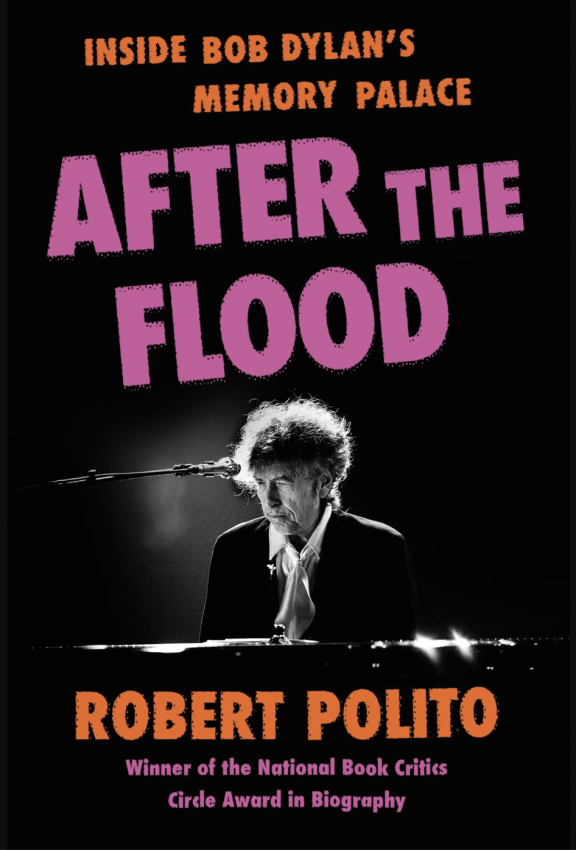
After the Flood: inside Bob Dylan’s Memory Palace by Robert Polito was published on January 27, 2026 by Liveright, and is a winner of the National Book Critics Circle Award in biography.

The founding director of the Graduate Writing and Writing and Democracy Programs at the New School, Robert Polito teaches writing and literature. For his book Savage Art: A Biography of Jim Thompson he was awarded the NBCC Award in Biography. He served as president of the Poetry Foundation from 2013-2015.


photo by Kristine Harris