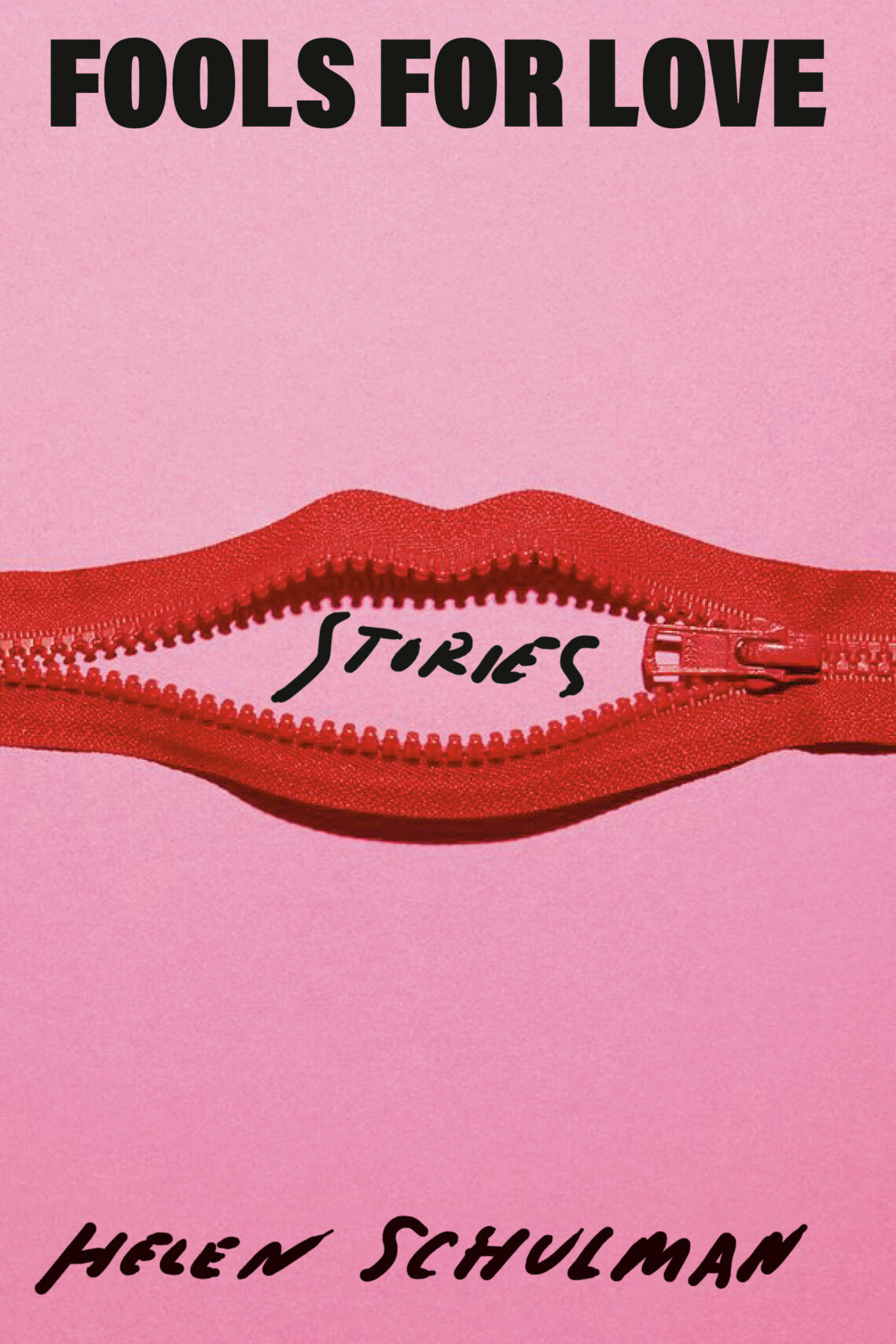
Fools For Love: An interview with Helen Schulman on her short story collection
Interview by LIT Books Editor Jonathan Kesh
While reading Fools for Love, the new collection of short stories from New School MFA professor Helen Schulman, it won’t take long until you see names begin to reappear between stories.
While comprised of separate, standalone tales, the full collection blends together into a much more interconnected world, and follows a number of different New Yorkers from different corners of the city over multiple generations. As hinted by the collection’s name, unsustainable relationships and characters with dysfunctional ideas of love abound. The title story follows a web of bohemian partnerships in the heyday of the East Village, while another story set many years later (“In a Better Place”) follows the same narrator as an adult seeking closure with her difficult father — still, you don’t need to read one to engage with the other. One story’s narrator is a baby, with his own strong ideas of what love should be (“The Memoirs of Lucien H.”). Another narrator falls in love with a rabbi in Paris (“The Shabbos Goy”). The specific subject matter moves around quite a bit, but no characters ever feel too far apart from each other.
The collection itself also spans a significant portion of Schulman’s writing career. One story, “The Revisionist,” was eventually expanded into her first novel in 1998. Another story, “P.S.” also became a novel, and then eventually a film in 2004 starring Laura Linney, Topher Grace, and Paul Rudd. Each story reappears here, with alterations made and connecting threads weaved in between tales; while some narrators have their eventual fates revealed in other stories, Schulman was deliberate in making sure that individual stories stand up on their own. That each story shares so many thematic elements wasn’t necessarily planned, but it’s certainly how the collection reads.
Fools for Love comes out on July 8, 2025 from Knopf. Shortly before its release, Helen Schulman sat down with LIT to discuss how you’d tie together multiple decades’ worth of short stories.
LIT: This story collection is titled Fools for Love, and most of these stories are built around relationships of different kinds. But, what do you see as the connecting thread between all of these stories?
Helen Schulman: You know, that’s an interesting question because I didn’t know there was a connecting thread. I wrote them over many years, in between novels and screenplays and teaching, when I didn’t have an idea for something bigger.
My agent was never a big fan of stories. I love my agent — put that in the interview, that I love my agent — but I love stories and he just thinks they’re really hard to sell. Whenever I’d give him a story, he would roll his eyes. Then I kept saying, “Well, can’t I collect them?” Finally with Lucky Dogs, my last novel, he agreed to ask for a two book deal. And so the second book was Fools for Love. I had a whole bunch of stories that I’d written and published, and I showed them to my editor, who’s really wonderful also — her name is Jennifer Barth, [the agent’s] name is Sloan Harris. She said, “let’s find a way to interconnect them a little bit.” I was hesitant. I thought it might feel a little gimmicky. My first novel would have been a novel in stories, it was called Out of Time. And, yeah, we marketed it as a novel, but it was really an interrelated story collection. So I didn’t want to do that again.
But then I started to see that there were characters that could make sense in some of the stories, that they might know each other, or there was a way to connect them, or there were similar themes or ideas that I guess I’d been thinking about all these years. Once I started to find the commonalities, which really had to do with various types of love and what gets in its way, and what its pleasures are, I found spots to connect the stories together.
LIT: What was the timeframe like, for when you wrote these stories? Were a lot of these older stories, or are many of them more recent?
HS: The first one that was written — that’s in this collection — is “The Revisionist,” which became my first real novel, published in 1998. The story was written earlier and published in The Paris Review. How many years ago is that? I’m afraid to say. That’s a long time ago. Then the most recent one, I wrote for this collection, “Fools for Love,” which is now the opening story.
And the final story in the collection is a story I wrote, oh, I don’t know, about six or eight years ago. It’s about the same characters who meet in the first story, “Fools for Love” — the same characters that the book closes out with when they’re much older. Over the years, I had been writing about them in several stories and I couldn’t get any of them to work except the last story, which is called “In a Better Place.” So I decided to write this new story about their origin story. And in that, I placed a lot of the characters from the other stories in that opening. As you go through the book, you find out what happened to them all, which I hope makes you want to read on in a strange way, or that there’s a popcorn-like pleasure about it, like “Oh! I know them,” and, “Oh, is that what happened to him?” That kind of feeling. Familiarity.
LIT: Did you have a process for assembling the stories into its final order? Since you mention that you bookend the collection with specific characters.
HS: Yeah. The process was what? I don’t know. Like, trying to balance it. There are some stories that are closely connected, and so I tried to get them in chronological order, like all the stories with Mirra in them. There are three. She’s a very sexually active young woman with a lot of anger and hunger and three marriages that don’t work. I wanted to place them, not next to each other, but to have things in between them and have a long time-span in between the stories.
There were a couple stories that seemed like they’re really outliers. I was trying to find a way to stick them in. I just got a review of the book, and in the review, they said there’s a story about an evil baby [“The Memoirs of Lucien H.”]. I’m not sure I think of Lucien as evil, but I didn’t know what to do with him. But then I thought, oh, I can make Miguel’s best friend Angel from “Fools for Love” be Angel in this story and work in that garment center, where they make the dresses. And so now there was a connection between the stories.
LIT: There are a lot of different voices at play throughout the stories. One comes from this very young “evil baby,” to use that reviewer’s words, versus another story about a widow who’s reached the end of a decades-long marriage [“I Am Seventy-Five”]. Did any of these voices come to you more easily? Were some of them tougher to write?
HS: It’s funny because, you know, none of them were hard. None of them were hard. With Lucien, it just came from having children. And also my agent, whom I adore, Sloan Harris’ son — his wife worked in fashion, and she used to bring the son to work. They would dress him up all the time, with all the scraps, and they’d bring him little outfits. I just thought that was hilarious. And, watching my own children and their interactions with other kids, made me want to write it.
Also, at that time, there were so many people writing memoirs. When I was growing up, you wrote a memoir because you did something really important or bad, or something really important or bad happened to you and you were famous. But then, there was this whole period where people were just writing memoirs about their lives, and some of them were ordinary. Everybody was saying, “all these babies writing memoirs.” So I thought, okay. I’m going to really write a baby writing a memoir, and that’s the title of the story, “The Memoirs of Lucien H.”
LIT: In your writing workshops at The New School, at least as I remember it, you would ask students to submit a revision of a previous work for their final submission, and then everyone would critique the revision together. Were any of these stories heavily reworked for this collection?
HS: You know, that’s what’s so crazy. The story “The Revisionists,” not only did I write it a zillion years ago, but it was edited and published in The Paris Review. Then it became the basis of this novel, and so it was edited again. And it was anthologized a few times, and it was edited again. A lot of people’s hands were on it. This time, I showed it to my editor, and she says, “this doesn’t make any sense.” And I’m like, you’re right. She says, “And that’s antiquated.” And I’m like, you’re right. Did I totally rewrite the story? No. But I really rewrote it, and a lot was on the line-by-line level, which I always pride myself with, but I got a lot of things wrong.
I was amazed at how much work it was to revisit these stories. Some of the work was trying to make them fit together and create a loosely larger narrative. Some had to do with trying to make the stories more current and change language that, at the time, had felt cool, but which now felt dated and maybe even offensive. Other parts of it was just looking at possibilities for enriching the story and making changes that made it better. It took me a year. Then I had to write the title story. And when all that came together, then I went through it all again. The title story really changed everything for me.
LIT: When you were creating this cohesion between the stories, and reworking certain characters to recur between stories, did any of these characters change significantly?
HS: I think Mirra is probably the most off-putting character. I tried to give her more compassion, to make the reader feel more compassion for her, and understand that some terrible things had happened to her as a child — that a lot of what looks like lunatic behavior came out of that. She really was carrying a lot of weight around with her and learning to live with it, and finding out how she could be in the world with all these children and ex-husbands in a way that suited her. So that was very different.
The main character of another story, Mirra’s mom, is in her 70s [“I Am Seventy-Five”]. And of course, when I wrote that, that seemed really old. Now, it doesn’t seem as old. But, she finds her husband’s sex diaries, and she realizes that she didn’t really know her husband the way she thought she did. And she is bent on getting even. So she decides before she dies, she wants to have the kind of sex that he had. And, I think that that story was much jokier when I first wrote it. One of the characters that she interacts with is an old lefty hippie who blames George Bush’s election on himself, he couldn’t handle the butterfly ballots. Originally Jennifer, my editor, said this story felt too dated, but I didn’t want to let it go. So I tried to find a way to make it not feel as dated.
LIT: This is more of an abstract question, but going back to the connecting thread between the stories, of relationships: what do you feel draws you to these recurring motifs in these stories, these dysfunctional relationships or forms of love?
HS: Well, I mean, I’m human. I’ve experienced a lot of life already. Young love, long love, dead love, grief, raising children, in a way raising parents, taking care of parents. This is what I didn’t understand when I was writing them. I was just writing them as I’ve lived my life, but now they’re sort of a portrait of different stages of life and love, which I didn’t set out to do. I was just writing about what was preoccupying me in the moment.
LIT: Based on your experiences with this most recent book, do you have any advice for writers who are currently trying to put together a story collection?
HS: There are so many ways to do it. There are many wonderful story collections where the stories aren’t related, but I’ve always been attracted to story collections that were related, and that’s how I wrote my book Out of Time. When I used to teach seminars here — for the past, I don’t know how long, I’ve only taught workshops — but I used to teach short story seminars on the interrelated story. There was just so many books that I loved like that, such as, oh, The Things They Carried by Tim O’Brien, or Annie John by Jamaica Kincaid, or Denis Johnson’s Jesus’ Son, all of Olive Kitteridge, all of these have stories that didn’t necessarily depend upon each other, but enrich each other. You had the pleasure of a novel in which the world doesn’t have to be recreated every minute. Sometimes with a novel, it feels like you’re diving into a pool and maybe you’re not ready to dive in just yet It’s going to be cold and you’re not going to know where you are, and you might feel a little out at sea. So you would have the pleasure of knowing these characters and seeing them over time, but you would also have the freshness of a short story.
I love short stories. I mean, take a kid to a ballet lesson, you can read a short story while she twirls. Do a load of laundry, you can read a short story, before the buzzer goes off. Take the bus across town, you can read a short story. I love that. I’m sad that people aren’t that into stories anymore. When I was coming up, everybody was writing stories and reading stories because it was right around the time when Raymond Carver and a whole bunch of short story writers were publishing. It was very exciting. And then of course, before that era, there were all the New Yorker stories, that people just loved. I love John Cheever, he’s one of my favorites. And I like to read contemporary short stories, like Jamel Brinkley’s. So, I’m kind of hot on short stories, you know?

HELEN SCHULMAN is the New York Times bestselling author of seven novels, including Lucky Dogs, Come with Me, and This Beautiful Life. Schulman has received fellowships from the Guggenheim Foundation, the New York Foundation for the Arts, Sundance, Aspen Words, and Columbia University. She is a professor of writing and Fiction Chair at The New School and lives in New York City.
photo by Denise Bosco