Never/Ever
by Laurel Doud and (posthumously) Gregory W. Martin
You died last year after a three-year battle with Acute Myeloid Leukemia. Six months ago your partner sent me your handwritten journal from 1973, her note reading: Greg put this in the box with his important papers. He wanted you to have it.
The journal was from the first months of our courtship.
I never knew such a thing existed.
In 1973, you were 26, newly divorced, and my high school creative writing teacher. The Situation, as we liked to call it then, wasn’t easy for my parents, my mother in particular. I realize now that she was just scared for me.
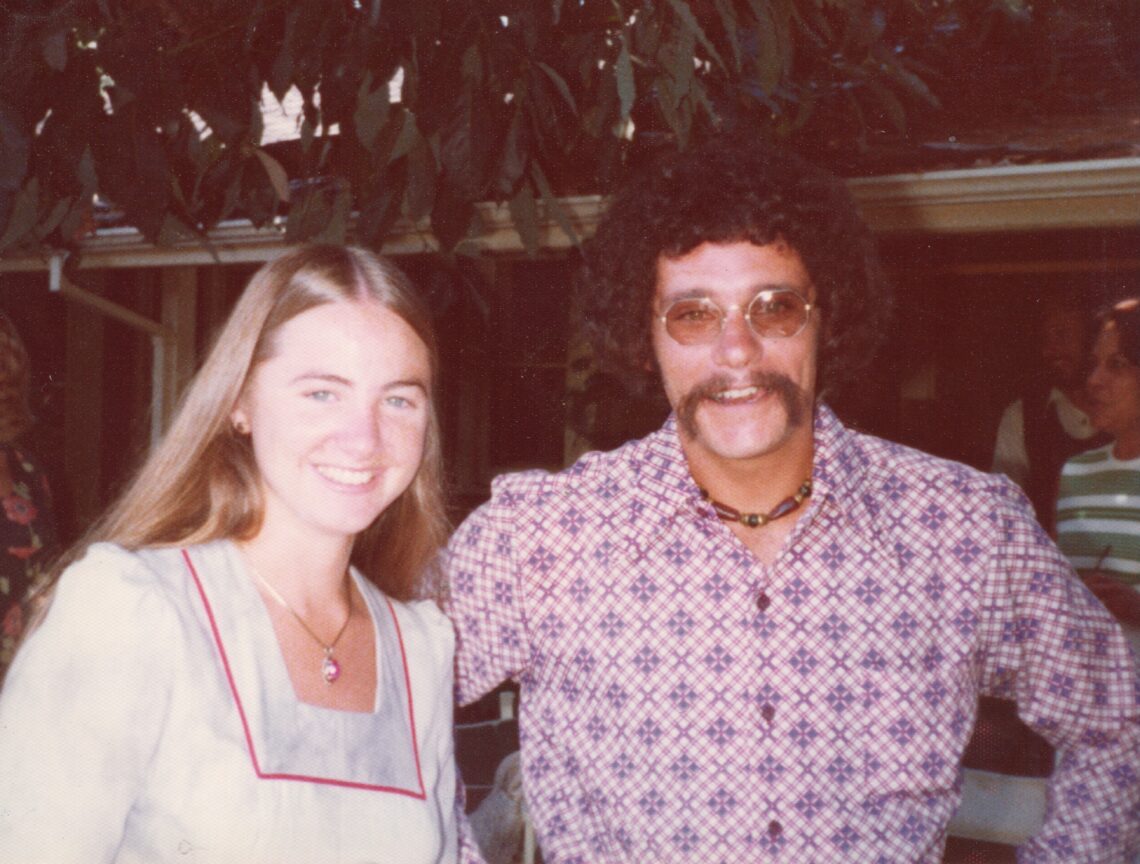
We got married right before my sophomore year at Stanford, in a backyard ceremony presided over by a family judge—me in my granny dress and you in your patterned shirt and necklace that said, Don’t Take Any Wooden Nickels. My parents were perplexed as to why I was going to remain Laurel Doud and not become, Mrs. Gregory W. Martin. “How else will anyone know you’re married?” my mother asked.
That was 1974.
My mother grew to love you and, of course, our two marvelous children. During one of her hospital stays late in life, she called out in delirium, Where’s Greg? Why hasn’t he visited me?
It broke my heart to remind her you wouldn’t be coming. You barely talked to me anymore. You left me shortly after our 23rd wedding anniversary and four months after my novel manuscript was bought by Little Brown, saying, as you walked out the door, “We never should have married. We never loved each other.” That was 1997.
You died never taking back those words.
In a rare display of frankness a few months before the cancer won, you told me, “When I decided to leave you, I committed to the decision to not look back. No regrets. Never. Ever.”
It took me a long time to finish your journal—though it was admiringly clean, no errors  in spelling or grammar, each entry titled like a little short story. I read it at my desk, one-hundred and fifty miles south from where we lived, looking out at the straw-colored Sierra foothills; the hawk in our tallest tree, his chest puffed out to greet the morning sun; my husband taking the dogs for a walk.
Yes, your handwriting was sometimes difficult to decipher, but I was nervous about what it would say. Would it show that your feelings for me were always mediocre? That somehow you felt obligated to marry me?
Memory is such an odd thing. We can be convinced that this and that happened, but maybe my memories have been corrupted after fifty years. Well, of course, they have, but beyond recognition? Would your memories, so closely chronicled after they occurred, force me to revise mine?
When I finally finished, I went through my boxes tucked up in the garage rafters and found my own “journal” from the same time period—a 19-cent 3×4-inch red spiral notebook. I couldn’t believe it had survived fifty years of moves and purges, but then I understood, of course it did.
It seems preordained that our journals should exist together on the same page.
***
Gregory W. Martin (GWM): Friday, January 5, 1973: Before the Omelet, Pt.1
My proverbial life took a turn today after I ran into Gus at the mailbox. My mail comes to his home because we live at the same address, although my cottage behind his house isn’t connected.
Gus teaches Existentialism at the same plant as I do. I call Willow Glen High School in San Jose, “The Plant,” churning out graduates on a conveyor belt. In my more philosophical moods, I believe it’s an opportunity to nurture young minds, preparing them to be transplanted to a bigger pot, offering them clean water, warm sun and manure. Or bullshit, in my more cynical moods.
I teach Creative Writing three days a week and, on Tuesdays and Thursdays, I write for myself. Other people are skeptical and occasionally contemptuous about my writing. Maybe what I really do is try to make some sense out of teaching creative writing to students by writing it later. I’m not sure myself, but I am sure, and there can be no question about this, that Laurel is one of my students and Laurel likes the rain.
Gus was lighting his pipe and I could tell that he needed to say something. I was more than content to stand in the winter warmth and let it come. I lit a cigarette and waited.
“How are you and Laurel getting along?” he finally asked me. Laurel had been his student when she was a sophomore and this Christmas break he had noticed her comings and goings through the side gate to my cottage.
“Fine,” I answered. “Laurel’s beautiful.”
“She shows a definite attraction to you.”
“Awkward as it is, so am I.” I wondered if I should tell him I hadn’t even touched her.
“I believe showing good faith is beneficial in cases like this,” Gus said, as he pulled on his pipe. “Why not ask Laurel’s parents to dinner? Show them that your intentions are above board.”
The very idea of Laurel’s parents in my cottage made me a sniveling neurotic, running around Woody Allen style, breaking things and stumbling all over myself.
“My intentions, whatever they are, aren’t base or anything…but Jesus…I’d probably come out and say something like, ‘This is to establish my good intentions.’” I broke off. I was seeing that Gus was right; I’d have to be open about our relationship with certain people—her parents, definitely—if there was to be a relationship (and I couldn’t really imagine otherwise)—and take the chance of making an idiot of myself.
“Maybe just for drinks or something.” I was thinking out loud. “They play bridge,” I remembered. “So does Laurel.” I ran the whole thing through my mind, trying to imagine what would happen if I didn’t do what he suggested. I didn’t really want people at school, administrators, other students, to know. But the possibilities of their knowing seemed infinitely better than having Laurel’s parents think I was robbing the cradle.
***
Laurel Doud (LMD): October 7, 1971
Martin on ego trip, I wrote the year before when I was a junior in your class. He thinks he’s so cool. All the girls have crushes on him. I don’t.
March 6, 1972
Mr. Martin is making me so flustered. I guess I’ve got a crush on him now. My fantasy is personally knowing Kurt Vonnegut, because if I knew him, Martin would have to notice me.
June 9, 1972
English final great. We had to pick out a song that we think represents each of our classmates. Anonymously. Mr. Martin did the same for all of us. The song I think he chose for me is, Here Comes the Sun by the Beatles. I was blushing.
August 25, 1972
I’m back from my summer study in Germany. I met a boy, Peter, who professed his love for me. He wants me to come back after graduation and marry him. I told Adele we had sex, but we didn’t. Not really. He barely put it in before he pulled out and came all over my thighs.
September 5, 1972
Stayed after the first class to talk to Mr. Martin. We talked about our summers. I told him I had a boyfriend. Had. Last week, I wrote Peter and told him I smoked marijuana. I didn’t, but to him, that’s like shooting heroin. He hasn’t written back. I hope he won’t.
Nov. 4, 1972
I’m madly infatuated with Mr. Martin. I dream about him passionately and he makes it worse by being so nice to me. I keep thinking maybe, maybe. But I know it’s too silly. He’s not that much older than I am but, as of now, we’re worlds apart. A 26-year old teacher and a 17-year old student. He’s getting a divorce. He told us. It’s like this tiny shining seed in my heart. He must know how I feel. I mean, how could he not? In class, I stare at him like some star-crossed moose. It’s really pathetic when you think about it.
He wrote a recommendation for me to Stanford. It was so beautiful, I cried. He said I have more potential than any other student he’s had. I’m mature, creative and intelligent.
I told him it was too perfect. Stanford won’t believe I’m real. He said he was going to put down one of my weaknesses, but he hasn’t seen much of it this year. I asked him what that was and he said I was awfully sarcastic and cynical last year, but I grew out of it.
“Well, it was because I didn’t like you,” I said.
“That was very evident.”
“But you’ve changed since last year, too.”
Dec 15, 1972
I wrote a story for class about a girl and a German boy. Greg said he figured it was autobiographical. He wants me to send it in. “Fame, my dear. Fame.” Before I walked out of class for the Christmas break, he said he’d call me. He gave me the book he’s writing, so I can read it.
Dec. 18, 1972
Went to Greg’s at 1:00 p.m. and got home at 1:00 a.m. Mom awake. “What does he want from you?” she demanded. “You know it’s not natural. Please keep in mind that he might be using you.”
Greg and I talked about his book. I didn’t understand it. I felt so stupid.
He played a song for me. I was wrong about our final last year. He didn’t choose Here Comes the Sun for me. That was for Janet and her buttery blonde hair. The song he picked out for me was Taj Mahal’s Keep Your Hands Off Her. The only lyric I remember is about being heavy with great big legs. I laughed and said, how cool, but I was crying inside. He thinks I’m fat.
Dec. 29, 1972
Turned 18. Didn’t visit him. Read Jane Eyre again. The part that hit me hard this time is when Jane tells Mr. Rochester, “I am not talking to you now through the medium of custom, conventionalities, nor even of mortal flesh: it is my spirit that addresses your spirit!”
Saturday, Jan 6, 1973
Went to G’s. Played bridge. Ma says she can see how much he likes me.
***
LMD: The Present:
Okay, I have to cut in here.
I have to admit I gulped. I know how this reads. I know what people are thinking, what with the #MeToo and #TimesUp movements. People will say you were grooming me, that this was about a teacher/student power dynamic.
The world sees a relationship like ours differently than how we saw it then and how I still do. Yes, I was young. Yes, I was naïve. But I was “of age.” Legally. I knew what I wanted. I always have. I believed then, as I believe now, that I knew what I was doing. As much as anyone does. In my eyes, you were so mature and worldly but, looking back on it, you were just a kid yourself.
We tried to make it all above board. Yes, the school’s administration didn’t know, though they figured it out by the end of the school year and punished you by sending you down to the minor leagues, as we called it—to middle school. It was the best thing to ever happen to you, you admitted, because that’s where you learned to teach. When you were recalled back to the majors—back to Willow Glen High School—you were a different and better teacher. You wanted to educate more than you wanted to be liked.
My parents knew about us and that’s who mattered. They trusted me—or they were just too tired to fight after raising three other children to adulthood. They knew it was the best course to take with me because I would have gone to ground. They raised an independent little cuss and they knew it was the only way to keep the lines of communication open.
***
GWM: Saturday, January 6, 1973: Before the Omelet, Pt. 2
“Gee, Greg, you’ve got a real nice place here,” Lee, Laurel’s father, said before he was anywhere near inside.
They entered without incident. I shook Marian’s hand, perhaps too formally, because I remembered she’d given me hers when she and Lee left on Back-to-School night.
Thanks to a time warp of considerable duration, we got ourselves seated, drinks in hand, conversation only slightly strained on my part, and, concisely underway.
“San Jose State,” I answered with the usual self-consciousness a San Jose State graduate feels in the presence of a Stanford graduate. I was praying she wouldn’t ask me about marriage. Next Friday, my wife and I will be officially divorced, and they would be up and out the door.
The game was without incident. Poor Laurel suffered amicably and honorably through a plethora of vacant hands. Lee and I chuckled over our good luck in whipping the ladies. “Yo, this proves the superiority of the male,” her father said to his daughter. Laurel had told me her nickname was Yo, something about being a yo-yo when she was a kid.
Too soon, I felt, Marian looked at Lee and said, “We have to go, if you’re getting up at 5:30 to play golf,” and things broke up.
I walked with them out to their car after Laurel finally accepted my pea coat. I was concerned about her warmth, or rather the lack of it, considering her flimsy shawl.
Lee and I chuckled while Marian got in the back seat, maybe we’ll give them a chance some other time to regain their honor. Laurel’s father was just what Laurel said he would be; he tried to make everyone comfortable. I wasn’t exactly sure how to tell her how much that meant to me.
Laurel, or Yo, stood by the car, smiled beautifully and whispered, “It went pretty good, I think.”
I agreed, shaking with more than cold.
Regaining honor rung through my head like a vague invitation. Whoever lost their honor, whatever that was, I was dying for the chance to give it back to them.
***
LMD: The Present:
This reminds me of why I fell in love with you in the first place.
Mom and Dad have been gone for twenty years and this entry brought them back to life for a moment. My mother comes across a bit frosty here, but she was a wonderful woman and my dad always tried so hard to make others feel at ease. I’m glad you saw that so early on.
I was so desperate to come across as grown-up that night. I hated bridge and was terrible at it. I remember being mortified and wanting the game to end as soon as possible. Now I want to wrap that young woman in my arms and tell her she did great and see? he thought so too.
***
GWM: Sunday: January 7, 1973: Before the Omelet, Pt. 3
Laurel sat down in the leather chair, her straight hair hanging down to her waist and slowly creeping over her shoulders. We looked at each other and the subject changed itself.
“Are you hungry, Joey?”
Her eyebrows scrunched up. “Joey?”
“You know. Yo. Yo-ey. Joey.”
She laughed, her whole body joining in.
“You like omelets?”
Her smile was wide. “I’ve never had one.”
I got up, almost begrudgingly, and made the omelet. We looked at each other a lot, trying like kids to stare each other down, trying not to grin. Staring at Laurel was wonderful. I got to watch her eyes twinkle, the corners of her freckled mouth turn up.
It seems to me now that Laurel was very beautiful tonight. She was beautiful when she put our plates in the sink, her own on top of mine. She was very pretty in the glaring light from the kitchen while we stood and waited for the water to boil for her tea and my coffee.
There were some things we talked about, but I’ve forgotten what they were. Her eyes seemed to give me clues to myself, to what I thought, but I couldn’t be sure.
I was about to tell her how much she made me feel, when she looked at her Mickey Mouse watch, told me where the big and little hands were and had her coat on.
I walked her to her piss yellow VW bug.
The next part I don’t remember very well. I wasn’t sure if I were myself until Laurel was in my arms. My hands had her hair and her face between them. We kissed awkwardly, past my grin, and hugged. Her wool coat was rough on my chin, but she was big and soft against me. I looked in her eyes again. It was rainy and dark, but they twinkled and accepted. No, I think they even wanted.
“Why didn’t I grab you before?” I asked her and she watched me try to answer myself.
***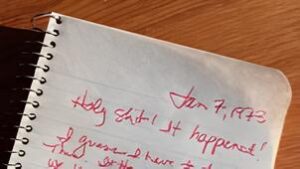
LMD: Sunday, Jan. 7, 1973
Holy shit! It happened!
***
LMD: The Present:
We’re so cute here. I still have that coat, purchased that summer in Germany. I remember being startled when you grabbed me, but then I realized it had been heading in that direction for a while, even though I wouldn’t let myself imagine it. I was so relieved. I did want you; very badly. I just didn’t know what to do with that longing.
I got a jolt when I read “Joey”, though. It’s not that I had forgotten that you—and only you—called me “Joey.” I just hadn’t thought about it in a long time. When I married Tom four years after you left, I asked him not to call me “Yo” as I was starting a new life with a new man in a new town.
I can hear you calling me “Joey” right now: with humor, affection, and a sidebar of sarcasm. Actually, that was you in a nutshell, though the proportions changed as you got older. You were sometimes cruel. You tried to come across as just kidding, but no one felt that.
I know I made you a better person—as you did me—but you wouldn’t acknowledge that after you left and wouldn’t allow me to tell you either.
***
GWM: Thursday, January 23, 1973: Keep Your Hands Off Her
I asked Laurel what would make her happy and she told me about music, books, her quilt, and a room. That told me a great deal about her. She’s been here a lot in the last week, and each time I see her, I’m happy and wish she wouldn’t leave. She always seems to be leaving though, Mickey Mouse tattling the time.
Laurel is a woman in so many ways, but whenever the man in me arrives, for she makes it, the child in her somehow peaks out through eyes full of my own desires. We wrestled with more conviction than I could find to feel her breasts. When I did, the inescapable guilt and paranoia only arrived when she was gone. What was I doing with her? Leading her places, blindly, where she might not wish to have gone? You couldn’t have told me this when I was touching and kissing her though. I thought she liked my touch. Now, I’m not sure.
***
LMD: The Present:
It’s bittersweet to read about these two young people who used to be us. That sensitive, introspective young woman. That dashing, charming, curly-haired man. I wonder where they went.
I don’t think you ever knew how sexually inexperienced I was. I wanted to be a mature and knowing woman for you, but I was so self-conscious. If I had asked you for help, had told you the truth, I might have been a better lover. You might have helped me be a better lover. In some ways, I think I created a fiction that I could never change. Or admit to.
That might have been our downfall.
***
LMD: Feb. 13, 1973
We hadn’t talked about it much. In fact, hardly at all. Last week we were standing on my front porch. He was leaving.
“I’d love to take you home with me to bed,” he said.
“I’d give my eye teeth to come,” wondering at that moment what in hell were eye teeth and then wondering why I was wondering about them.
He said softly, “Then we’d have little Martins running around.”
“Little Douds,” I corrected, not so softly.
“If things happen naturally, the Pill is, if you can say it in this situation, the most natural thing. God, I already feel guilty. But it’s up to you. You have to handle my heavy breathing.”
I smiled, which I often do, and that conversation ended.
I went to Planned Parenthood. By myself. I didn’t tell him because I didn’t want him there. If Whatnot and I are seen together, he could be in trouble. Whatnot. That’s his codename. Adele and Glen know about him and it was Glen who came up with it. Greg says whatnot a lot in class. It’s from a short story by Salinger, Just Before the War with the Eskimos. “Let him clutter up the whole apartment with his horrible manuscript papers, and cigarette butts, and radishes, and whatnot.”
The last thing I want to do is jeopardize his job. He wants to stay there. He told me people would love to know about me. After all, his appearance, his reading material, his popularity make him a target.
Last week, while I was at work, Greg went over to talk to my parents about The Situation. He told them he wasn’t going to put any pressure on me or try to influence me. He knows that I’ve got places to go, people to meet, questions to ask, hands to shake. He doesn’t want to hold me back. How noble of him. It’s true though, and I know it.
I have nothing against the Pill, I told him, though I wasn’t telling the truth. I wasn’t about to expound on my fears, the horrible rumors that circle around gym classes: gaining 20 pounds (just what I need), cancer in your tubes (just what I need), clearing up your skin (just what I need!).
The next day I showed him the beige compact with a white cameo on the top.
He looked stunned.
You know, it doesn’t end there, of course. They gotta be used, don’t they?
***
GWM: Saturday, April 5, 1973: One Thing Leads To Another
These are really letters, in case you didn’t know. They’re letters to you. Unsent, sure. Unread, probably. Why else would I sit here, wondering as I always do, why you cause me sadness? How can I tell you what I really feel when you aren’t able to accept it?
You’re going to go to Stanford next year and it’s inescapable that you will be gone and everything in my life will resume as it was. You’ll learn a lot…and grow up.
I’ll be more whole for loving you, more alive, but it occurs to me with the pain I don’t wish to hide that the possibilities of that love are pulling away from me in a small automobile and, try as I might, I can’t catch the driver.
I want to tell you something I’ve learned, something that suddenly has struck me as the only viable reason for living. An astounding statement for me, heretofore bitter, cynical someone, who for all practical purposes exuded confidence, self-discipline, self-assurance.
I know one thing. You’ve been the cause of my knowing this. Love is the only reason in life to live. Love given and taken. Love understood.
I would give anything, I suppose, to be able to love you without wanting you as much. To be able to maintain a sense of humor about this, as your mother suggested. People spend their entire goddamn lives chasing each other. You take two people and there’s always one after the other, the other one’s always running away. After a while, they change directions, that’s all. And the one who’s running never sees the chaser reaching out.
Such is life. So it goes.
It has occurred to me that many people are correct when they summarize our relationship.
I am too old.
I know what I know and you know what you know, but we do not know the same things.
Regardless of what you say you know about time, I cannot see that you understand my conception of it. Time is plentiful for you, although you would not say as much. You have more time. It has been there for me and it has shaded me in more than it has you, Mickey Mouse notwithstanding.
It’s kind of pathetic when someone begins to spew what they see as truth. It’s very sad to listen to someone tell us about something we wish to learn for ourselves. I resent that. I think
most people do, yet people older than ourselves are always trying to ram that down our throats.
I know that I am doing that to you.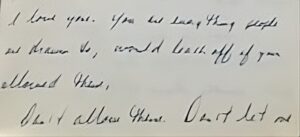
I love you. You are everything people are
drawn to, would leach off if you allowed them.
Don’t allow them. Don’t let me.
***
LMD: The Present:
It’s all here. In your own handwriting. You did love me! At least once upon a time.
All those things you tried to convince me of, after you left, was only to rewrite our history. Make it justifiable to you, our children, our friends, why you left. You were my husband and my best friend and you hurt me.
You fucking coward.
I don’t know what went wrong from your perspective and, unless there’s another journal squirreled away someplace, I’ll never know. You talked about living in a fish bowl, living so close to the Plant, your children and their friends in your classes and on your sports teams; how you hated to mow the front lawn; how I was too reserved. You talked about sex. A lot. But I never loved you was a narrative you created to get by. “Anything,” as Penni said, “to get out of the room.”
Did you leach off of me? Did I allow you to? Were you warning me of a future fate? Though, of course, it’s only “fate” in hindsight. My father believed you left because I was getting published and you weren’t. I didn’t and still don’t accept that, but I can’t deny the timing. I was surprised when my dad told me what he thought. He never said a negative word about you and he didn’t even say this in an unkind way. He was just reporting the facts as he saw them.
This seems prophetic now. You changed directions and ran away and never saw me reaching out. Why didn’t you turn around?
***
(My high school reunion was held recently. I pulled out my yearbook and found this.)
GWM: June 1973:
Joey,
Here I am at my desk at home, writing you in a very formal way in your senior Plant yearbook. Whatever goes down here will remain for a long time.
I’ll try my damnedest to be very clinical about something I’m very torn on—as you know—comings and goings, and so on.
You made me very happy this year. You made everything more fun. In fact, exciting. I hope the flavor of that enthusiasm you’ve shared with me, the life you’ve given me this year, will allow me to go back next year as happily as I leave this one.
So happy transplanting and thank you for the new manure. The soil isn’t bad. The air’s much cleaner and the good person who transplanted me, well, I hope she comes back and waters me when she can.
There. Now Go.
Whatnot.
Postscript
LMD: The Present:
Whatnot,
The ubiquitous yearbook quip, Never change, rings in my head. But we did, didn’t we?
This is my last letter to you. You’ll never read it, but I’m tossing it out anyway, hoping it will wash up on your shore somewhere in the multiverse.
Thank you for getting your journal into my hands. My emotions have softened and I realize what a gift this is. I did occupy a good deal of space in your head. I’ve been so angry for so long with you trying to get me to buy into your scenario that we never should have been together. It’s good to have validation about those days—though I wish you had given this to me before you died.
Halina asked if I had any doubts about sharing your journal as part of my own writing. I told her the story of Franz Kafka instructing his friend, Max Brod, to burn his unpublished work upon his death. Brod reneged and published Kafka’s works instead. You and I loved that story. You even had a steamer trunk full of your writing. “If I die first, you can be Max,” you’d say. We’d laugh, both of us trying to imagine our writing out there in the world.
More than anything, though, I wish I could talk to you about this. We had so much unfinished business. That’s what hurts the most and that has always been the hurt. I wish you had been able to talk to me. We were two complicated, intelligent human beings navigating a powerful human experience. It was a messy, beautiful, tragic thing. But it wasn’t just one thing, it was a million, and it led to kids and decades of commitment—until it didn’t.
But I never got to say these things to you.
Such is life. So it goes.
But do I regret it?
No. Never. Ever.
Love, Joey
*Photo Credits: Laurel Doud for journal photos and author photo of Greg Martin. Wedding photo taken by Diane Terry.

Laurel Doud’s novel, "This Body," was published by Little Brown, translated into German, and optioned to Hollywood where it disappeared into development hell. Her short stories and creative non-fiction essays have been published in online magazines and literary journals such as Air/Light, Smoky Blue Literary and Arts Magazine, and After Dinner Conversation. She lives in the Sierra Foothills of California with her husband and their senior rescue dogs.

Author photo of Laurel by Tom Stern
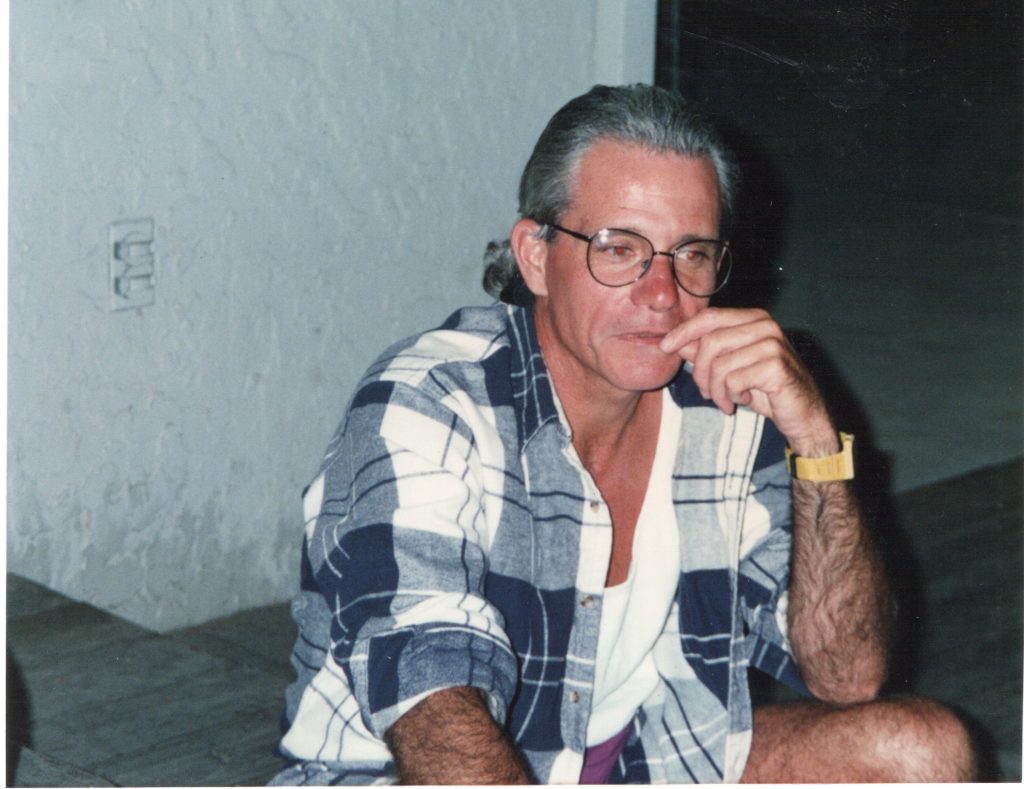
Greg Martin taught English and coached basketball and cross-country for over 50 years in San Jose, California. Although he never finished his Great American novel, as he liked to call it, he did publish a book in 2017 called “Teaching From the Inside Out,” a non-fiction account of teaching in public schools in California’s Bay Area.