One Last Supper Together
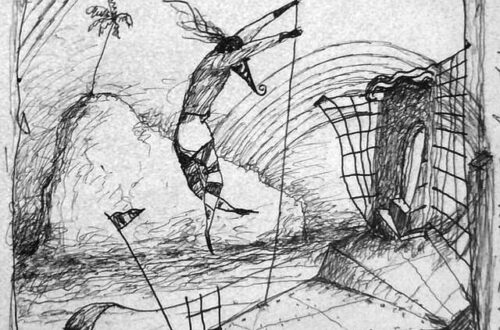
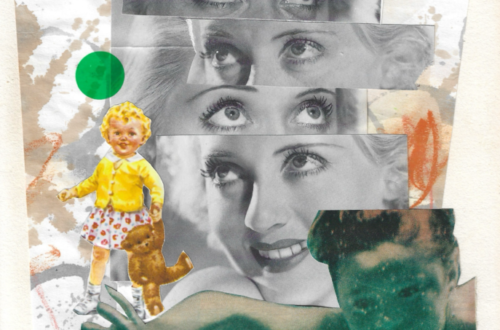
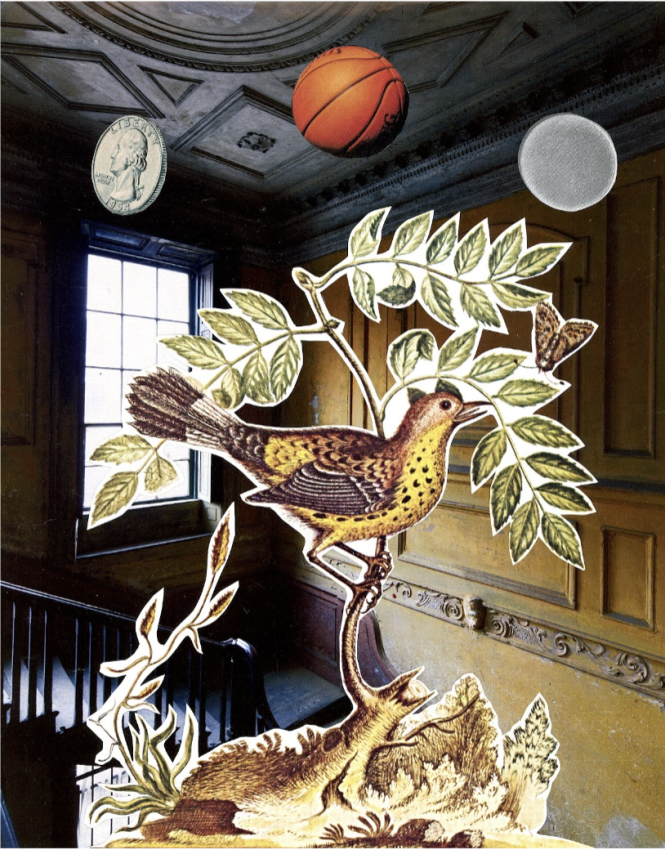
art by Helen Hofling
by Marie Anne Arreola
The door is ajar, and it doesn’t occur to me to knock; it is my house, after all.
The gunshot sounds like toast popping—quick, obvious, almost polite.
A child holds the weapon, his arms trembling like new branches trying to bluff the wind. I set a hand on his shoulder and ask if he’s okay. He tells me dinner’s ready.
On the table waits a plate without a fork, a hunger waiting for instructions.
When I walk into the kitchen, the orange walls glow; every bullet lodged in the plaster flickers its foolish metallic hello. He has shot me, and something in me unlatched: the heart opening its album, stiff pages loosening, releasing the secondhand rainbows I hid so carefully so I wouldn’t lose them.
When the ringing in my ears finally quiets and my sight returns—green as a promise you’d fight for if paradise were parceled into housing lots, I remember the field behind the house and the wind whispering, Run, before the grown-ups suspect. Good advice I took so late it counted as failure.
What was childhood, if not a collection of things moving too fast?
Birds singing over a fluorescent sadness, the boiler humming its low disguise. Once I stood in the kitchen, cold as the tile, knowing I ought to eat but forgetting the choreography of chewing. Outside, a child sprinted out of the pantry as if joy hadn’t yet gotten the memo, and that became a heaven I could bear: someone giving thanks over toast, someone offering you the last piece of bread without asking why you’re crying.
My mother says, Set the table, though she isn’t here. The tablecloth flares like a prayer trying to anchor itself with a chipped vase. Everything is frayed the same way—the past, the dream, the Winnie-the-Pooh scarf I only ever owned in imagination, warm as the soup you hope to finish before walking to school. But now it’s always winter, and I’m always pulling on gloves that cannot quite understand my fingers. Would you let the snow explain itself? Would you be the tablecloth feigning straightness, secured by things that only guess at beauty—flowers, memory, all the artificial soft things?
I return to the orange kitchen. Again, the bullets raise their tiny metal hands as if they want to testify. In the yard, the tulips try once more to become real. They never succeed, but I respect the effort. The azalea resurrected once—smelled like peaches and something undeserved—and for a moment I thought maybe I could come back from the dead too. Turns out not this season. Turns out this isn’t Kansas. Where I am now, there is only sun. The table is outside. My grandmother is bent over a puzzle, my parents shredding chicken as if it were an offering. The tablecloth is smooth; there is no wind. Only this calm—an alarming suffocation.
The child walks toward me, my blood drying on his face. He takes my shoulders like levers and says he is sorry, that he just wanted us to be together again. I look at him, and forgiveness arrives easily, almost automatic. Can’t we go back? he asks.
I blink, and the world reassembles itself: mountains, the precise lip of an abyss, the air thick enough to drown in—a slow suffocation for the quiet creatures living inside me, those shy nocturnal instincts that never bare their teeth at the moon. Run, they whisper, before they learn how to bite. I still carry old scratch marks across my palms; my knees no longer rise to command, yet I offer myself, a willing sacrifice murmuring to the magician who tugs the invisible threads. My heart comes apart, falling into a pale blurred stain, a brief collapse of dust. Sugar?
I am Leo, born under July’s last scorched coin, pretending I can hold the Lion’s jaw, pretending the ghosts have stopped humming in the rafters of my blood—at least during this season of sudden farewells. My family weeps past the wheat fields, losing track of time’s grammar, the plotline of everything we shoulder in silence. I forget too that reincarnation tastes like latex and dry spit, like chewed sugar and the queasy salt-edge of nausea. Yet I remember I’m partly fire, a spark born the moment darkness relents. What name belongs to me now? What is left to ignite?
The world is ash, but I cling to my mother’s gazelle eyes, coffee swirling inside amber. She walks into the kitchen towel-drying her hair, sunlight scattering sacred small flashes across her face. I pretend not to watch the golden cookies cooling on the table, that vanilla warmth opening its breath between us. She gives me those deer eyes—How many did you steal?—and I smile. Listening to her is like stepping on the luminous lung of heaven. She presses a cookie, testing its texture, tells me next time we’ll use the farm eggs but we’ll need my father to watch the coop, asks if I’m ready to talk to him. With her, I’m always ready.
Collared shirt. Short sleeves. Navy pants. Dark loafers shining like glass turning light back. My father used to tell stories—his classes at the community college, a friend who could call cattle with one bell from the far edge of the field. Even then, weariness circled him like a halo. His voice was a soft draft in my hair, a kiss on the forehead, the steady weight of his hand on my shoulder. Until it wasn’t. Until the arguments arrived—over bread, over money, over the new job. He made a choice. He left. And with every mile he drove, his gaze thinned until it no longer searched for mine.
I often dream him back into affection. In one dream—the one waking me with soot dragging in my chest—his body is a refrigerator. I curl inside his frozen arms, ice melting into my eyes, heat and cold combining. I look up at the lid above me and ask why he went, when he changed, how.
I am Leo, a last flame of July, my mane tucked inside unruly curls. I see my family standing like patient saints in the wheat. Patrick. Woody. Buzz. Old friends whose names still glow. This identity was never the inheritance my grandfather imagined the summer I followed him through the pastures, gathering, tending, learning the craft of mud drying on our soles—keeping us close to the past but far from the present. The present split us open; I never knew why. Still, I told him I’d die for the belief, as if that were the true weight. I searched for my own pulse beyond the farm, outside the dense history casting its shadow across my hair, my chest, my mind. One night, drifting toward sleep, I realized I had wandered far from the sweet shadows that raised me.
Had I swallowed the last tenderness, consumed the final trace of love? A voice asked it. I answered: there are still so many revelations ahead. I don’t know their faces, but their certainty—their simple existence—must mean something. Isn’t that enough?
At night I think about survival, how my thoughts cling like thrown darts, missing sometimes, returning always. I watch my earlier selves stuttering before the page that wanted too desperately to decode the parable. I burned that page and told it: you always wanted to speak in avalanches. Your shift is over. Do not split me again between faith and blood, between duty and destiny.
In the last chapter, the parable obeys its own sentence. Its teaching passes through a narrowing doorway and settles inside me. It is, I think, unconditional love. That sealed me. Thank God a small ember remains—enough to steady the courage, enough to stand again in the warmest colors.
I blink, and the scene resets—a sky without wounds. Mountains. And above them, an arc of color drawn wide, offering itself as a bridge.
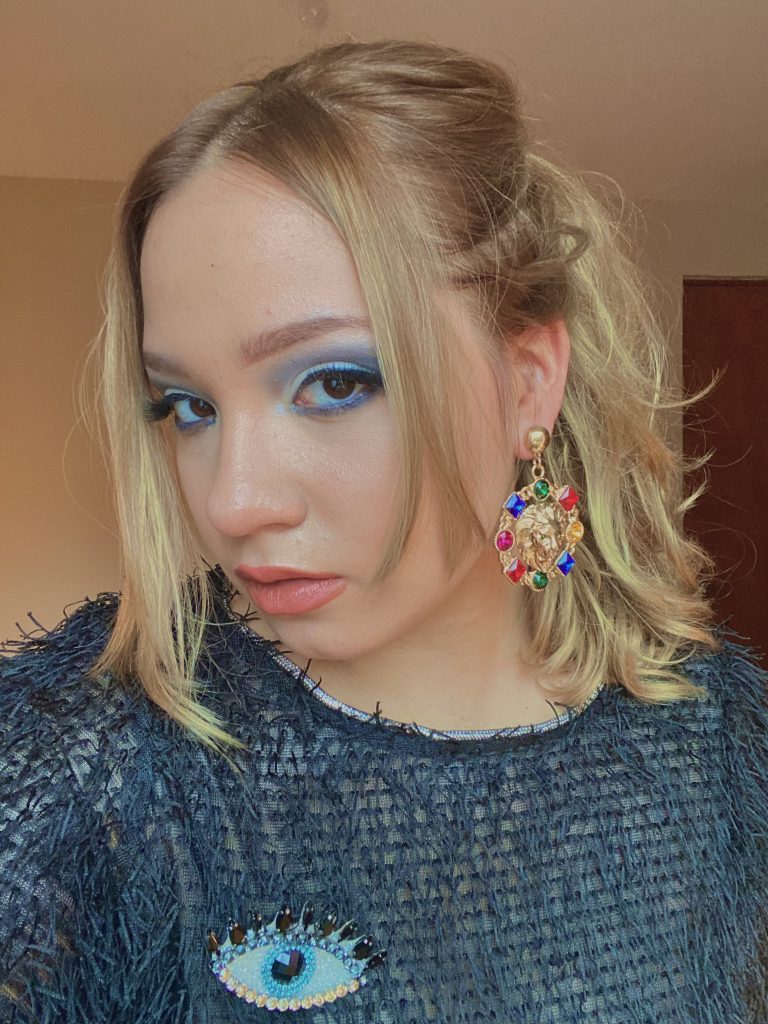
Marie Anne Arreola is a bilingual writer, journalist, and cultural critic working at the intersection of U.S. and Mexican literary cultures. Her work has appeared in more than forty literary journals across the United States, Europe, and Latin America. She is a Pushcart Prize and Best of the Net nominee and a Rotten Tomatoes–certified critic.
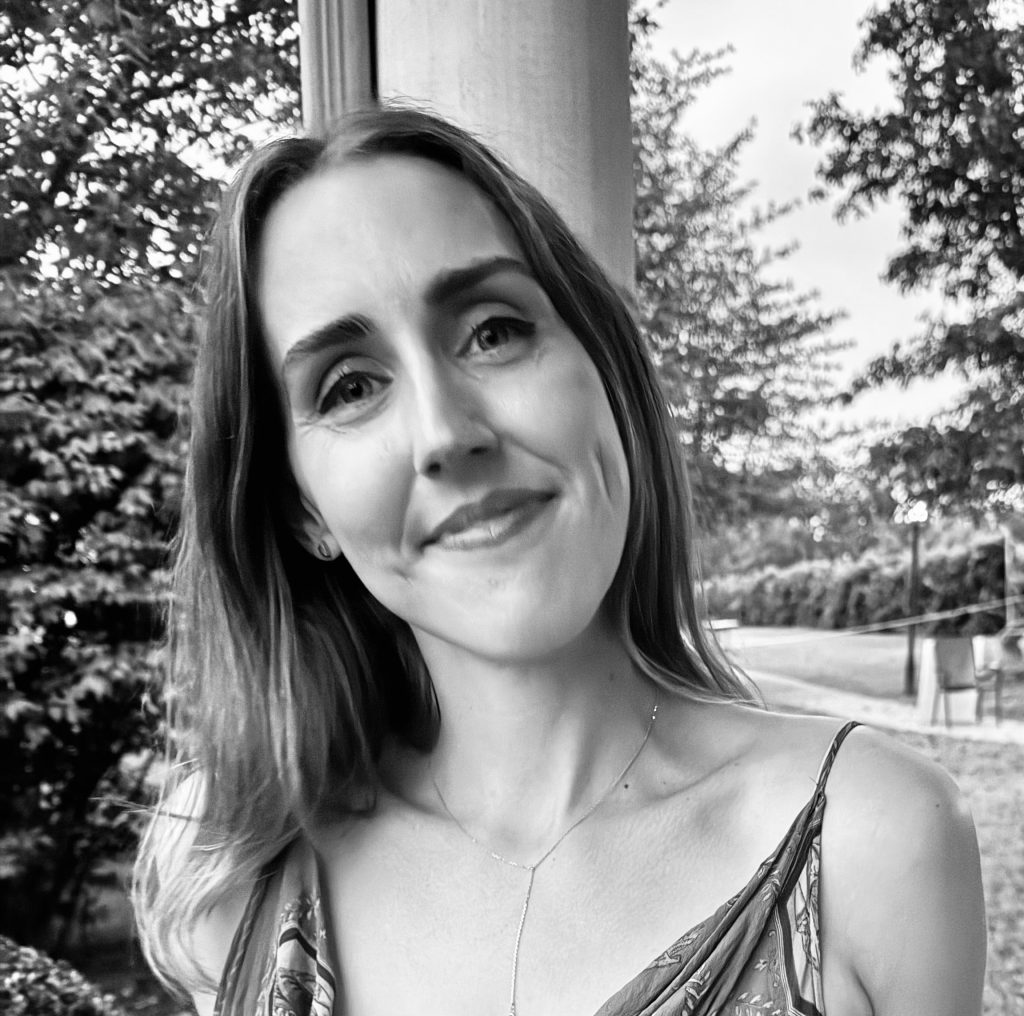
Helen Hofling is a Baltimore-based writer, editor, and artist. Her work has appeared in Epiphany, Gulf Coast, The Hopkins Review, Prelude, the Seneca Review, and elsewhere. She is a member of the PEN Prison and Justice Writing Project, and she teaches writing at Loyola University Maryland. www.helenhofling.com.