Poetic Inquiry: poetry editor Richard Berwind interviews poetry co-editor Rebecca Endres /// Rebecca Endres interviews poetry co-editor Richard Berwind
Richard Berwind and Rebecca Endres are the current Poetry Editors at LIT and both graduated from The New School’s Creative Writing Masters Program in Poetry at different times in the program’s life: Richard in ’22, and Rebecca in ’18. To celebrate National Poetry Month, both sent questions to each other to discuss their time working at LIT, their inspirations for the poetic genre, as well as other fun yet funky questions about their special interests in writing. The interview goes as follows:
Richard Berwind: Poetry is one of our most ancient mediums of storytelling. What is it about poetry that you think speaks to us culturally the most?
Rebecca Endres: I think it’s the audience’s engagement. Poetry started as music, a chorus, and today poetry retains its musicality. There’s an inherent call and response, a level of activity required of the reader to parse through the poem, to feel rhymes and rhythms. We crave that kind of mental puzzle, I think.
RB: You stayed on to LIT through the changing of the masts. What kept you on?
RE: There were definitely times that I felt maybe my tenure at LIT should wrap up, but the thing is I never wanted to leave. I don’t work in the creative writing field, so LIT is a way for me to stay engaged with New York’s literary scene and to experience so much of its talent and meet so many incredible people. Being able to stay close with like-minded creatives has been invaluable for my sense of self post-graduation from TNS. It’s a lifeblood.
RB: How has your tastes in poetry changed over the years working at LIT?
RE: I think back in the day, I wanted to publish poems that really said something profound. And I still do, but I think age has helped me lighten up a bit. I’m more interested in finding poetry that pushes the boundaries of what we expect to see on the page.
I also really enjoy the emphasis that we’ve begun to put on themes for each issue. We didn’t really do “themed” issues back in the day, and I think it really helps to focus on what kind of conversation we’re looking to have with our readers and contributors.
RB: If you could revisit any book you had to read in high school, what would it be and why?
RE: I’d like to revisit Candide, because I remember loving it and feeling very shaped by it, though I’ve forgotten most of it. The black humor, the blithe sarcasm. I think that sort of satire really shaped my humor. I also wish I’d been a bit more engaged with some of the existentialists. It was a complex topic to grasp in high school, but now I wish I’d tried a little harder to appreciate it—Ralph Waldo Emerson, I’m sorry I found you boring in 11th grade!
RB: What short book took you the longest amount of time to read? And what long book did you just fly through?
RE: Listen… I am a terribly slow reader! All books take me an embarrassing amount of time to get through. It’s not exactly a short-short book, I have a collection of Wallace Stevens that took me a shameful amount of time to get through. I tore through the first few sections, but his later work? So much time. Similarly, I have a copy of the complete poems of Emily Dickinson, which I come to every few nights and just read a page or two. I leave it in my apartment’s common area as a reminder to read it, and I think my roommate has started leafing through it too, which I love! It’s not a race, more a meditation.
Meanwhile, the hulking new fiction novel Katabasis by R.F. Kuang—I flew through it! I figured I’d need like a month to get through it when I first picked it up, but I tore through that in like 2 weeks. At over 550 pages, that’s a feat for me.
RB: We often describe our poetry section as a zoo of some sorts, what animals do you think would make the best poets?
RE: Such a delicious question! The seals absolutely have a ton to say, although I have doubts about how good they’d be with words. Still, I think their earnest engagement with people is inherently poetic, their performances a call for response and attention, to defeat boredom, to earn fish. Forget all the big cats: they’re lazy. Those guys don’t write poetry. And apes and monkeys may be intelligent, but I think lemurs have more unique perspectives worth exploring. But I think the ones with the most captivating things to say would be the goats. Any zoo that has a section where you can feed farm animals? Look at the Dionysian glut of goats. We have a lot to learn from their surrender to their id.
RB: You have two familial pet birds with such distinct personalities. What poets would you ascribe to each bird’s personality and why?
RE: Ironically, the answer for our evil cockatoo, PeeWee, came first. Marquis de Sade (did he write poems? He must have!) Or perhaps Boudelaire. Anything dark, terrible, perverse. If you’re feeling uncomfortable or defeated after a read, good. That’s how PeeWee wants you to feel, the nihilist.
As for our angelic little parakeet, Stevie Ray, I think he’d quite resonate with Alexander Pope’s rhyming couplets, due to their energetic quality. I can so picture his tiny voice recounting them. His love of butchering the phrases we’ve taught him to say and making up his own words/expressions makes me think he’d be more a Lewis Carroll type of poet! He’ll speak absolute gibberish with a look and tone of absolute confidence. “Jabberwocky” definitely seems like the kind of phrase he’d cry out when he wants attention. If not Carroll, then E.E. Cummings for sure.
RB: You’re hosting a dinner party for 3 dead writers, who are they and what do you make them?
RE: Virginia Woolf, Walt Whitman, and Oscar Wilde. Three dynamic W’s. Don’t care if they get along, they’re sat! I have a lot I’d like to ask them about what it means to be alive, to be queer, to be lonely in circles that so adored their writing. What do I make them? The same food I’d cook for any guest: hearty bean stews, maybe some roasted vegetables with homemade tzatziki or tahini sauces for dipping. Baked tofu with sesame oil and scallions. My love language is feeding people the healthy stuff I make all the time. If Woolf gets gas, she’ll get over it. I’d keep them at the table with plenty of Prosecco of course, and I’d love to offer them some Fireball after dinner, just to see what The Greats would make of it.
RB: As poets, we inherently love the moon, but is there any other celestial body that influences your writing?
RE: I love galaxies. The unfathomably huge mass of multiple stars and planets and debris all collected together. I’ve written a lot comparing individual bodies to galaxies, or tried to grapple with interpersonal relationships as one tries to reconcile different stars within the same galaxy. It’s a theme I’ll be returning to forever, most likely.
RB: Has there been anything you’ve always wanted to write but never had the time to get around to?
RE: According to physics, we never technically “touch” anything due to the electrons in our atoms repelling the electrons of anything near us. The sensation of touch is just the sensation of our atoms pushing hard against the atoms of whatever hovers over our hands or bodies. That fact messes me up something fierce. I know it’s a technicality: that no one would ever argue their lover never held them, their mother didn’t cradle them as a baby. But I live for that technicality and have drafts for a chapbook exploring touch or lack thereof. It feeds into my love of writing about science, but also my obsession with loneliness. The day that I have a bit more free time, get ready!
///
Rebecca Endres: This is not the first literary journal you’ve worked on. How do you feel LIT’s mission statement and themes differ from other magazines?
Richard Berwind: In the past, I worked on my undergrad’s Genre Fiction magazine and did a Practicum with Barrelhouse (and I also had a minor in Publishing and Editing so I had my hands in a lot of other publication pots too). I think the biggest difference is that LIT is the most straightforward “literary” magazine I’ve worked on, whatever “literary” means. I have always been so interested in the weird, the genre, and the counterculture, that now working on something more traditional feels like an ice plunge; I never thought I’d end up somewhere like here! That being said, we’re still a part of The New School, so we are obviously still pushing the boundaries of what “literary” means, and I think that’s incredibly beautiful! I feel like in a post-Covid world, we’ve definitely transitioned into accepting the weirder and more experimental into literary spaces and it’s so refreshing to see.
RE: Do you prefer to type your own poetry, or hand-write it? What’s your preferred method of jotting down new lines/ideas when they come to you?
RB: A little bit of both to be honest. I have always been pretty analog when it comes to poetry, so I will always prefer to physically sit down and write down an entire poem in a notebook, even at times doing edits through rewriting on a separate page. But the poem can’t just sit alone in a notebook forever, so when I transfer it over to a document, I feel like I can do even more edits once I can see the entire page. From there, I usually play around with the visual aspect of a poem because now I can (theoretically) start thinking about what it would look like on the page once published. Sometimes lines need to be cut because they’re too long on the screen, but they were fine in the notebook. Sometimes I’ll explode a poem across a page to make it more visually interesting. To the second point, I am (notoriously) an incredibly busy person, so I am always on the run doing something. I will usually be struck by the Muses and Apollo at the most inopportune time to be writing, so my notes app is littered with fragments and titles and ideas for poems. Sometimes they make it out of the notes app, sometimes they don’t.
RE: Do you tend to complete a poem in one sitting, or do you find your process is more piecemeal?
RB: A little bit of both to be honest (again). Like in the previous question, I will write pieces of poems over time in my notes app before sitting down and writing a poem. But, I will usually write a poem from start to end. I’ll even do edits in the same session. I was in a Slam Poetry club in undergrad, and during meetings, we would usually spend 30 to 40 minutes writing a poem, so over time, I’ve just gotten better and better at getting a poem down quickly. From there, perhaps I’ll add an extra stanza, rearrange lines, or change wording. Sometimes, it’s completely piecemeal, especially when writing formal poetry.
RE: LIT has grown a lot since you and Charlotte came on board to renovate it: what’s a change to the magazine that you’re most proud of?
RB: There are two things I’m really proud of when it comes to the magazine right now, though I’m sure if you ask me in a few months my mind will change to something new. The first is the covers of the issues. Now, that’s not to say the prior covers were bad (I really like them!), but I feel like playing around with our logo and really thinking hard about the contents of the issue alongside the timing of the issue has really got my creative juices flowing. And I think people really like them too! The second is the fact that we regularly meet in person for drinks. We started that with our poetry meetings every once in a while and eventually every week. Then it trickled over to include all-of-staff get-togethers. We work really well separately, but I think it’s important to build community and part of that is seeing each other face to face and putting aside our stressors and getting a little silly together.
RE: Our magazine continues to linger over poems that use specific forms: golden shovels, sestinas, sonnets, ghazals. What is it about form that keeps us coming back in an age of freeform?
RB: I think we particularly come back to the form as an additional way to add meaning to our writing beyond just language and metaphor. There are rules to formal poetry, and it’s hard, but I’ve always felt like writing one is some sort of puzzle to be pieced together. I think in part it shows a poet’s mastery of the genre while also participating in the centuries of poetry that came before us. I’ve been trying to write a poem in the heroic verse to participate in the Homeric tradition while also acknowledging the work of Virgil, Dante, Komnene, and Milton; it is incredibly hard and has me flexing every poetic muscle I may have in my body. Poetry is one of our oldest storytelling traditions (alongside painting, pottery, and song) and I feel, at least for me, I am connecting to all the poets that have ever felt the need to express something about the human condition.
RE: Who are some of the poets you draw most inspiration from?
RB: Right now in my life and writing, I find myself mostly drawn to the Romantics and the Gothics. They wrote with such passion and ferocity that I find myself relating to such intense emotions at this point in my life. Even beyond the poets and looking at the novelists and playwrights, this period of writing offers so much to the feeling of being lost and heartbroken in a world actively falling apart. Obviously I look towards the Shelleys, but also Whitman, Keats, Byron, Thoreau. Even pushing further past the Romantics and into the Decadent period, the Symbolists, and the Modernists with writers like Oscar Wilde, Seamus Heaney, Daphne du Maurier, Shirley Jackson, and Frank O’Hara. I find that inspiration should come from everywhere and not just your genre of choice. Watch plays, listen to music, go dancing; art is everywhere.
RE: Any particular books in your backpack or on your bookshelf that you’ve been meaning to return to?
RB: I have been trying to read Grapes of Wrath since I was, like, in the fourth grade. I grew up on “The Great Illustrated Classics” book series, which were just the classics with illustrations for kids. Sometimes they condensed the books, like with Moby Dick, but for the most part it was just the entire book. So by then, I thought I could pick up the full, unabridged Grapes of Wrath and be able to understand it. Reader, I could not. So, I have spent the last 20 years with this tome on my shelf just waiting for me to be ready for it. Perhaps this summer…
RE: You have a clear love for ancient mythological references in writing—why do you think characters like Odysseus and Persephone still resonate so much in our modern day of artistic expression?
RB: This is an incredibly complicated question with decades of academia asking the same question. Why do we keep coming back to the Classics? For the longest time, knowledge of the Classics was seen as a symbol of power because it meant you knew how to read and not only read in your own language but also in Latin and Greek. Eventually, it became a part of fascistic regimes to know the classics because it became the symbol of whiteness and a white purity (hence the white marble statues when they used to be so colorful). I think in the modern day, it particularly touches us because the myths are so widely accessible now and many of us grew up on the tales (no matter how butchered they may have been for profit) that it becomes this sort of archetypical shorthand in our own stories. I mean, really, there is a sort of Jungian archetype to the pantheon anyway, so now we think we can boil down these incredibly complex characters for their time to being “a man who loves his wife” and “the physical embodiment of spring” rather than the original distrustful, mean, trickster that was still considered heroic like Odysseus and the goddess of the seasonal cycle, rot and decay, and rebirth like Persephone. And that’s not to say the media that boils down these characters to archetypes are necessarily bad either as I really love myth retellings! I personally would like to see us pushing the complexity of these myths beyond “horny sky god” and “mean wife.” This is basically me just begging and pleading with everyone to read more scholarship. JSTOR lets you read 100 articles online a month for free! Please go read!
RE: If you could have drinks with three characters from Greek mythology, who would you choose?
RB: Absolutely none because they are all awful.
But looking beyond that, I would probably love to have a sit down and gossip session with Medea, Asterion (the Minotaur), and Dionysus. I have always been incredibly drawn to the monstrous, so I have done an incredible amount of study into these three figures. I will always defend the first two, and Dionysus is just fun (you have to invite the god of party to the function if there will be drinks). Also, we would all have to form a “We Hate Theseus” book club, as all three have been incredibly affected by that man: Medea tried killing him, he killed the Minotaur, and he left Ariadne all alone on Naxos where Dionysus found (and married) her.
RE: Likewise, you can take a workshop with Sophocles, Euripides, or Aeschylus: whose class are you signing up for?
RB: This is such a hard question! Each of the ancient playwrights bring something so different to the table and I would sign up for any class given by any of them if given the chance. My immediate reaction is Sophocles because of how much I love the Antigone and the Trachiniae, but more specifically how Sophocles constructs a story and writes such intense kathartic moments. At the same time, I would probably say Euripides is my favorite tragedian, so I would jump at the chance to pick his brain on combining tragedy and comedy while still making absolutely horrific stories. But, I think the correct answer is Aristophanes, our only surviving Ancient Greek comedian. Comedy is such a hard genre to write, especially social comedies, and the fact that we have so many comedies that have survived through the sieve of time and still impact us to the modern day is such an incredible feat of writing. The Lysistrata, the Women of the Thesmophoria, and the Frogs are some of my favorite of his comedies, two of which involve satirizing Euripides and calling him a lame poet (which is hilarious to me because Aristophanes and Euripides were probably good friends).
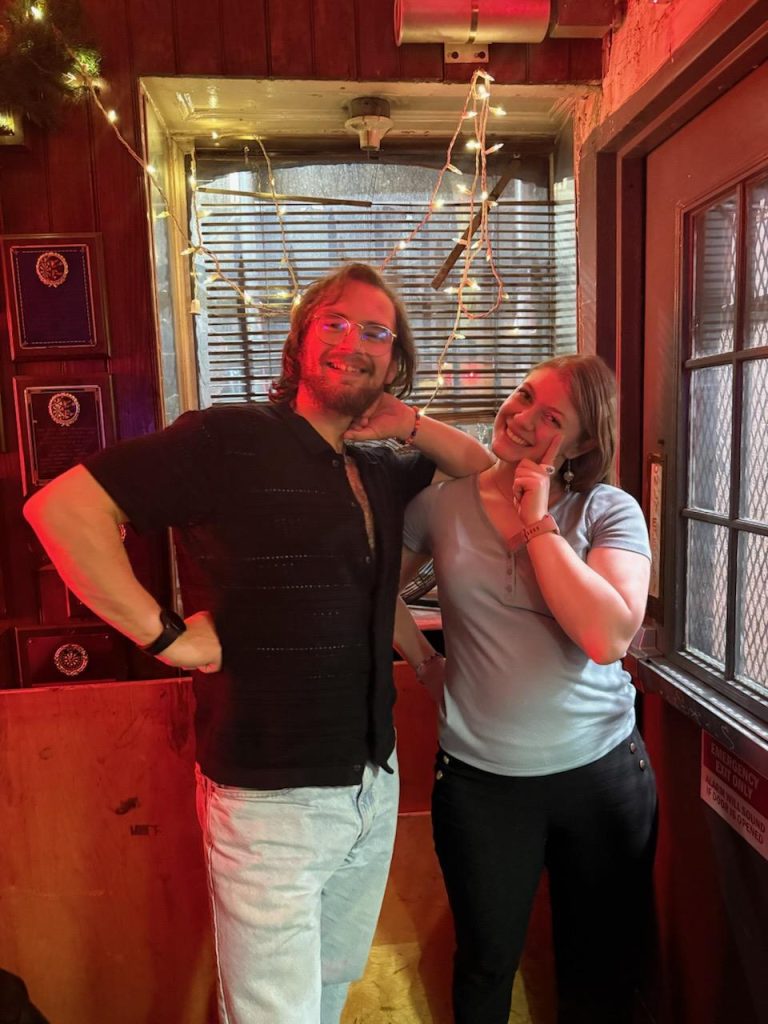
Richard Berwind @richardjboiii (he/him) is a New Jersey based poet and writer who grew up in Pennsylvania. He is the Managing Editor and Co-Poetry Editor at LIT Magazine starting in 2023 and through to the current day. He is also the creator, editor, and host of the podcast, “Sinister Seminar: A History of Horror,” which explores the development of the horror genre through a critical lens. In the future, he wants to adopt three dogs and live with his partner in an apartment on the moon.
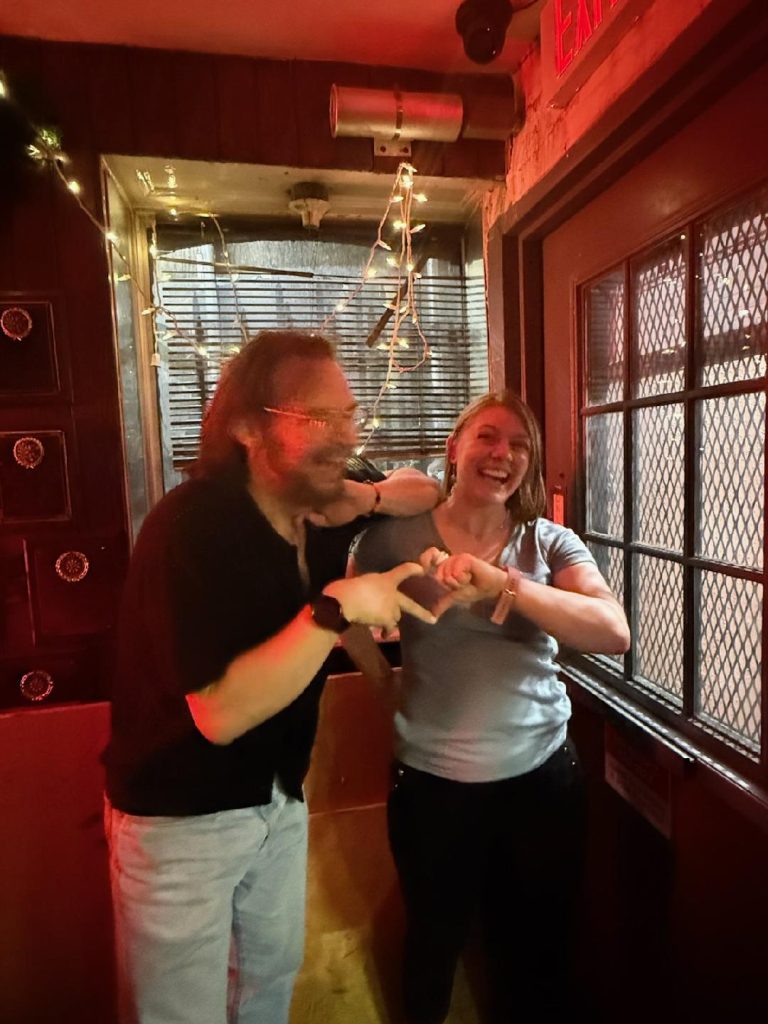
Poetry Co-Editor Rebecca Endres(@rebeccaendres) is a Brooklyn-based writer. She was the 2018 recipient of the MFA Poetry Chapbook contest at The New School, and her writing has been published in Thin Air, In Parentheses, The Best American Poetry blog, and others. When she’s not reading, she can be found wandering the city in search of friendly bodega cats.