Snowblind
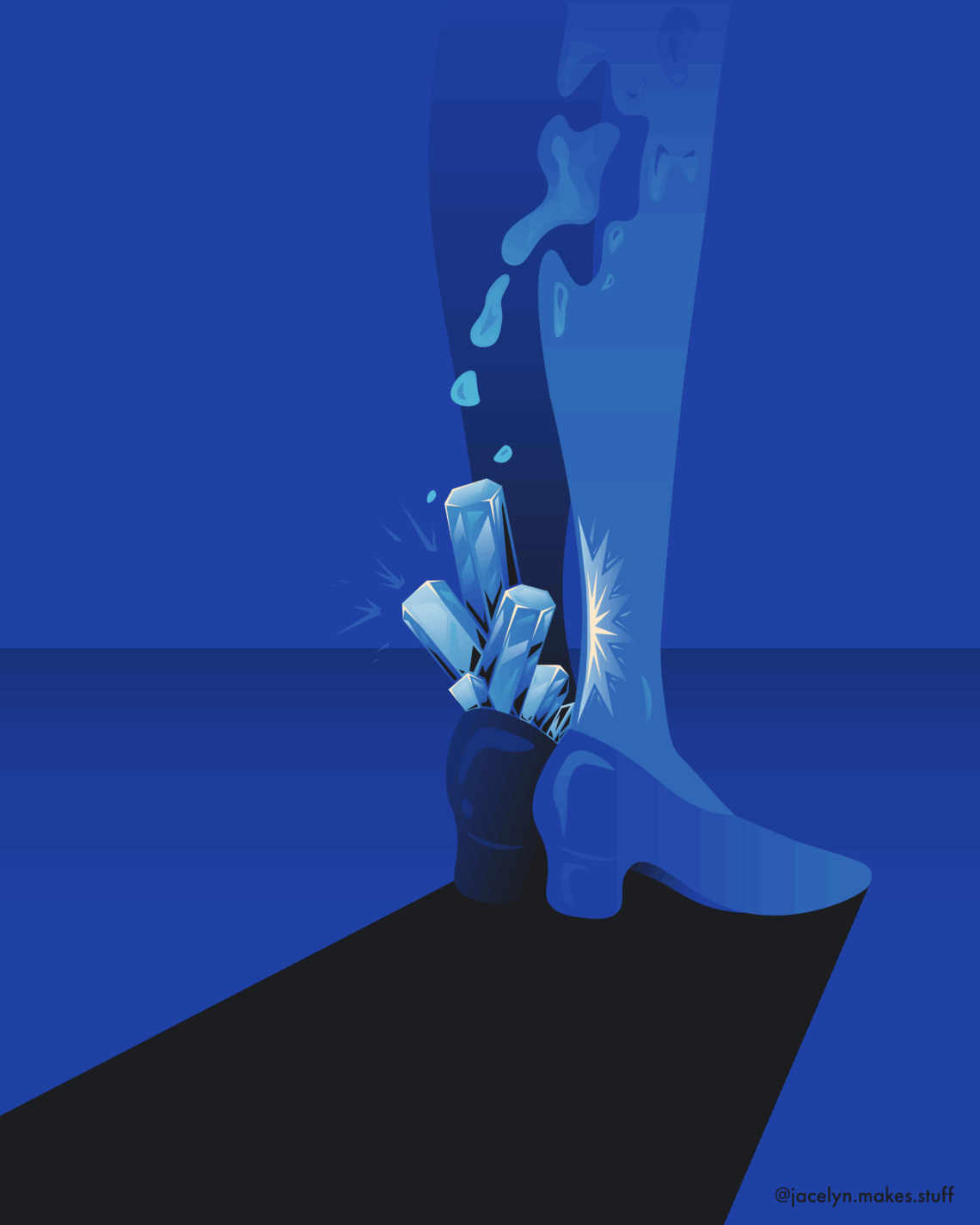
art by Jacelyn Yap
by Mar Koren
The line for the Reading Station stretched three blocks, and rain dripped from the awnings in a constant tempo.
Marion fiddled with his watch impatiently, as the woman in front of him berated her child.
“I don’t know, Jack,” she said for the fourth time, grabbing the child’s shoulder to pull him more evenly into line.
Stop trying to reason with him, Marion thought, shifting from foot to foot because his Converse sneakers had soaked through.
“But you PROMISED!” the child shouted, grabbing fistfuls of his mother’s skirt and banging his head against her leg.
“Enough. I’m tired of the attitude.”
Jack screamed into his mother’s skirt, and Marion checked his watch again. Jesus. This was the worst way he could imagine spending a Sunday. After six days of garbage sorting, Marion usually reserved his Sundays for sleeping. It didn’t allot him much time to get chores like laundry and dishwashing done, but actually, that worked in his favor.
Two hours later, they made it to the front of the queue, and Marion listened as the woman told the disinterested GreenFed worker that she needed a car so she could take her son to visit his grandparents.
“Present your watch please,” the worker said, bored.
The woman in front of Marion held up her FedWatch to the scanner, and the scanner emitted a loud, negative tone.
“Sorry,” the worker said. “Next.”
“But I’ve been saving—”
“Ma’am, the scanner declined you. Nothing we can do if you don’t have enough Victory Points.”
Jack screamed again, and his mother protested, but the worker was motioning past them to Marion. He stepped forward.
“Yes?” The worker’s eyes didn’t leave her computer.
“Just wanted to check my balance,” Marion said with a tight smile.
“You can do that at home.”
Marion wanted to point out that holding up his watch to the scanner after waiting in line
for two hours took nothing from her, but he knew this wouldn’t work. “Don’t have internet,” he said.
The worker finally looked up at him.
Marion held his watch to the scanner before she could say anything else. It dinged pleasantly. “Could I have a receipt?” he asked, making a mental note of the total, in case she told him no.
Instead, the woman sighed and tapped a button on her keyboard. A skinny receipt unfurled over the counter, and Marion took it, just as the woman yelled, “Next!”
Marion spent the rest of the day on the couch. Once day turned to night, he rose to cook ramen in his small kitchen. When GreenFed came through a few years before to “redistribute” the apartment building, Marion got lucky with a full room, galley kitchen, and a bathroom all to himself. The rooms that used to belong to him, his sister Al, and their parents got divided up into apartments which less fortunate families moved into.
Al was always telling him to redecorate, but Marion kept the space mostly the same. What used to be the living room was now his bedroom, with the faded blue couch, his dad’s record player, and his mom’s bookcase. In the kitchen he used his mother’s heavy-bottomed red pot for ramen. Plates and glasses chipped over time, but Marion had stopped using most of them to conserve water. Since he used the red pot only for ramen, he simply sprayed it down after each use. Al told him this was disgusting, but Marion didn’t care. He had only one goal in the past five years: the Antarctic cruise. Nothing mattered as much as that.
Al came over later in the evening with groceries. She now worked at a military base filing paperwork and fielding phone calls, and she was always bringing him groceries, even though Marion told her not to.
This time she’d brought something new. “They’re little juice boxes of milk. They don’t have to be refrigerated!”
“But I’ll have to throw them out!” Marion protested.
She shook one of the small bottles in his direction “Sometimes you need to throw things out!”
Marion knew she’d stash them in a cupboard somewhere before she left, and he knew
he’d never use them. They’d go bad and rot probably, but as long as they didn’t go in the garbage or recycling, he wouldn’t use any Points.
“Please just let me take some things home to wash,” Al said.
They were sitting on the couch, Marion cueing up Breaking Bad. It was the only series he owned in entirety on DVD.
As the opening credits rolled, Marion reached under the couch cushion. “Got this for you.”
“Oh my god!” Al snatched the Indigo Girls CD from his hand. “No way!”
“Found it at work.”
Al popped open the jewel case to examine the contents. “Not even scratched! Who are
these people?”
“Rich people.”
“Ugh.”
When Al left, she took a tote bag of his clothes and tried to take his ramen pot.
“But then I can’t cook dinner!”
“You can use another pot.”
“But—”
“Okay!” Al let the pot clang onto the stovetop. “But I’m taking these.” She swept up a
few of the mason jars he used as glasses.
The next morning, Marion rose in the dark and dressed in clothes he’d washed in the sink. They never smelled as clean as he remembered from his childhood. Or maybe the word wasn’t even clean, but appetizing. The thought of washing machines and Tide made him sad. He remembered his dad holding a coat hanger in clenched teeth while he secured a button-down shirt’s top button, and his mom refusing to match up Al’s colorful socks, so Al always wore miss-matched ones. He hurried through getting dressed.
He packed two peanut butter sandwiches into his bag, along with his work clothes: rubber pants and a raincoat. He didn’t need a water bottle since water was free at work, which he really couldn’t believe GreenFed had the decency to allow.
The Reclamation Station glowed preternaturally in the dark world. Marion tapped his watch at the door’s scanner, and it opened with a smooth, “Hello, Marion.”
All day, GreenFed trucks delivered tons and tons of trash, and Marion and his coworkers sorted it by hand, tossing bits into the correct bins which would then be ferried by conveyor belt to the appropriate Recycler Station. Mostly, the trash came from the rich, because regular people couldn’t afford to throw away so much. Which was why Marion kept an eye out for things he needed. Most recently he hunted for novels and candles, to prepare for Plan A.
This morning, Marion donned his rubber gloves and sorted a disposable baby diaper, then some beer cans, and what looked like a chicken carcass. The work didn’t bother him much because he was free to think whatever he wanted, and today all he thought about was the number. His Points. The bright pixels flashing on the scanner yesterday. He was close. And with a big enough push, he might be able to accrue enough Points to finish in the next couple of weeks. His pulse beat faster just thinking about it. His Arctic cruise. The sharp, white cold. Water lapping at the boat’s hull. Maybe even the Aurora Borealis.
Yes, it was almost time to enact Plan A.
When Marion got home that night, he found the itemized Points receipt and sat at the coffee table with a pen clenched between his teeth. According to his calculations, he could earn enough Points by the end of next week if he didn’t use any water or electricity, didn’t throw out any trash, and of course didn’t use the internet. The only problem was Al. She’d know something was up, and she’d never allow him to complete his Plan. But Marion knew that he couldn’t wait any longer. Now was the time to push. He’d wait until Al came over on Sunday, and he’d start right after. Tell her the next week that he was sick so she couldn’t visit. And then he’d give her the good news when it was all done. She knew how long he’d been working for this.
That Sunday, Marion woke early to double check his lists. He had the sealed buckets of water he’d saved months ago, during a week where he hadn’t used any electricity to compensate. He had the shitty candles, the few novels he’d found at work the ten jars of peanut butter, the crackers, and the deodorant.
Al came over with his cleaned clothes. They didn’t smell like his childhood because name-brand laundry soap was an extravagance, but they had been cleaned in a washing machine.
When their parents died, Al joined the military since it was the most lucrative option. Because she was serving her country, GreenFed sent Marion boxes of food, tokens for laundromats, and free bus chits. Marion lived alone in the apartment. Back then, it had all their old bedrooms, but he’d slept in the living room anyway. It felt too quiet without his family. He cooked ramen and dragged himself to school, and one day, he was assigned a report on Antarctica for his geology class, and everything changed. He spent nights researching types of penguins and watching nature documentaries on VHS tapes from the school library.
The annual Victory Points catalog arrived in the mail that January, and that’s when he learned about the cruise. Marion had never cared about the catalog before; his mother usually took it into the bedroom to work out tense calculations. But realizing he was in charge of himself, Marion paged through to see how much bread and peanut butter cost this year and if he could get a crank radio. And then, at the very back of the catalog, there were the big-ticket items. Cruises. Private plane rides. Mobile home rentals. Costing millions of Points each. But Marion was sixteen, and he figured he had nothing else to do with his life but save.
Al plopped down onto the couch next to him, and Marion shook himself back to the present. “Any Arctic updates?” She dropped her chin to her chest so she could scoop her hair into a bun.
“Getting close.”
“Yeah? That’s great!”
Marion was anxious for her to leave, but knew he couldn’t appear so, so he asked, “Breaking Bad?”
“Someone at my office gave me this.” She held up a DVD of Veronica Mars. “I think
you’ll really like it.”
“Okay.”
In the middle of the episode, Al turned to him. “Oh, someone told me that there’s a heat wave coming. Are you going to be okay?”
“Of course.”
Al looked around his apartment dubiously. “Would you please think about staying with me? Just until it gets a little cooler?”
Marion shook his head, eyes on the TV. “Can’t.”
“Mare, please.”
If he went to Al’s apartment GreenFed would start counting the way she lived as if it were the way he lived: with a dishwasher, internet, and perpetually available hot water. It would take weeks to make up for those Points. He couldn’t do it, not now that he was so close. Not now that it was time to put Plan Antarctica into action.
“If it gets too hot, I’ll call you,” he said. This was a lie, but he knew it was the only thing that would get Al off his back. Al paid for his phone, or else he wouldn’t have one. Because of her military service, GreenFed gave her a special family plan and didn’t count it against his
personal Points. He’d charge his phone tonight, but once it died, he’d be out of communication until the two weeks were over.
Marion had weathered plenty of heat waves before. Since he worked six days a week, and the Station was mostly air conditioned (GreenFed buildings usually were since they subsidized their own electricity costs), all he had to do was get through the nights. This strategy worked fine for the first few days.
Marion ate the rest of his bread and started in on the crackers. He drank from the sealed buckets of water. He kept his phone off to conserve battery but used a little charge to text Al that he wasn’t feeling well (a head cold; not heat related) and that they’d have to skip her weekly visit. Each morning, he scrubbed his underarms with the deodorant and washed his face with a damp rag. Each night he lit a candle and read one of the novels until he finally fell asleep, sweating profusely on the wooden floor, which stayed cooler than the couch. On night four, he was so hot that he wasted an entire bucket by pouring it into the bathtub, then lying in the shallow water until he fell asleep. He woke up with an aching neck and wrinkled extremities.
It was day five when things started to go wrong. The floor shifted under Marion’s feat, and he had to take breaks at the Station, leaning against a support joist to settle his spinning head. He’d brought two extra water bottles from home, and during his lunch break Richard noticed him filling them. Unlike at home, the Station’s water was cold and delicious. At this point just thinking about peanut butter made Marion feel sick, but he knew as long as he kept drinking water, he’d be okay.
“You alright, Marion?” Richard asked. “Oh, yeah.”
“You look pale. Are you keeping cool in the heat? Low on Points?”
Marion almost smiled at how wrong he was. “No, I’m okay. Just anemic.” This wasn’t exactly a lie, he figured, since he hadn’t been to the doctor in five years. For all he knew it might be true. He went to the bathroom and chugged both bottles of water, then refilled them when Richard had moved on.
Marion was very particular about food, and normally he never tired of his favorites. Which was why he couldn’t explain his aversion to the peanut butter and crackers. But there was nothing he could do about it. He didn’t have any other food reserves.
Saturday night he practically crawled up the stairs to his apartment. Just one more week to go. His supplies were lasting okay. It was awful to have no AC and no ramen and no lights once it got dark, but it was all worth it. In a week he’d have enough Points, and when he waited in line next Sunday, it would be to cash them all in. That night he lit a candle and went over his calculations again but could only get halfway through before he fell asleep, naked, on the floor.
That night he dreamed of the 7/11 his mom used to take them to when he was four or five. She’d let him and Al each get a Slurpee, and Marion would spew every flavor into his small cup and eat it like soup with a spoon. In the dream he was so, so thirsty, but every time he raised the Slurpee to his lips he wasn’t satisfied. He filled cup after cup, but it wasn’t enough.
Marion awoke in the middle of the night and stumbled to the bathtub where he kept the buckets. He wrenched off the lid and used his chipped white mug to scoop up the water, which was warm and tasted like plastic. What if I used the faucet for just a minute, just long enough for the water to get cold. Just one cup. But he knew he’d never be able to stop at one, and soon the bill would be so high that the agony of these past six days would be for nothing. No. He needed water, and this was water; it would serve its purpose.
Then he remembered: GreenFed sometimes subsidized the incredibly high cost of water and electricity during heat waves. He tottered back to the floor of the main room and reached for his phone, jamming the power button. The screen lit his face blue, then flashed a red bar, and went black again.
“Fuck.” It was an old phone, and he wouldn’t let Al replace it because he was worried GreenFed would find out.
“It’s ok.” Marion said. He got the spray bottle from the kitchen and sprayed down his whole body, then lay back on the floor, and finally fell asleep.
He thought he’d go to the library to fill his Sunday. They didn’t have great AC but it was better than nothing. But late Sunday morning, when he awoke, he knew he could not make it the two miles. Even if he was willing to use Points for the bus, he wasn’t sure he could even make it down the stairs, much less wait at the stop in the blistering heat.
He tried to go back to sleep but his head throbbed, and all he could think was the color red. Every cell in his body vibrated at a frequency he could not resolve.
It’s just one day it’s just one day anyone can do anything for just one day. One day one day. Then he remembered the milk Al got him, probably hidden in his corner cupboard. Nutrients and fluid. He got up to find it, but something in his body revolted and he was sick on the kitchen floor. His head spun. His skin felt crusted with salt, but no more sweat came, which was something of a relief. He was so tired of wiping it from his eyes and his chin and feeling it trickle down his back. Marrion crawled back to the couch. He’d just sleep through the day, and tomorrow at work everything would be OK again.
***
The cool, crisp, white Arctic.
At night water brushed the hull of the ship, soothing him to sleep, like a whisper. So much water. A sea of ice water. Their first day, he got to hold a teen-aged penguin while one of the researchers callipered its wing, and one of the rich people snapped a selfie with a Macaroni penguin, the kind with the golden tufts.
At night they drank rich hot chocolate, and the scientists regaled him with stories about seals, and great blue whales. They had a snowball fight, and Marion shivered when the ice crystals slipped down the neck of his parka, melting as they ran down his chest.
“I think I’ll go rest for a bit,” Marion told Etienne, the scientist.
“Good for you, Mare.”
He’d sleep as long as he wanted, and tomorrow there’d be more penguin data to gather,
and more hot food, and maybe even the Aurora. He’d finally done it. Earned all the Points. And it didn’t matter what came next, because, for the first time since his parents died, he smiled easily. He rested. He’d made it.
Marion opened his eyes and everything was white. The ceiling, the walls, the shiny floor. He closed his eyes again, only to feel a hand shake his arm.
“Mare? Marion?” someone asked. And then added a near-silent, “Please.”
And he knew the voice. So, he opened his eyes again. And it was not a lab facility in Antarctica, not Etienne the scientist with him, but a hospital room, and he was in a bed with several tubes feeding into his right arm.
“Fuck.”
“Marion!” Al launched herself at him, tackling him around the neck. “Oh my god,” she said into his hair. “What happened?”
“What do you mean?” he asked, his throat so dry it came out as a rasp. He coughed and coughed harder. His stomach hurt. Pin-pricks of light sparkled before his eyes. “I was at home!” he tried to shout, but it came out as a whisper.
“Oh, Mare.” Al leaned back in her chair but clasped one of his hands. “I was so worried about you. I kept calling and texting, but you never responded. So, I came over on Sunday, and you were passed out on the couch, and it was like ten hundred degrees inside. What were you doing?”
Much to his surprise and humiliation, Marion started to cry. Like sweat, the tears ran down his cheeks to his chin. He let them go. They landed softly on his hospital gown until Al wiped them away.
“It’s okay,” she said, smoothing his hair back from his forehead. “It’s okay.”
“I just wanted to go on the cruise,” Marion said, speaking slowly so his voice wouldn’t break.
“But—”
“I calculated it. If I went without everything for two weeks, I’d make it.” A nurse came in to check his vitals, and they fell silent. With Al holding his hand, Marion stared at the patterned foam tiles on the ceiling.
When the nurse left, Al crossed her legs and took a deep breath. She looked at Marion for so long and so sadly, he said, “What?”
“The cruise.”
“I know, I’ll–”
“No. Mare, they never would have let you go on the cruise.”
Marion closed his eyes. “What do you mean?”
“No one ever gets those super high-Point rewards. I work with the people who run those
things. You know who gets to go on cruises? Rich people. Maybe scientists, maybe. But they don’t even really care about the research or whatever. It’s just something to hold over our heads. Hardly any regular people ever have that many points, and then they always come up with some reason that they can’t go. Like, they’d do a home inspection or something and then fail you for some fake reason. People like us don’t get things like that.”
“But it’s in the catalog.” Marion knew this didn’t prove anything, but why even print it if it was fucking fake? The tears came faster. Was he just stupid, naive, too attached to the old world? But he couldn’t believe that. This had been his life for five years. Marion squeezed his eyes tighter. “If it’s fake, why didn’t you tell me?”
“I should have told you, I just didn’t think you’d get so far.”
Marion opened his eyes. “It’s been five years!”
“I know, I know, I’m so sorry Mare. It was the only thing that made you happy, and I was
worried that if that was gone there’d be nothing to live for.”
He looked at her. One tear ran in a smooth arc over her cheek. With his eyes alone he
tried to say: you’re right. There isn’t anything else. That was it.
Al brushed the tear away, and her eyes said: I know. I know.
***
The next day they released him from the hospital. They handed him a bill that would use
months of the Points he’d worked so hard for. A social worker visited and said that because Marion’s apartment was a “hazard” and he seemed to have “disorganized thoughts,” he wasn’t allowed to live alone anymore, “At least for the time being.” The social worker patted his foot through the blanket, as if he were a small child.
They were evicting him as well, and Al was busy all morning making calls to get movers to pack his things, line up a storage unit, even though they were incredibly expensive, and hold his stuff there until she could figure out what to do next.
They took the bus to Al’s small but neat apartment. She gave him a clean towel, and said she’d make ramen for dinner.
“It isn’t crazy to want to go to Antarctica,” Marion said, while they ate dinner on the couch. Al’s AC buzzed in the window, and Marion felt hungry for the first time in a week.
“No. It’s not,” Al said. Her teeth clinked against her fork.
“But apparently it’s crazy to stockpile water and never flush your toilet.”
Al smiled just a little. “Yeah. That’s kind of crazy, Mare.” They ate in silence for a
minute, then Al turned to him. “But it’s not crazy to care about something. It’s actually kind of brave. To hope for something.”
“Whatever.”
“I’m serious.” She scooted over to a shopping bag in the corner of the couch and held up a VHS copy of Exploiting the Arctic, the same one Marion watched so many times as a teenager. “Too soon?” she asked.
Marion didn’t smile, but he shook his head. “No. It’s good.”
He settled back as Al popped the tape into the VCR, fast-forwarding through the ads. And then there they were: the bright Arctic. Huddles of penguins and calling seals. Dark blue water. And they were there together, he and Al. She sat next to him, patted his knee, and asked which kind of penguin had the funny blond hair.

Mar Koren has writing published in Runestone Journal, Windmill, and elsewhere. They live in Somerville, MA, with their two bunnies.

Jacelyn (she/her) is a self-taught visual artist who ditched engineering to make art because of a comic she read. Her artworks and photography have been published by the Commonwealth Foundation's adda, Chestnut Review, The Lumiere Review, and more. She can be found at https://jacelyn.myportfolio.com/ and on Instagram at @jacelyn.makes.stuff