Consequences
art by Isabelle Carasso
by Larry Niles
Andrew heard voices out by the curb and lifted the corner of a shade. The day had been leaden, rain splatting off the trees lining his walkway. Now there was a line of fast-moving clouds and bits of the sun that had been missing all week. Outside, a tall girl, Andrew guessed her to be twenty, maybe a bit older, had her arm locked under that of an old man who was trying to heave himself upright from the passenger seat of a dark gray car. She held on as he shambled up the walkway, stiff at the knees, bent at the waist, each step calculated. Andrew watched as the old man pushed the girl’s arm away and grabbed the bottom railing of the front steps. The girl continued up to the front door. Andrew let the doorbell ring several times before unlocking.
“Yes?”
The girl took a step back. “My grandfather” she said. “He wants to talk to you.”
The old man kept his head down, scuffed his feet on the welcome mat and squeezed past Andrew.
“It’s about your boy,” the girl said.
***
It had been seven months since the accident. The twisted frame of a bicycle lay at the side of the road. Police were there, one measuring a scar of skid marks, another sweeping up the remains of a shattered headlight, a third talking to a neighbor while spinning the upright wheel of Robbie’s bicycle. Andrew had gotten the call only moments earlier, but he was still too late. As he closed in on the accident site, a slow-moving ambulance passed in the other direction.
Andrew was told of a dark green car swerving, jumping the curb, leaving a deep gash in a large oak tree. Smashing a headlight. Then the car lurched into reverse and hit the bicycle. Hit the boy. Andrew’s boy. Robbie. And drove away. That was all the witness saw, only adding later that she noticed a license plate was hanging loose and, next to it, the corner of the red sticker for the local landfill was torn. “Not much to go on” the officer said.
***
After the funeral, Andrew and his wife, Hannah, went home, climbed the stairs to Robbie’s room, and sat on his bed. A faded backpack hung from the closet door, a Ghostbusters poster was taped to the wall, a Red Sox jacket, one arm pulled inside out, lay on the floor.
“That service.” Andrew said. “Those people, some friends I haven’t seen in years. And all I could think of was that they get to go home, take off their shoes, undo ties, take off dresses, have a drink …and hug their kids goodnight.” He paused. “Hug their kids…”
Hannah squeezed his hand, leaned into his shoulder.
“And somewhere out there is that son of a bitch who did this. Walking, driving, talking to people, eating dinner, maybe even laughing, He’s out there…somewhere.”
***
Andrew went to repair shops asking if anyone had fixed damage to a dark green car. Checked the local hospital in case the driver was injured. Talked with the state’s investigator almost daily and was always told “we have no leads, sorry.” He bought an atlas detailing every road in the county, pulled it apart and pinned the pages to a four by eight-foot cork board he propped against the living room wall. Then he started to drive. Up early. Home late. Figured he would find that car somewhere. He looked in driveways, back yards, open garages, barns. And after each day he would go to the maps, and with a thick red marker color the roads he had driven. As time went by there was more red on the map than not, each red inch a frustration. After several months, a local television reporter picked up Andrew’s story and ran a human-interest piece. He told about the hit and run, the green car, the loose license plate, the red-lined maps. How Andrew had just bought the bicycle as a special surprise for his son. At the end the reporter asked the community to help Andrew, to think back to what they were doing on that twentieth day in March, to do what they could to help find whoever it was that ran over and killed Robbie.
***
The old man gave a tug to the knees of his pants, sat down. His blue-checked flannel shirt opened to a white tee and his olive-green pants were cinched by a thick leather belt drawn in to its last hole. His shoulders were wiry thin and caved inward toward his chest like commas. And while he was clean shaven, he had missed a ridge of white stragglers on one side of his neck. He brushed his hand through thick gray hair. Looked over at Andrew. “Won’t take but a minute,” he said. “What I got to say.”
Andrew watched as the girl surveyed the room. It was recently cleaned, matching lamps on matching side tables, books all aligned in their shelves. Matching pillows on the chairs and couch. A few scenic photos were scattered about, while several lay upside down on a mantel above the fireplace. Pillows were stacked beside the couch, and a pine blanket box blocked the stairway.
The old man pushed himself back up from his chair. Started to walk toward the kitchen. The girl grabbed his arm. “Bathroom?” she said. He nodded.
Andrew tilted his head toward the hall. “Second door, on the right.” Andrew watched as the old man walked down the hall, tried to open the door to the closet, then found the bathroom door. The girl settled into one of the dining room chairs, then got up. She wore a navy-blue hooded sweatshirt with most of its logo worn off, cargo pants, running shoes. Round glasses highlighted her brown eyes, eyes that fidgeted everywhere except at Andrew. She went to the kitchen window. Andrew knew what she saw: two empty bird feeders, an unmown lawn, and what had been a garden, but was now just a scramble of lettuce bolting to seed, wild grasses, dandelions, and a tangle of weeds. “Nice yard” she said.
“Used to be.”
The girl raised her eyebrows. Walked over to Andrew’s maps. “Heard about your maps on TV,” she said, then pointed to a short side street. “He lives here” she said. “My grandfather. Your red line goes right by his house.”
“So” Andrew said. “Why you here?”
The girl started back toward her chair. Andrew noticed as she paused by a small table holding a bowl full of peaches.
“They’re rotten” he said. “Likely all of ‘em. My wife left them there.”
***
Hannah had leaned on him for support, and she had been there for him to work through their shared pain. Andrew said all it took was seeing one of Robbie’s friends at the grocery store or coming home to a deflated soccer ball in the back of the garage. One evening Hannah came to Andrew in tears holding a single gray sock she found under the couch. And yet, after a few months, Hannah began to function, to find small joys in her day-to-day life. Not Andrew. He stopped coaching Robbie’s Little League team, quit his Thursday night softball league, had a falling out with their minister, dented the front end of his car going into the garage. Most days he drove all over the county, and, in the evenings, worked on his maps.
That week, the one before the old man showed up, Hannah had come home from an evening with friends. She was much later than Andrew wanted. As she came into the living room, Andrew said, “You lock the door?”
“I had a good time. Thanks for asking.”
“What?”
“Nothing. Yes, I locked the door.”
“Where’d you go this time?”
“This time? Like I do this a lot?”
“Well…”
“Not a lot Andrew. Hardly ever. You know it’s not a party. Just us four women catching up. Like we used to.”
Hannah went to the kitchen and returned with two glasses of wine. Handed one to Andrew. “So” she said, “I’ve invited some of our friends over for dinner.”
Andrew’s head jerked back. “Dinner? Here? Why?”
“Just two couples. You like them.”
“No. I’m not doing that. I don’t want people here.”
“Fake it then. You can do this for me.”
“You didn’t ask! You didn’t ask me.”
“You’d have said no. You know you would. These days it’s always no. Anyways, I already invited them.”
Andrew glared at her. His voice was low, face red. “Well then” he snapped. “You can just uninvite them.”
Hannah shook her head, lowered her glass onto a side table and walked toward the stairs. “Good night, Andrew.”
The next morning Hannah got up early. She arranged a dozen ripe peaches in a cut glass bowl, the one they had bought on their trip to Ireland, and propped against it a short note. Said she had to get away, at least for a while. Wrote “love you” at the end.
***
The girl sat down across from Andrew, reached back, loosened her pony tail, regathered her hair. Bunched it together with an elastic tie.
“So,” Andrew said “You said it’s about my son. What about him?”
“Ok. So that thing on TV.” she said. “About you. The accident. The missing green car. Your maps. Made me wonder. Grandpa wasn’t supposed to drive. Had a few too many accidents. Nothing major, a few scrapes, dents, lost a side mirror, got stopped for driving at night without his headlights. Was lost a few times. Things like that. Enough for me to worry about him. Enough for me to quit college for a while to take care of him. Lost my scholarship. Anyway, I made him promise not to drive.”
“Took his key?”
“No. Couldn’t do that.”
“But he drove anyway”
“Well, I didn’t stop him if that’s what you mean. He’s my grandpa. Wish I had…”
“You wish!” Andrew’s face reddened. “You let him drive didn’t you. Didn’t you! You let him drive!”
“I know I did wrong. But let me finish. You need to know this. Grandpa isn’t well, like in his head. His memory, long term anyway, is shot, non-existent. He also forgets from one moment to the next. For the past several months his memory is pretty much gone.”
“So…you’re thinking…” Andrew felt his anger rising.
“Yes. I asked him, point blank. He says he knows nothing about that. That it never happened. But that only means he doesn’t remember it now. I think he knew at the time because he cleared the mess out of his garage and parked his car in there. That was a first. And I went out and looked. Green car, broken headlight. Found his license plate propped on a shelf. Ripped sticker from the dump, landfill, whatever.” The girl took a deep breath, lowered her voice. “Then there was the receipt for a pack of batteries on the passenger seat…dated March 20. From the hardware store.”
“Did you call the cops?”
“Of course not. Besides who knows for sure?”
“So why come here? Why now?”
“I don’t really know. I didn’t know what to do. I mean you were looking. Everybody’s looking. No telling what would happen if you found him. You looked so angry. Don’t blame you. But jail. An old man like that!” The girl took a deep breath. “And I’m thinking if you met him, realized all this, saw he’s just a sad harmless old man with no memory of what he’d done…”
The bathroom door opened. Then footsteps going the wrong way. Andrew watched as the girl ran down the hallway and caught her grandfather just before he opened the back door to the garden. “Got turned around” she said as they returned to the room. She settled in beside her grandfather. “Grandpa, I’ve told this man what we know, what you did, even if you don’t remember. Why we came here. So, tell him, tell him what you came to say.”
The old man scowled, gripped the arm of his chair to steady a shaking hand. After a few moments he started to speak, quietly, slowly, his voice unsteady: “So…Grace. My wife. You might not know her. She died. Her name was Grace. They said it was a routine thing and I drove her to the hospital. But…but I never got to drive her home. You know what I mean? Never drove her home. It was just routine they said.” The old man brushed a hand under his eyes. Starred at his feet.
The girl moved closer to her grandfather. Held his hand. “Grandpa” she said. “That was a long time ago. We are not here about that. Remember?”
“What?”
“It’s about the accident. The boy.”
“Oh” he said. He scratched at the back of his head. “Right…I’m sorry.” he said. “I don’t remember much these days. She can tell you that. But sorry…about your boy. Sorry it happened.” He looked over to the girl, his eyes raised.
Andrew glared at the old man. “That’s it? That’s all there is? You just show up. Say you’re sorry like you’ve been told to do. Not even sound like you mean it.” The old man leaned back as Andrew’s voice started to rise. “You ran over my son. Ran right over him. Killed him.” Andrew moved in close. The girl put her hand between them. “Killed him!” You get that!” Andrew knew he was losing control. “Then you just drove away. Left Robbie on that road and drove away. What the hell do you expect from me old man. Pity? Forgiveness? No memory be damned. No memory? Well, that’s pretty damn convenient for you isn’t it!”
***
It was Andrew’s idea. The three of them, in his car, the girl in the back, the old man in front leaning against the passenger side window. They turned right. The street was only a short drive from Andrew’s house but he had avoided it ever since that day. When he pulled up to the curb, the sudden stop made the old man sit upright, shield his eyes from the bright sun. “This it?” he asked.
“Yes.”
“It’s a dead end.”
“Right,” Andrew said. “It is. Been here before?”
“No.”
“Well yes, you have. You just need to remember.”
“Remember what?”
Andrew looked at the old man. He had a glassy-eyed stare that seemed to look right through Andrew, his mouth was slightly open, lips damp, brow furrowed.
The old man shook his head. “Remember what” the old man said, his voice trembling.
The two of them sat there like that, staring at each other, saying nothing. Then Andrew abruptly pulled himself upright in the driver’s seat. “Damn it” Andrew said. He slapped at his steering wheel, threw his head back against the seat. “You really don’t remember do you!” He pushed his door open. Got out. Slammed it shut.
Andrew walked to where the accident had happened. He was surprised that there were no longer any skid marks and while the oak tree still showed its scars, new wood had begun to fill in where the bark had been torn off. He sat down on the curb. Is this it, he thought, Nothing. Really? Just nothing. It’s all I get? A sob was rising in his throat. He gasped for air, put his head down, closed his eyes.
***
Andrew looked up as the car door opened and watched the old man shuffle towards the shade of a nearby tree. The old man tried to lower himself to the curb, but stumbled, and reached out his hand. Without thinking, Andrew moved, grabbed the old man’s elbow, and eased him to the ground.
“Thanks” the old man said.
The girl came over and put her arm around her grandfather’s shoulder. “Do you remember anything about this place grandpa? Anything?” He shook his head, leaned into her. “Can I just go home now?” he said.
Andrew picked up a small stone, turned it in his hand, threw it a few feet away. Picked up another. A larger one. Threw it harder. Took a deep breath. “Go” he said. “You two go on home. I’ll take you.”
The three of them sat there a while. A small bird landed in a branch of the oak tree. Hopped to another. The old man watched as it flew away, then turned and faced Andrew. “I’ve got it!” he said. “My Grace, she remembers everything. When I get home, I’ll ask her.”
***
Back home, Andrew opened the shades and sat on his couch. Then he got up, went to his map, and used the red marker to color in the dead-end road. Then he unpinned the entire map, rolled it up tightly, and put it beside the stairs. He walked towards the kitchen, but stopped by the bowl of peaches. He picked through the rotten ones until he found a peach that was bruised but still ripe and took a bite.
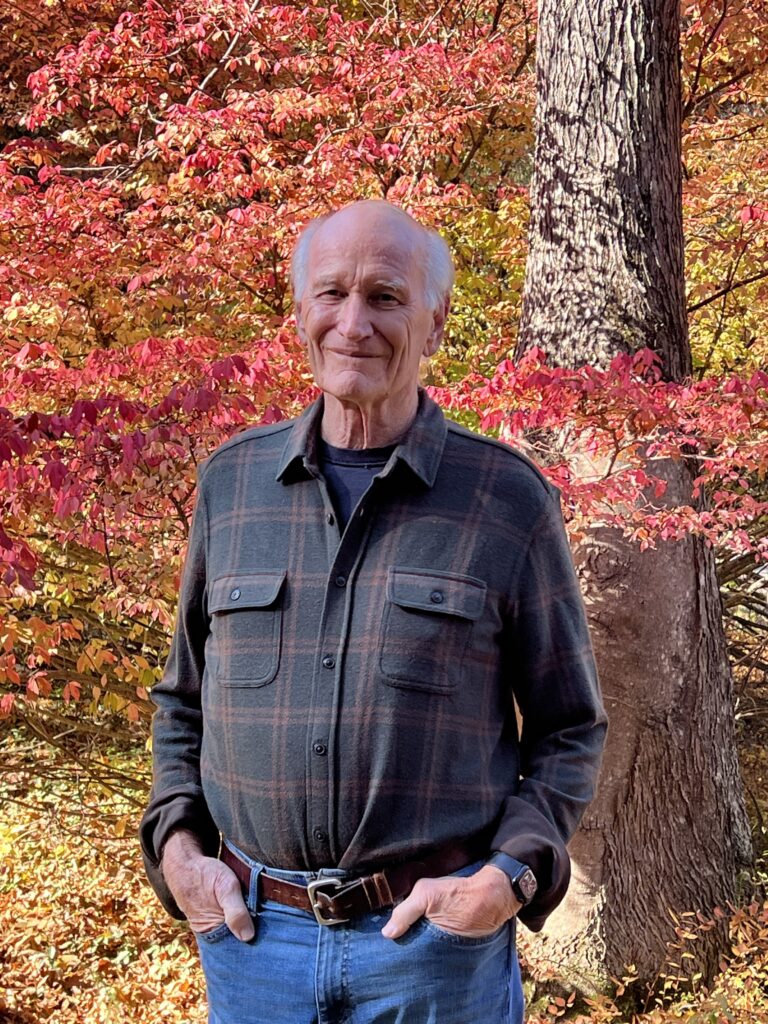
Larry Niles lives in Quechee, Vermont where he has traded a career in law and the adventures of running a guided bicycle touring company for the pleasures and challenges of writing fiction. His stories explore the subtle undercurrents of human life and the ever-changing complexities of relationships. He is a devoted husband, father, and grandfather and a graduate of Williams College and Duke Law School. This is his first published short story.

Isabelle Carasso is a writer based in Los Angeles. She’s worked as writers' support staff in Emmy-winning writers' rooms, had short stories and essays published in The Catalyst and Cusper, and a knock-knock joke published in the LA Times when she was 4. In her free time, she shoots 35mm photos to capture moments that feel like movie stills. Her film photography has been published in Red Wheelbarrow Anthology and Door Is A Jar Magazine.