Early Bird
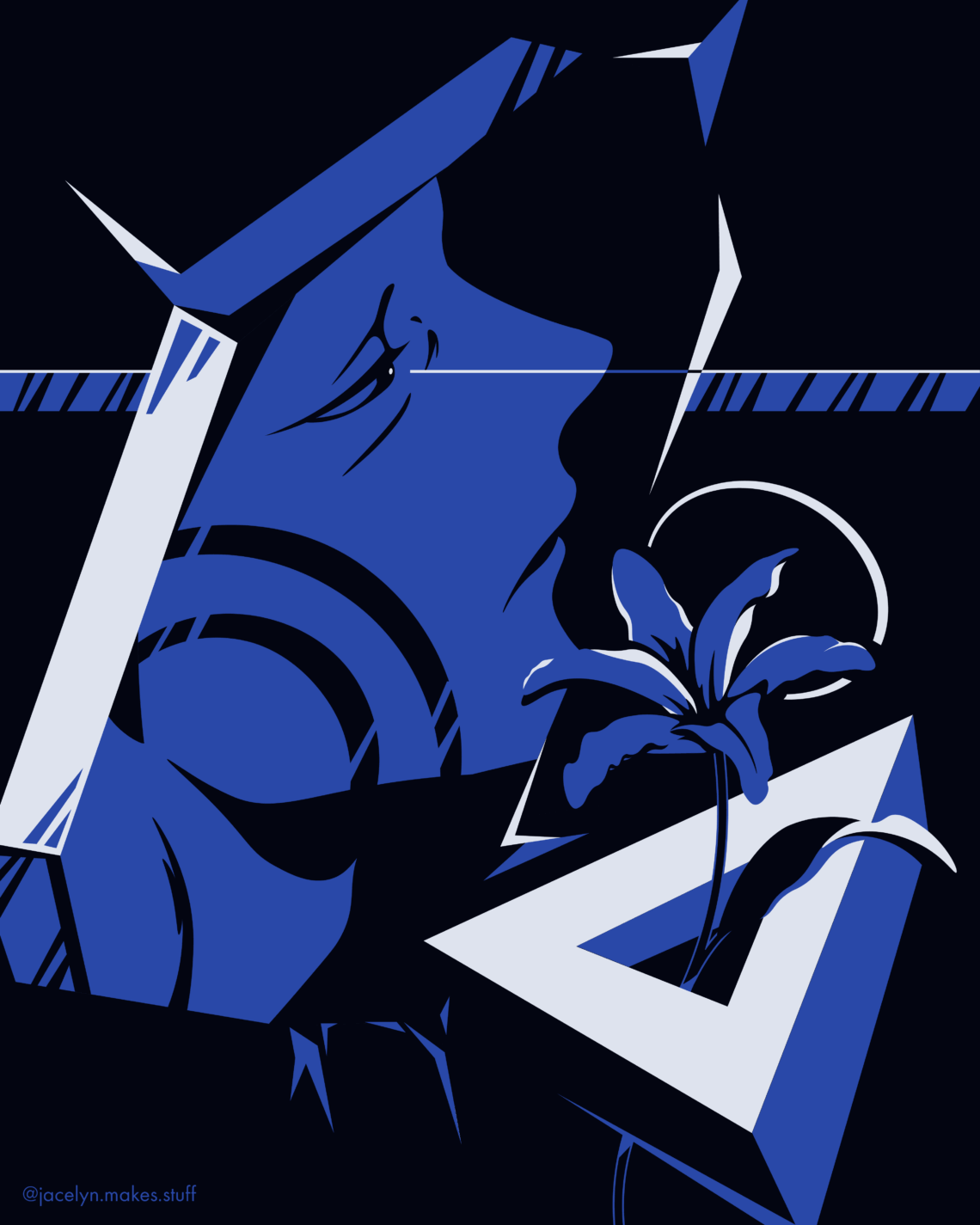
art by Jacelyn Yap
by Cameron MacKenzie
When we were pregnant with our first child, my ex-wife and I began to dig back into our family history in the hopes of clarifying the medical record. How prevalent were cancers and which ones were manifest? Who died of heart disease or a blood disorder? Were there any birth defects?
It was a strange process for many reasons, but it principally led me to think, for the first time in a long time, about my uncle. He had what is now called cerebral palsy but, growing up, I had always been told that my uncle’s varying disorders were the result of a botched birth—that forceps were used, and that he had been damaged irreparably. That explanation, while vivid, did little more to explain my uncle’s maladies than our current medical terminology, but I took it as hand-to-God truth until, many years later, I read a similar scene in a Faulkner novel.
My neighbor, a young man of about 17, suffers from the same condition, and while cerebral palsy is an unhelpful description for what his brain does, it is the most efficient way to explain why my neighbor—Carl, is his name—spends the sunny days wandering the neighborhood streets, following the mailman from house to house, shouting at people walking their dogs, or waving down cars in the intersections to show the drivers his Pokémon cards. I can often hear Carl hustling about his backyard in the early afternoons as I do the dishes. He speaks loudly and quickly on a variety of subjects, often addressing his dog as he furiously tends the raised beds of vegetables that surround the back deck of his parents’ house.
But today, Carl is standing at the bottom of my driveway, and he’s talking to the no man’s land that separates his house from my own. I don’t see anyone there. My son is at school and my home is otherwise empty, so I ask Carl through the open window who he’s talking to, and Carl doesn’t respond. He appears to be in his pajamas – large checked pants and a button-down nightshirt – and he isn’t wearing shoes. I slip on my flip-flops and head down into the driveway, where Carl is standing with his thin hands flat on the sides of his unshaven face.
“What’s up, Carl?”
As I get closer, Carl’s look begins to frighten me. His face is contorted, his eyes wild, his fingernails digging into his cheeks as he stares into the dry thickets that separate our houses. His mouth is open, but he isn’t making any sound.
“Carl,” I say. “Is everything alright?”
My uncle lived in Farmville, Virginia, in a home with others who were like him. He spent his days working in the laundry, washing sheets and so forth, and in the afternoons he would have a cigarette and drink a Coca-Cola on the bench under the oak tree beside the parking lot.
I saw my uncle twice a year, once at Christmas and once at Easter, but it is the Easter visits I remember most clearly. He was brought by a van to my grandparents’ house, and once there with us he would install himself in the living room for about five days in what everyone called a club chair, and he would sit, and smoke, and look out the window.
His Christian name was Arthur but everyone called him Earlybird, and while my little sister and I woke up on Sunday to Easter baskets full of chocolate and candy, Earlybird was excited to receive cartons of cigarettes, L&M brand. He was very tall and quite thin, had at most seven or eight teeth left in his head, and his right arm was twisted at a dramatic angle, up and around like a gooseneck, the fingers emaciated and delicate, the skin like stained paper. As a young child he would let me hold that hand. As I got older he would not.
He had a hollow voice and a shuffling gait, and he affected a disposition similar to that of his namesake, my grandfather, who commanded attention and acquiescence with the behavioral characteristics of a silverback gorilla. My grandfather stood six-foot-two and weighed around 260 pounds. He called all women Sister, and his progress about the house could be tracked by the shaking of the furniture upon the floorboards as he moved hither and yon. Earlybird was taller, and louder, and while he moved less and with less authority, he nevertheless carried himself with a similar degree of ease and confidence. In the evenings my grandfather would sit in his own giant recliner at the head of the living room and hold forth on the issues of the day, and I often watched as he and Earlybird would bark at one another in clipped conversation about the stupidity of the world and those within it, their language steeped in an accent and familiarity so impenetrable it was as though I were watching an exchange between two men from another country. I idolized my grandfather. I sat in quiet awe of his son, who seemed to exist in a liminal space, knowing both more and less than I did, receiving both more and less attention—commanding, somehow, both more and less respect.
And so every Easter, as Earlybird secured himself in his club chair and smoked, staring with quiet intensity out the picture window on the far wall of the living room – the window right above my head, where I huddled in my own club chair – I watched him, fascinated, and terrified. Was he reflecting on his life or the lives of those around him? Was he content or resigned? What did he make of me, wide-eyed and silent? I think I was a gentle boy, much like my own son, who is now roughly the age I am in these memories. And I was just as inquisitive as he is now, but much less forthright. I think my son would have spoken to Earlybird, would have walked across the room and stood before him and tapped him on the top of his knee. Would have asked him these questions and more. Can you read me a book? What’s your favorite song? Who’s your best friend? My son would have listened to what my uncle said, and quietly considered the answers.
This innate reticence of mine was a key point of contention between my now ex-wife and myself – my preference for watching over speaking or, in her words, my refusal to engage. I found her characterization unfamiliar, as I have always felt present, at least to myself. But I will confess that I have lately found it increasingly difficult to focus in this quiet house, sleeping on the bed she chose under the pictures she hung. It’s as though someone has taken the world through which I moved and handed it to me and said There. It’s yours.
Schedules have changed for everyone now of course so I’m at home a lot during the day, and as I find myself padding around the kitchen at 10:30 in the morning, I’ve recently found it helpful to turn my attention to the birds, which have just arrived from their mysterious wintering spots. The bluebirds in particular are thick this time of year, their plumage secretive and scandalous: sunset blues overtop a blood orange breast. Every time I catch a glimpse of one I’m certain I haven’t really seen it; I’m certain that it’s a mirage. A willed illusion. Lately I see them all the time.
In the afternoons Carl often stations himself at the bottom of my driveway, waiting for me to pull in from the coffee shop so he can tell me that today is National Pancake Day, or that it’s Gandhi’s birthday, or that Tom Brady has once again unretired. Often Carl is holding a prop to better facilitate conversation, and I think he knows that he slurs his words, because he’s quite patient with me when I ask him to repeat himself. For the last month or so, Carl has been walking around the neighborhood carrying a picture of Jesus Christ.
A few weeks ago, Carl was holding the picture of Jesus above his head as I pulled in from picking up my son at daycare. My six-year-old was curious, and after I opened the car door he walked down to Carl, who asked my son if knew the man in the picture.
“It’s Jesus,” said my son.
“That’s right,” said Carl. “He died for our sins.”
“Everybody knows that,” my son said, smiling, gleeful to be having a conversation with an adult.
As I waved the boy into the house I remember Carl holding the picture down at his waist, and grinning — happy, perhaps, that he had made another connection, and therefore may be in possession of something objective, something understood and shared, something with which he could bridge that yawning gap and tell himself that he is not what he is afraid he might be. Or perhaps that’s just how I see it. Or how I see things in general. Carl has often wanted to tell me about Jesus as well, but I am now deft at turning our conversation toward the weather, which occupies him considerably.
As I hustle down the driveway to where Carl is standing, I see that he is not holding Jesus today. He has no props, and he is not eager to explain himself. Today Carl is harried, and nervous, and scared. I begin to look around wildly for Carl’s parents, who don’t often seem to be at home.
“Carl,” I say to him. “What’s going on?”
Carl waves a hand.
“The squirrels,” he says, “are noisy.”
He takes a few steps in place and points at the trees. I follow his arm and do indeed see several squirrels chasing one another around the branches. I watch them for a moment and then turn back.
“That’s what squirrels do,” I say. “They play. They chase each other, and they have fun.”
“No,” Carl says.
“Yes,” I say. “Look. They’re enjoying themselves.”
“No,” he says again, his eyes focused out in the bushes as though they housed a nest of the pale animals in a thicket of the pale branches, biting and clawing and churning and churning.
“It’s too loud,” Carl says, “and I can’t watch TV.”
“What are you watching on TV, Carl?”
His eyes are still back in the trees. “The squirrels,” he says quietly. He slaps his hands against his cheeks.
“Carl,” I say, “are your parents at home?”
I watch in sorrow as Carl’s face starts to turn. This was inevitable, I tell myself. Something has cracked. It cracked some time ago, for all of us, and we have all been pretending for so long, but Carl doesn’t have to pretend as much as we do. Maybe. Or maybe he has to pretend more. Either way it all feels too soon. And the birds are back already. We barely had a winter. Maybe we won’t ever again.
“Is it going to get hot today, Carl?”
“Eighty-two,” Carl says. He drops his hands. “It’s going to be eighty-two degrees.”
“I didn’t know that.”
“And tomorrow it will rain.” Then he turns to me. “Do you like baseball?” he says.
“Sure.”
“I watch baseball on TV,” Carl says. “I was watching baseball last night and the count was three and two. But it rained.”
“That’s too bad.”
“Do you know what that means?”
“I–“
Carl shakes his head quickly. Then he pulls himself up straight, and his face relaxes. He becomes composed and patient, as though he’s leading a classroom full of children.
“There is a strike zone,” Carl says, “and it starts at your chest.” He presses one thin hand flat against his sternum. “The strike zone goes to your knees,” he says, turning that hand to the side and lowering it to indicate the imaginary boundary. “The strike zone is a square, and if they throw the ball there, it’s a strike.”
“That’s right.”
“And sometimes they hit it foul.”
“They do.”
“And when they do that,” he says, “you get to go again.”
I don’t respond. I stand in the driveway and watch as the boy’s eyes begin to lose their focus. It seems as though he’s looking over my shoulder into the forest behind me. Perhaps something’s there. Something down by the creek. I listen for the birds and hear nothing and I keep my eyes on the young man before me.
“Maybe there’s a game on right now,” I say.
Suddenly Carl laughs, a guffaw that bends him at the waist.
“Maybe,” he says. “Maybe.”
And then, holding his hands at his chest, he starts back up my driveway in bare feet, past the trees and the squirrels, clapping his hands together softly.
I stand in the driveway and watch Carl walk up to the road, and as the young man passes down on the other side of the no man’s land he pays no attention to the trees or the squirrels who continue to run inside them. He is instead looking at his hands which are held before him, open like a book, and he speaks quietly to them, making at times a mark on one palm with the finger of the other as though tabulating, or venturing a proposition that must be struck and reconsidered.
After the door closes to Carl’s house I remain in my driveway for quite some time. I realize that the bushes along the side of the house need trimming. I notice that a carpet of ivy is beginning to overtake the flowerbed. I see that the driveway needs a good sweeping if my son is going to run around out here in his sock feet, which he will do, no matter what I say. After a while the mailman walks by on the road and, seeing me, throws out his hand in a wave.
It’s the beginning of April. Red buds are on the tree branches. Easter is still some three weeks away.

Cameron MacKenzie’s work has appeared in Blackbird, Salmagundi, Cleaver, The Rumpus, and The Michigan Quarterly Review, among other places. His novel,The Beginning of His Excellent and Eventful Career (MadHat 2018) chronicled the early years of the Mexican Revolution. His collection of short fiction, River Weather (Alternating Current) appeared in 2021. His flash fiction collection All of Our Sadness Has Been A Mistake is forthcoming from Alternating Current Press.

Jacelyn (she/her) is a self-taught visual artist who ditched engineering to make art because of a comic she read. Her artworks and photography have been published by the Commonwealth Foundation's adda, Chestnut Review, The Lumiere Review, and more. She can be found at https://jacelyn.myportfolio.com/ and on Instagram at @jacelyn.makes.stuff