Lost
by Derick Chan
for Pat, at the corner of Prince & Mott
We met one day in SoHo, right across
from Old St. Pat’s Cathedral. Through the crowds
I headed north and late for happy hour,
sharing an urban sense of self-reserve
to hardly hear a stranger’s call, but as
the sun began to sink between the rows
of city blocks I saw you tapping with
your cane against a row of Citi Bikes.
You called, “Can someone tell me where I am?
Can someone help me out?” Averted eyes
in answer: Yes, but how? Behind our how,
how long, how much, and why exactly should
we be the ones who help you, after all
I have a lot to do. A sense of guilt
exchanged and felt between our eyes, our sight
secured in schedules and glossy screens.
Your shades were dark, your clothes were old. You asked
for help to get to Little Italy.
Umberto’s House of Clams is what you said.
The others shook their heads and looked away.
My promises were thin. I checked my phone
and said I knew the way, that maybe I
could walk with you a bit, avoidant fear
behind my non-committal tones. I said,
“Let’s cross the street,” but when you dropped your cane,
I heard the sounds of cars and trucks. I picked
it up. You took my arm. We headed South.
We passed the piles of trash and puddles, pressed
pedestrians and walked through scaffolds where
construction never seemed to end. You asked
if I might speak about the signs we passed.
“Well sure,” I said. I ran my fingers through
my hair and thought of pretty things to say—
Beyond these buildings rising high in stone
and glass, unbroken as…as canyon walls
cut through by Colorado streams? And on
whose banks flood walkers on their Monday stroll
and on those waters taxied, trucked, and biked
awaiting carshares, maps to load, to find
or lose their way, avoiding remnants of
a rain whose pooling ponds reflecting names
of shops and sky? I pointed out across
the street, uncertain what they sold, and caught
myself mid-gesture seeing you, my friend,
were faced the other way. I asked you for
you pardon and described the stations of
the shop: across the street we crossed just now,
a glass-encased boutique, a window scene
of warm delight of objects no one needs.
You smiled at that and asked what else I saw.
Enumerating wardrobe items, hats
of every shade—I asked you for your thoughts
on color. Silent, you began: “What’s blue?”
You paused, then laughing said, “I’m kidding man,
I used to see as well as you.” You saw
the lights and darks and vibrant hues within
your mind, though now they were less images
than ordered pairs of contrasts, compliments,
arranged as rules within your head, observed
unseen the way an old composer deaf
still knows the notes without their ringing out.
“And words themselves,” you carried on, “Each have
within them colors mapped by vowels, their sound
and shape create a circuit.” In your loss
I saw you found a sense I hardly knew.
You told me all about your home—a home
in only name—“It’s always full of those
like me, you think we’re sick, us wandering lost
without a home and who among us takes
the time to wander far in speech and thought
and step as I do now? The help I need
is hardly help, a hand is all…” You took
up mine in yours, “…is all I need to see.”
“But they, they hardly walk or speak. They live
beneath the constant watch of nurses, aides,
and medication, drifting time without
a start or end, less ship unmoored or sunk
or wandering flight than pure confusion gone
as every word is risked for paradise,
as symbol without meaning, as a love
endured both found and failed is one day claimed
to be misunderstanding all along.”
We passed a row of shops and were surprised
to find them empty, not abandoned but
unpeopled and unstocked. Across the street
a park as empty. “Once, before all this…”
you said with such a tone that all things might
be listed part of endless woes (for all
this may well be, not just for you, but all
this here for us as well). You’d had a friend,
someone to lead you far from home and back,
before the friend, a dog, a spouse, a place
to show or bring. “Do you,” you asked, “know just
how much it takes to only take and have
no chance to give?”
We walked another block
with little else to say. You asked my age,
my work, and told your own—how more, how less.
We traded facts about our lives until
we found our birthdays shared their month if not
their star and wondered how we ended up
so close in orbit, though so far in space.
At last we reached the doorway. So I waved
a waiter over, said you had the cash.
I almost waved goodbye to you but caught
myself and said, “Alrighty, here we are.”
But you insisted that I take a seat
and as you led me through the maze of chairs
and tables, upturned stools, I knew you knew
exactly where you were. The staff was quick
to take your order: “Just some oysters, please.”
“If here’s not home,” I asked, “then where?” To me
you’d been here all your life, but here, to you,
a smaller word, was little more than street,
yet full of life as any here I saw
in cities, states, or countries. Here a place
right now as full as any moment. Here
a state of mind and heart and sight (to me)
and sound (to you) to feel and hear a voice
as soft or loud, a world as fully-formed
as any found across a sea or sky.
And Pat, although I don’t know where you are
or why your name—like church—returns as sound,
I hope you’re well. You’re Here in presence now.
I hope you’re walking strong enough to seek,
to find, if not to see, to feel—that you
can give enough, you gave enough to me.

Derick Chan was born in Singapore and raised in Northern California. A writer and technologist, he has been at various times a photographer, yoga instructor, and death metal guitarist. He has degrees in East Asian Studies and Computer Science from Penn and an MFA from the University of Virginia, where he was a Poe/Faulkner Fellow in Fiction. His writing can be found at SUSPECT, HAD, Peregrine, and the Sino-Platonic Papers.
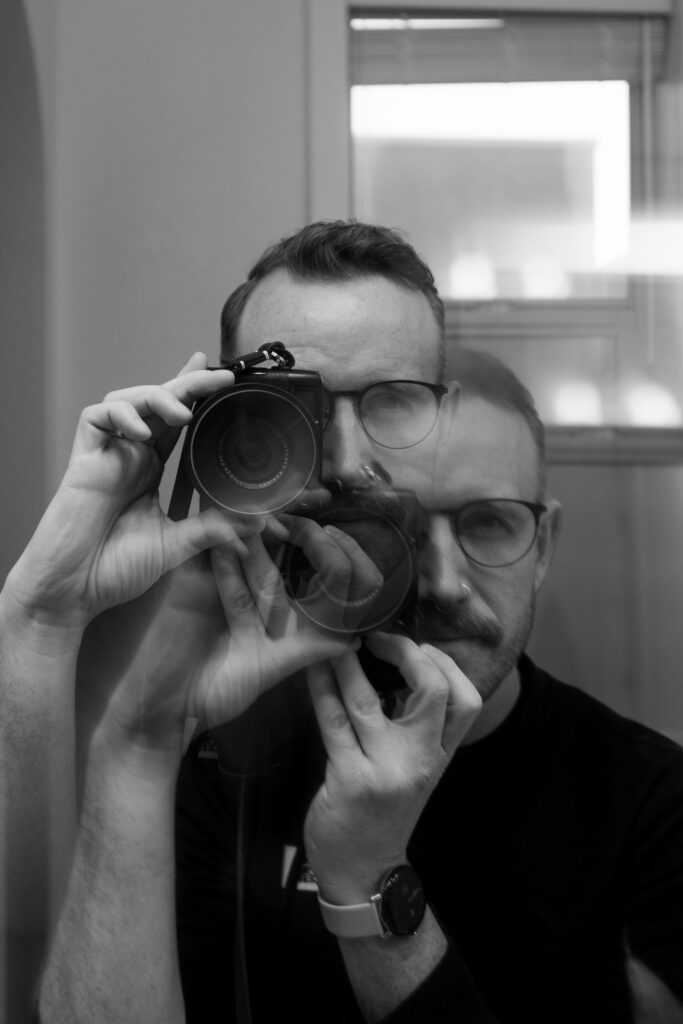
Thomas Vogt is an aspiring poet, photographer, and city planner in Sacramento, California. He enjoys capturing the ‘every day’ through a pen, a lens, or behind a mug at your local coffee shop. His work can be found in Radar Poetry, Magpie Zine, and 3elements Review.”
bsky.app/profile/tele-vision.bsky.social
@___television