“ZOUNDS!” a review, and an interview with Aleksander Zywicki
by Rebecca Endres
ZOUNDS! does not lallygag. From the moment the raw, clear-eyed book of poems opens, Aleksander Zywicki brings religion and torn flesh to the forefront of his imagery. Consider the transmutation in “The Sign of the Cross” from the first section:
my dead father has risen
his arm to hang
the wrenching Christ
above our dinner table
& my eyes like wounds
are always opened
In this childhood memory, the father figure, who looms over early memories and haunts his son from the grave for the rest of the book, becomes indistinguishable from Christ. Both of them rise—we can see his father’s arm like the limp, sinewy arm of Christ hanging on the crucifix. Young Zywicki too becomes part of the holy body, his eyes like the wounds on the dying savior’s flesh. Indeed, Zywicki’s eyes take in details through multiple stages of life, bracketed by the death of his father and the early childhood of his daughter over the course of four deeply connected sections of poems. Throughout this journey, he is never content with a single image for long, using a stern and death-obsessed Christian upbringing as the backdrop for the many forms his body will take as he grapples with grief, guilt, and awe.
The word “zounds” comes from a seventeenth century contraction of “Christ’s wounds,” an exclamation of fright, anger, or shock that conveys itself without directly taking the Lord’s name in vain. Fascinating, that stigmata are used to express surprise or uneasiness, a preoccupation with wounds that many a Shakespearean character utilized, and that Zywicki employs expertly. How else to convey the turmoil of occupying a body, of watching other bodies wither and age, than to place yourself right into the rips in the body, the seams upon which they begin to unravel? By marrying the psychological and the corporeal, Zywicki embraces pain and the potential for healing, and we peer out from the torn edges, taking in each discovery from within this compact communion.
Loss is inevitable, and many poems in the collection give us a stark reminder of that, addressing not only the loneliness of losing loved ones or outgrowing the beliefs that buoyed us as children, but also nestling between the gaps of longing and that helpless question of what’s next? In one poem, “misgive & mistake,” we witness the pulling away from devotion, the tearing off of a gauze over the eyes as “suddenly it’s the hour/where God is peeled from your tongue.” Zywicki goes on:
it is possible you don’t know
how to want anything
some die from this
some grow old
& die from this
Another hyperaware moment, one of the most raw and honest in the book, comes when Zywicki describes the day his father dies (an impact that will reverberate throughout the next three sections of the book). He doesn’t dwell on the shock or the pain, relief or concern for his father’s soul—a surprise given the constant religious overtones. Instead, he considers how this will impact his return to elementary school:
& how my septic
brain swelled
in pools of greed
as my thoughts
turned to the morning
announcement biting
through the tender ears
of my fourth-grade class
that I had been made
new & special
A strange transformation occurs and our young narrator becomes the one to receive prayers. Is this the ego of a “septic brain” filled with “greed,” or the clarity of childlike honesty, fracturing death and considering the many shards of light that pass through the cracked mirror? Either way, the consciousness of the author is shaped by profound loss.
While the poems do meander across time and different stages of life, the form in the collection remains very tight. Zywicki puts line breaks to work, keeping his phrases short and imagery concise, even as a general lack of punctuation keeps any thoughts from being cleaved too far apart. Another poem later in the collection, “we don’t talk 10 years now,” spans over three pages but uses only ampersands and line breaks to separate ideas. The poet addresses the time that has passed since his father’s death, the ways he used to vie for his attention, and how desperate he was for approval. The narrator’s father is described like a dog by the end of the poem, one who “barks & barks & barks & barks” The final line feels mystic, a spell or a chant of distress. Indeed, many of the poems feel psalm-like, so quick-moving and frugal with language that it images and phrases morph as our eyes skim the page; dead fathers become barking dogs in the night. This mysticism isn’t surprising given the repetitive Catholic imagery and references to saints and miracles, but it still feels fresh each time, supported by the thrifty use of language.
Not only do the mostly short lines across the collection give a sense of urgency, of tumbling down the pages, but we are also increasingly aware of the passage of time and its relentlessness. “I want to be happy & I am/running out of ideas,” Zywicki admits in his poem “don’t look now,” a concept that is echoed a few poems later when “your granddaughter asks/me are you happy & I say yeah kiddo.” The narrator is questioned by the child—apparently his face says otherwise. We also see a moment where the narrator teaches a class, pausing a video for his students and asking them to discuss the scene in which a man freezes to death. For a moment in this poem, the speaker yields a godlike power, delaying the man’s death so his students can parse meaning, but the imagery is similar to many of the recurring scenes in the fourth section of the book: characters scrutinizing time, trying to fight age and inevitable changes that occur as relationships fade or alter, as our bodies break down, as our own memories of the past lose their luster. It’s hard not to think about the crucifix, the dying man preserved in the act of dying and replicated to sparkle against chests as a necklace, to loom over kitchen tables in homes.
None of this is to say that ZOUNDS! feels too dour or suffocating. The collection also gives us plenty of moments to see softer interpersonal ties between people, to even step back and acknowledge the dual perspectives any given situation can have. When a child’s crib is replaced with a bed in the poem “what feels like a ship but is,” the narrator imagines the horror his daughter will surely experience when she awakens the first morning without her crib,
she wakes unsure
of where she is
of where we are
of where the life she had
for herself where she knew
herself to be safe has gone
The reader will be largely unsurprised to learn that the daughter sleeps peacefully through this night, unaware of her parent’s anxieties. The ticking of the clock pounds in the father’s ears and his daughter might not yet perceive the noise at all.
Much of ZOUNDS! is so much like that anxious parent and oblivious sleeping toddler, or like the narrator who grapples with guilt over his father’s death, but also resentment towards his childhood memories. Experiences, even from a single person’s perspective, are multifaceted, like the two sides of torn flesh, trying to weave closer to heal. In his final poem in the collection, Zywicki informs us that “the heart is closed now,” but that doesn’t necessarily mean anything is over. Before the paragraph ends, he acknowledges that “now I can unbutton,/unzip.” Just when we close one wound up, there’s something new for us to tear into, flesh or query or belief system. If wounds force us to bear something unhealed and raw, then ZOUNDS! offers us a magnifying glass to lean in and inspect the damage, but also to marvel at the scars that are left behind. After all, Christ rises again, and so even as a poem, or a line, or a single image in the book fades out, you can always expect another ampersand to pop up, to connect the old hurt to a newer, broader, more enlightened take. Talk about a blessing.
~~~~~
Interview with Aleksander Zywicki by Richard Berwind
On a weekday in early October, mere weeks before ZOUNDS! hit shelves, I was able to sit down with the poet behind the gorgeous book over Zoom and pick his brain about his writing process, the inspirations behind his poetry, and his life as an educator in New Jersey. I had a few questions written down that I knew I wanted to ask Aleksander, nervous about interviewing because that is not something I find myself often conducting, but the conversation that followed led us down a revelatory conversation about how both of our lives intersected in odd ways having both lived in New Jersey and Pennsylvania, growing up within religious households, and our interest in the Gothic and the Romantic. Below is a transcription of our conversation.
RB: The first thought I had prior to reading your book was about the expletive of “Zounds!” It’s very Shakespearean, and I am a lover of Shakespeare, so I immediately thought of Hamlet and Othello, which was confirmed in the notes at the back of the book. And it’s, you know, a very striking word. I was wondering what the process was like of choosing it as a title.
AZ: Yeah, thank you for asking that question. You know, it’s a contraction to avoid committing blasphemy. It evokes the crucifixion wounds without ever forcing the speaker to say the name God or to take Christ’s name in vain in any kind of way, but it’s flirting with blasphemy. I love its use in Marlowe’s plays and in Shakespeare’s plays. You know, as I mentioned in the notes, when Hamlet says that word– he is Shakespeare’s most controlled, enlightened, new Renaissance man. But, it’s this completely uncontrolled moment. It issues forth from him as though it were like a bark or some kind of primordial scream. And, I love the idea of this kind of blasphemy. For me it expressed a lot; it expressed my feelings of an absence of control in relation to so many of the events in my life and to our current state of the world, but it also echoed my feelings of anger and disappointment in faith and the kind of traditional notion of faith. I mean to commit blasphemy to a small degree. You know, I mean to kind of point my finger at the sky and demonstrate my anger and so it’s a word that shockingly allows me to do that without ever really getting into deep trouble.
RB: Amazing. And, you know, you mentioned Christopher Marlowe too. I have to ask. Do you prefer Christopher Marlowe or Shakespeare?
AZ: For me there is only one ultimate poet and it was Shakespeare. I think he had the most capacious poetic imagination and he has been unrivaled ever since.
RB: That brings me to my next question in that the book reads very gothic to me with a sense of that Man versus Nature, Nature versus Nurture, and stylistically it evokes the works of Edgar Allan Poe, Ann Radcliffe, the Brontёs, and both of the Shelleys. I was wondering how much of gothic literature or horror inspired you in creating this collection.
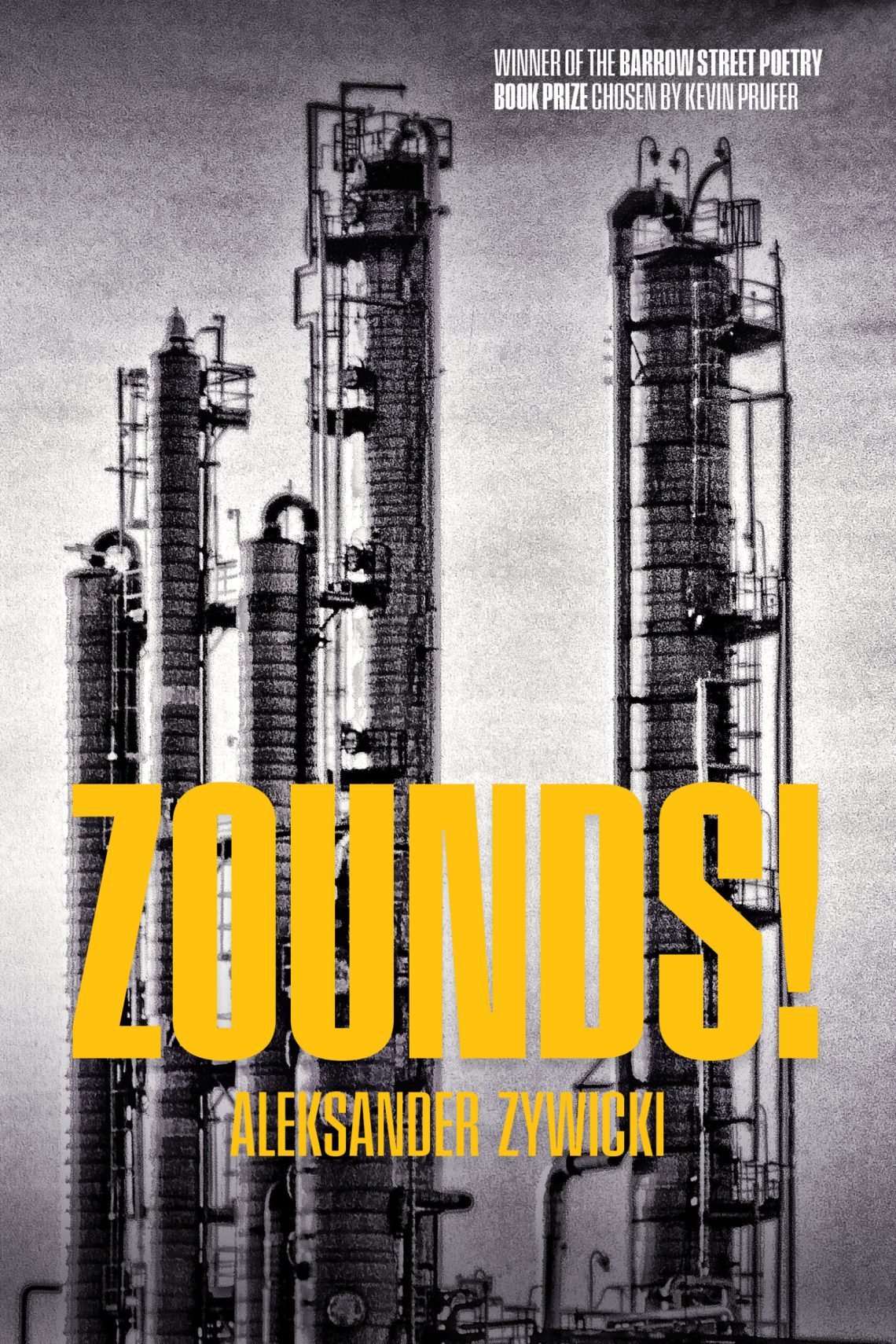
AZ: I can’t say that I’m all too in that world, but the novel Frankenstein, by Mary Shelley has always been important to me. As an author and as a thinker and feeler, she was doing something so weird in that book. She was taking all of these Romantic ideas and making them stranger. For me, faith was a really romantic idea that was made strange to me in my own lifetime, so I certainly felt as though I was borrowing some of her gestures. For the Romantics, the sublime is everything and the sublime is a mixture of awe, beauty, and terror. It’s when we recognize that nature is so beautiful and yet so capable of destruction. I was really drawn by her capacity to harness those extremes and to make such good use of them in her texts I knew I wanted to do something similar. You kind of see similarly on the cover of the book is kind of this strange, unnatural landscape. If you’re from New Jersey, if you’re driving on the Turnpike or on 280, if you look on either side of you, there are always these kind of strange oil refineries. In my broken brain, this looks like a cathedral to me, or this looks like the castle of Elsinore in Hamlet, you know, this, like, cracked beauty, this thing that is awe inspiring but is, like, clearly so debased and chemical and full of rot. That’s a lot of what I was trying to do. I wouldn’t necessarily call a gothic influence much more of a dark Romantic.
RB: Actually, I live in North Jersey, so I know exactly all about this. I was driving with a friend down the Turnpike, I think, and saw those oil refineries, and there was one that was on, like it had an eternal flame on it. I understand exactly what you’re talking about.
AZ: Yeah. And, you know, I went to Ireland this summer with my family, and it was my first time ever there. One thing that really took me by surprise was just how beautiful the highways were. There was a real sense that it was a place designed for people, then I came home and landed back in Newark and was reminded that this is not a place for people, right? These refineries, I don’t know what they signal, but it’s nothing good. But for me, growing up in Bayonne, is my natural world or, at least, what is most natural to me. You know, like, to Wordsworth, he had lakes. To me, I have this, this kind of disgusting Frankenstonian kind of concept.
RB: I visited Ireland too a few years ago, and it really is made for people. I ended up walking, like, 10 miles through the countryside just to get back to our host family’s home, and it was easier walking down those roads than it is around here.
AZ: Yes, and it makes sense how the population managed to stay so religious for so long that it doesn’t feel like they’re cut off from God; everything is still kind of animated and natural, but it can be really hard to arrive at those feelings in northern New Jersey.
RB: I agree! One of the other questions I had was about the fact that at the end of the book, you talk about your relationship and your family’s relationship to Jersey, specifically this area of Jersey right across the river from New York City. I was wondering if you could speak more about how much Jersey affects your writing in total, not just in this book but how it inspires you.
AZ: So I grew up in Bayonne, and it’s a three mile city that has a clear view of the New York City skyline, right? Always, always, always, if you’re in Bayonne, you can see just out your window the greatest city in the world. And yet, my entire childhood, Bayonne didn’t have a single bookstore. There was no place that you could see a play. There was only one record store. And, it didn’t have much going on inside of it. Right? I understand that New Jersey famously has this kind of inferiority complex in relation to its close neighbor Manhattan, but especially this place that I’m from, which seems so backwards in time. That kind of physical landscape, I think, becomes an internal landscape in the same way that I don’t have trees flourishing inside me, I have refineries flourishing inside me. There’s a poem in the book about visiting my father’s grave and he’s buried in North Arlington. To get there, you have to take Route 7. And while you’re taking Route 7, you’re going through the Meadowlands and all around you are those cattail reeds everywhere. And in the middle of all of that is this abandoned radio station. Right? And, like, what messages are they sending out and who are they sending out to? Is that God? Maybe. I don’t know. But it’s an eerie place; it’s an unsettling place to live in and work in and occupy. That’s just not true for a lot of the world. They get to have these kinds of creature comforts found in nature. They get to look at pleasant things and feel pleasant about them. I have always found the place I’m from to be unfairly unpleasant. I think part of the way that formed me is that it made me want something better, not just for myself, but for everyone who’s ever had to suffer through this. This kind of life of not being able to feel the presence of anything larger or more beautiful in the world around them because the world around them is so painstakingly ugly.
RB: I love Jersey. I love living in Jersey. NJ Transit has its problems, but the fact that we have, we have trains is great. And trains and buses and all of that, but, like, at the same time you’re right. Taking the train through the Meadowlands out to the rest of Jersey, you’re going past remnants of the industrial revolution and urbanization, places that time forgot. It’s this glorious mashup of nature and civilization. I think you’re right. It’s like, where is this God? Where is God? And having lived in Hoboken, especially during flooding seasons, is certainly a lot and sometimes you wade through water about waist deep.
AZ: Yeah, and don’t get me wrong, like, there’s so many things about this place that I do really cherish and value. I lived in Jersey City for a decade, and that was the happiest decade of my life. I took great pride in living there. It still felt like who I was supposed to be. For my undergrad, I went to the University of Scranton, kind of under the belief that if I put myself in a more naturalistic setting where I could walk to a waterfall and quiet my soul and read by it, that maybe I could heal these kind of inherent wounds. And, I went crazy out there. I hated my time there. I hated how quiet the nights were. For better or for worse, I’m married to this place, and I can’t imagine living anywhere else because of it. It sort of built me for its shape and now we belong together.
RB: Funnily enough, I grew up in the Poconos, so, again, this conversation was meant to be. But, I grew up in the Poconos and I completely understand what you mean about the quiet nights. When I visit home, the dichotomy between the countryside and urban life is insane. It’s an insane tightrope to walk. Having grown up there, I know my poetry when I wrote in Pennsylvania versus the poetry that I write now are very different poems, very different subject matters, very different feelings. So I completely get you. Do you feel the same way when it came to the poems or anything that you wrote in Pennsylvania versus New Jersey?
AZ: Absolutely. I felt like I couldn’t really write well there because I didn’t belong there. I kept kind of, to borrow a David Bowie lyric, I felt like I kept crashing the same car, you know? And it took coming home for me to understand what I’m all about, what my poems are all about. And also going to the New School. All of my education from kindergarten through my first run at grad school was Catholic and really traditional. It gave me this great steeped in tradition kind of understanding of the canon, but it also kept me closed off from all of the really cool, hyper modern, contemporary hybrid kind of fun stuff that’s out there. When I first got to the New School, I had this real crisis of faith, of, like, is this even for me? Am I supposed to be reading Gertrude Stein? And I reached out to a friend, and he said, “you know, what are you going to do? Reread Paradise Lost until you’re dead?” And he was right. I needed to be shaken up. And that’s exactly what that education did for me, and that’s exactly what being in this place did for me. They shook the dust off my shoulders in that way.
RB: I really like that that metaphor of shaking the dust off of you. And, it’s not just the Paradise Lost references in your book, but you open with a quote from Dante’s Inferno, and there’s quite a bit of Dante’s Inferno and other references throughout the rest of the book, including to Hamlet. I saw a reference to The Omen, the movie, and the famous scene with the nun. I’m just going to leave it at that, just in case of spoilers. But, there was one movie that I didn’t get, and it’s the poem “The Man Who Died in the Cold” What movie was that?
AZ: So there’s a short story by Jack London called, “To Build a Fire,” and it’s a great story, man versus nature kind of thing. But weirdly they made a film of it in which it was narrated by Orson Welles. I didn’t know that this existed until I was in my first year of teaching at Bayonne High School and I was way over my head with the thousands of problems that public school teachers deal with every single day. So, I dragged out the old television cart and the VCR and I borrowed the tape from somebody else and I put it in. I was like, “this is a masterpiece, and nobody knows it exists.”
RB: I’ll have to go and check that out. I’m a big movie person; I love horror movies and just dark cinematic movies along those lines. But along the lines of, teaching in grade school, I imagine that people reading would want to know what’s it like teaching the youth nowadays?
AZ: Well, I have put myself in a really good, really healthy teaching position. This is my 16th year as an English teacher. The first 12 years of my career were spent at Bayonne High School and Bayonne High school is a massive public school; it’s so large. It’s divided into six houses and each with their own vice principal. Throughout that entire time, I was teaching exclusively seniors. So I kind of felt like Sisyphus always pushing the boulder up the hill. I could never see these kids develop or grow or change. They would leave. It’s not the kind of school that has a great relationship with their alumni. People who graduate from that school and manage somehow to live and prosper look back at that as a like, “oh, I got out.” So, nobody was coming back to show just how much they had grown. And over time, it really kind of did a number on me. I was profoundly unhappy. I was unhappy in my soul. Poorly paid and feeling like everything that had drawn me to teaching was no longer enough. Then it was the pandemic. Because we were a public school, we couldn’t require that students who were taking our classes online had to turn their cameras on because we couldn’t guarantee that they had WIFi or safe home environments. So, of course, nobody turned their cameras on. So for two years, I talked to no one. I spoke to a blank screen which sometimes showed back my own face to me. I was losing my mind and I realized I needed to come up with a test for myself to see if it was me or teaching that needed to change. I applied to work at a Catholic school in New York City. They hired me for a year and it didn’t really work out; they should not have hired me. They knew they had to let people go at the end of the year and they hired me anyway without telling me that. They hired me even though I was leaving a tenured position, had another job offer and had a newborn to care for. It was really rotten of them. So, I was in this little free-fall and I finally saw this ad for this beautiful independent school in Hoboken called the Hudson School and here I have 12 person classes. Here I get to design all my own courses and pick all my own books. Here I’m, you know, treated like a real person with dignity. And so, I’ve managed to rescue my career and from that vantage point, I can tell you teaching today’s youth is wonderful. It’s a fabulous thing to do. It’s really enriching. And all of the traditional things you hear about teachers feeling inspired by their students, all of that has been made real for me here. That was a thing that was kind of dying a slow and painful death for me almost everywhere else, so it’s good.
RB: That sounds, one, harrowing, but two, like a dream, being able to teach your own courses to high schoolers and completely construct them yourselves. What’s on your reading list for this year?
AZ: So this year I’m teaching a junior/senior course called the Literature of Witness and Resistance. This is sort of my response to the state of the world these days. We started the year with King Lear. It’s a play about witnessing. It’s, you know, “see better Lear.” He’s instructed. And of course, it’s about a mad king as well, which, you know, I feel like we all know something about that these days, too. After that, we’re going to read Ilya Kaminsky’s Deaf Republic. We’re going to read Kindred by Octavia Butler. Such a great novel. What else? Well, I’m struggling to remember because I’m nervous now, but it’s a good course.
RB: It sounds great.
AZ: And one thing I do with the kids, I make them a poetry packet for each day. There’s a poem per day for every day the class meets. And so they’re going to read 160 poems by 160 different poets and all on this topic of Witness and Resistance. So we’ve just been reading a lot of great poems lately, too. Today we read Yusef Komanyaka’s “Facing it,” which is a gorgeous, gorgeous poem about war and how it lives on inside of us. The responses the kids have been having to it have been extraordinary, too.
RB: Amazing. The moment that you talked about witness and history and all of that, my mind immediately went to Antigone and the Theban Sophocles plays because I have a particular interest in ancient literature. And the way you were talking about King Lear, it was like it made a connection to me between those two stories.
AZ: Oh, absolutely right. Oedipus would have been a good choice, too, I think, for this course.
RB: The Greek stuff can be a little a lot, having had to read three Greek plays in my high school, I know it can be a little complex and over the top or over your head especially for high schoolers. But, in your poetry, in this book, you also reference Prometheus and a few other stories including a lot within religion. This book is packed with religious imagery and even poems that aren’t explicitly religious. They have the same biblical quality to them; this very similar voice with these references to different Christian rituals. I know in the notes there was something about kissing the baby Jesus. So I was wondering if you could speak more on your relationship to religion as well as maybe some stories and metaphors that you wish you could have included in this collection, but maybe left on the cutting room floor.
AZ: I grew up, I think, with a closer relationship to religion than most children will ever know, primarily because my own father was a deacon in our parish. He wanted to be a priest. He went to seminary to be a priest. But, he began to realize kind of early on in his life that he had severe juvenile rheumatoid arthritis and that he would eventually require the use of a wheelchair. When he told his superiors at the seminary that this was so, they wouldn’t let him be ordained. They believed that any disability would prevent him from really doing the work that he would need to do as a priest. Vatican II happens and the Catholic Church creates the idea of the permanent diaconate, the idea that being a deacon isn’t just a stepping stone to being a priest. You could be a deacon and deacons can get married. So he went to school to be a deacon. He baptized my brother, he baptized me, he gave me my first communion. And in our home, because he was in a wheelchair and could not always make it to church to perform these ceremonies there, we would experience these small scale dollhouse versions of these ceremonies right in our living room. There is one poem that I wanted to write and couldn’t figure out how to do it. There’s a Polish Catholic tradition called Kalenda, and it’s all surrounding the feast of the Epiphany. And what’s supposed to happen is that a priest is supposed to come to your house, bless the house for the new year, and an altar boy is supposed to accompany them. On the front door of that house, they’re supposed to write the initials of the three kings and the year that they’re currently in. And so it would be like 20 +k +m +b25. We would do this at home, but I was also the altar boy who would go out with a priest to go to strangers’ homes in Bayonne and write with chalk on the door to their house. All of this stuff. And usually it was poor immigrant people who still largely only speak Polish. And for them, having a priest in the home was this kind of enormously big deal. You know, it was like having a celebrity in their house or God in their house. So they would always make these enormous gestures to indicate to us how pleased they were. They would cook for us. They would try to give me money in a sneaky way to thank me and all of that. And my first time ever going out on Kalenda with a priest, I realized in my adult life, was so totally inappropriate in about a million ways. One of them was that I was taken out of class to do it. I was in school and could no longer remain in school because I had to go sit alone in a car with a priest as we drove from stranger’s house to stranger’s house so I could write the name of the three kings atop their doors. And at the end of this day of collecting little treats and money from all of these strangers, the priest turned to me and said that money is for the church and made me give up the tips I had earned, even as I was missing my day at school for which my parents were paying tuition. And something about that, the strangeness of that, the inappropriateness of that, the kind of low down, grimy, stealing from a child quality of all of that, I really wanted to somehow figure into a poem, but I couldn’t manage it. So that was very much on the cutting room floor.
RB: That would have been a great poem. I hope one day you can get that in words.
AZ: Thank you. Me too. Yeah, I haven’t given up on it.
RB: I completely understand your relationship to religiosity, too. My grandfather was a Jehovah’s Witness, and he got his degree in religious studies, and my father is a Catholic convert, so religion was very big in my household. So it’s something that is just very pervasive in your everyday life.
AZ: And there’s something strange that happens when you look around at your house and the only images that are there are either pictures of your family or Christian iconography. You know, like, they begin to kind of blend. And in the Catholic tradition, so much attention is paid to the holy family. So to see your family blending with that family and being unable to disconnect them. And having this father who was the embodiment of faith for me, die, and then only having his absence, like the absence of God to wonder at and think about, it sort of set me on this course where these became forever my primary thoughts.
RB: Oh, my God, yes! But with that iconography, there was one more question I have for you, and that is on the iconography of the ampersand in your poetry. All the and-s are ampersand. So I was wondering if you could talk about the stylistic choice for using that symbol instead of the word.
AZ: Thank you. Thank you for noticing that. It’s there for a lot of reasons. What put it there first was that, you know, I was just this kid from Bayonne. I didn’t know that being a poet was allowed. I didn’t know that was one of the options for someone like me—even though my parents did an incredible job of exposing me to literature. Becoming a poet felt unlikely and almost implausible. And then when I went to college, I had this incredible professor who taught a poetry workshop, and he did the most extraordinary thing: he just believed in me as a poet. He didn’t doubt it for a single second. He bestowed upon me a dignity that I felt I had been lacking my entire life. While I was a student there, Marie Howe had released her book, The Kingdom of Ordinary Time, which is such a religious book. It has a whole section devoted to poems about the life of Mary that is really just exquisite. He brought her in to read and he had me introduce her and seeing her do it made it all real for me. She was the word made flesh. I wanted to thank her. I wanted to thank him for opening the world that contained her and could contain me, as a poet, too. In his poems, he used ampersands in place of “and” and I thought it was a really compelling gesture—to use a symbol in place of a word, especially an ordinary and frequently recuring word. Originally my usage of it was a way of honoring him. But there’s another reason, too. ZOUNDS! is not the book I was trying to write. When I was a graduate student at The New School, I was trying to write a book called, Making the Shape. And there’s a poem in this collection that is still from that original idea. And it’s all about my great grandfather’s experience as a longshoreman. You can hear in its title how an ampersand might play with that idea, of one thing taking the place of the other, on the level of language. It’s the same way that the sign of the cross plays with the crucifixion.
RB: I never would have thought it that way, but it makes so much sense. It’s. Again, it’s this ever present, like, religious symbol in the work. Whether you realize it or not.
AZ: I love that it’s like the word made flesh. It’s a symbol that implies something other than itself, which is, you know, everything religious is kind of like that.
RB: That’s beautiful, I love it. I’m gonna have to reread it with that idea in mind. I just wanted to say thank you for meeting with me and I can’t wait to put this out onto the website for everyone to read. When is your book officially out?
AZ: It’s available for pre-order right now on the Barrow Street website and it will be officially out on the 15th, so next Wednesday, which is also coincidentally my 38th birthday, and I didn’t plan that at all.
RB: Happy early birthday and happy early publication day!
ZOUNDS! is now available on the Barrow Street website.
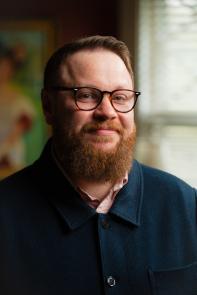
Aleksander Zywicki was raised in Bayonne, New Jersey. He is the author of ZOUNDS! (selected by Kevin Prufer as the winner of the 2024 Barrow Street Book Prize). Aleks received an MFA from the New School and his work appears (or is forthcoming) in: Plume, Gulf Coast, Laurel Review, Seneca Review, Chicago Quarterly Review, Hunger Mountain, Bear Review, Shō Poetry Journal, and elsewhere. He’s received a poetry fellowship from the Martha’s Vineyard Institute for Creative Writing and a teaching fellowship by the Folger Shakespeare Library. He teaches English at The Hudson School in Hoboken, New Jersey.