Art Therapy
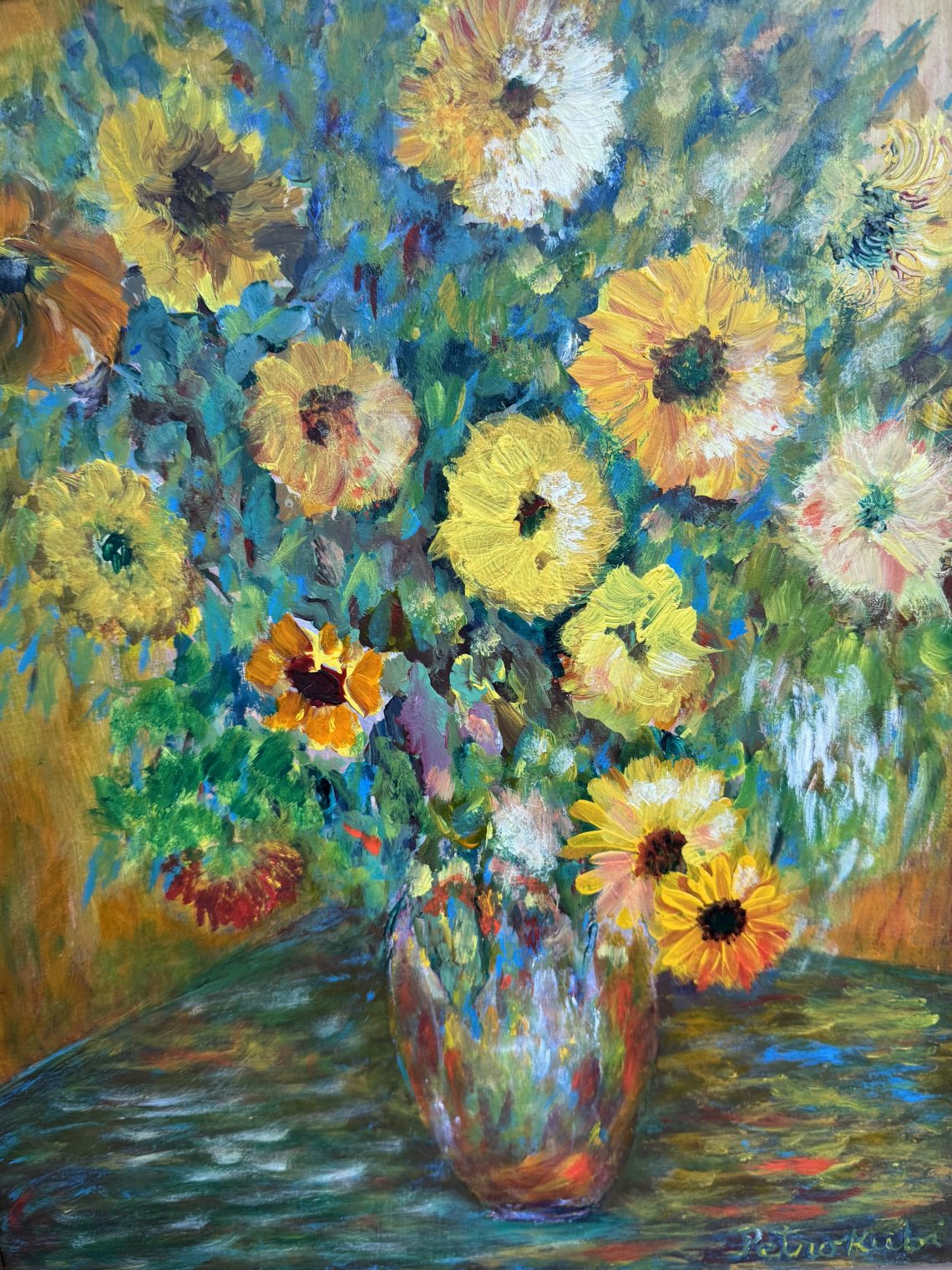
art by Mary Petrokubi
by Marilyn Petrokubi
Mary still rested in her bed near death. Her snow-white hair lay limp on the pillow. The year was 1950, and she was thirty-eight years old. Mary was dying from pernicious anemia, and to make matters worse, she was pregnant.
In the kitchen of their modest home, her husband Stephen, a science teacher, was preparing shank bone meat with vegetables in the pressure cooker. In those days it wasn’t called osso buco, it was just meat and marrow. But it was exactly what the doctor ordered for Mary in conjunction with an experimental vitamin B12 therapy, relatively new to the medical community. The home injections started after she left the hospital and would continue for the rest of her life. But in the end, they saved her. And me too. That’s right. I was famous from day one, and Mary and Steve Petrokubi were my parents.
My mother said to me years later, “They called you a miracle child in the medical journals. I was so far gone, the priest gave us last rites.”
I never got to read those journal articles, but I knew what she said was true. As a five-year-old, I remember seeing the strange looking vials of B12 stored in the refrigerator and my father drawing serum from them to inject her with that long needle.
Of course, I was too young to remember the earliest days of her recovery when my dad took over the cooking, cleaning, and infant care. Because the anemia caused nerve damage, she had to learn to walk and feed herself again around the same time I did. Imagine Mom and me, taking baby steps together.
Physical therapy became her full-time job, and as part of that therapy, my dad encouraged her to start painting to get her hand coordination up to speed. He was a bit of an artist himself, so I’m betting he was probably Mom’s first teacher.
He set her up in their blue bedroom, where the eastern light filtered through the venetian blinds in the mornings. The second-hand easel was a large contraption that took up too much space, but she didn’t care. Under it, a plastic tablecloth protected the oak floors. I can still smell the pungent odor of turpentine from the jar she used to clean her brushes. The small tubes of paint that she squeezed onto her palette reminded me of travel-size toothpaste.
She introduced me to colors that were not in my Crayola box—Titanium White, French Ultramarine, Cadmium Yellow…I would color by her side as she painted—me careful to stay within the lines, she dabbing and dipping with her fine-pointed brush. Perhaps I reached my artistic pinnacle when in fourth grade, I won a blue ribbon for my rendition of the book cover for “Lassie Come Home.” But that was it.
With time and patience, her skills developed, and mine did not. I can still see the look of concentration on her face as she painted, the tip of her tongue wedged lightly between her teeth. And with time, her brush strokes grew more confident. She worked at it for hours every day. That was her job. Her calling. And ultimately it became her passion, second only to loving me.
*
In tribute to her miracle child, she painted a portrait of me when I was around 6 or 7 years old.
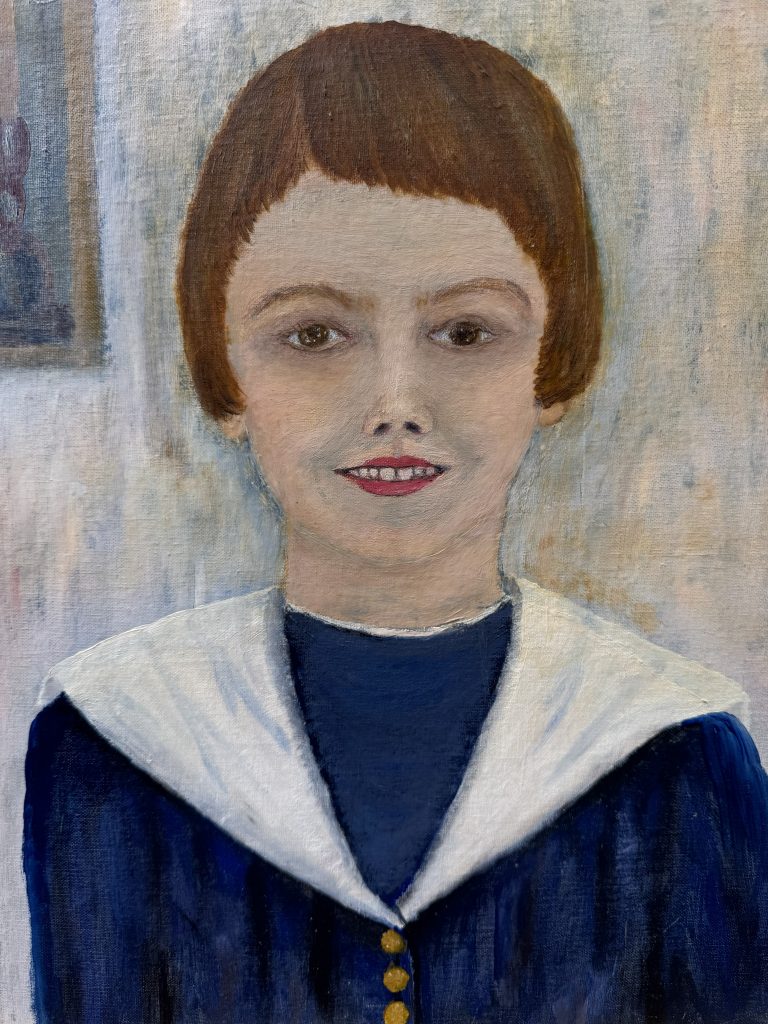
Like I said, she loved me, but as it turned out, portraits were not her forte. More successful were the landscapes and florals she sold at community art shows. She’d part with a few, but many she couldn’t let go of. These were her babies, my inanimate siblings that multiplied like rabbits in our house.
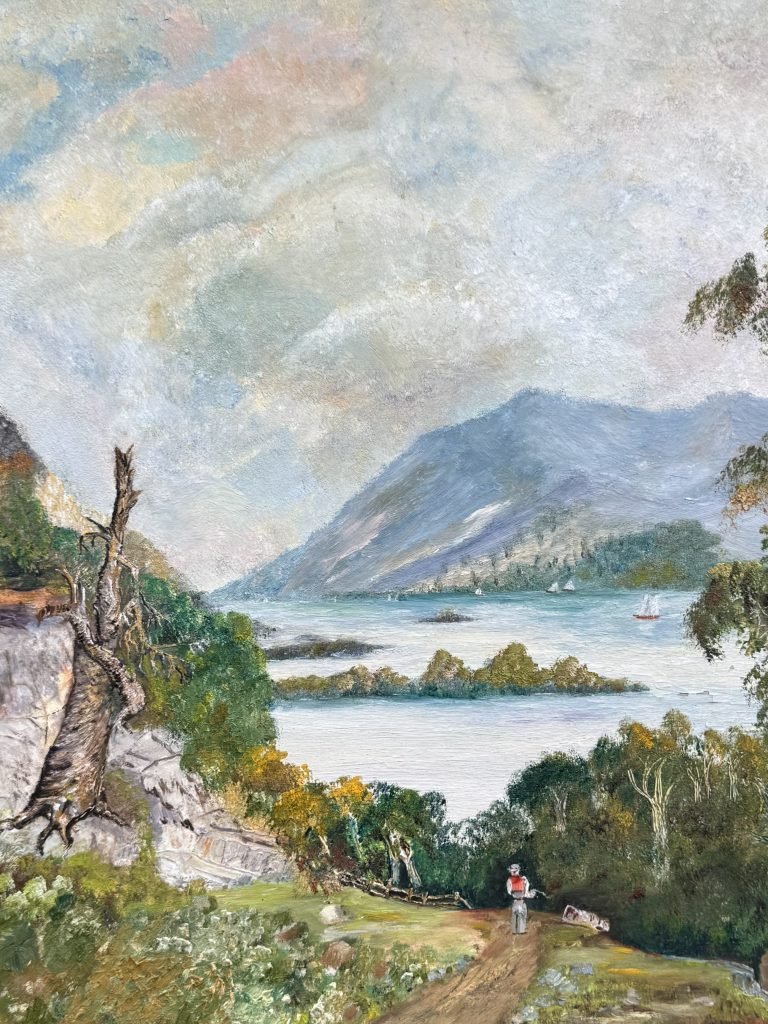
Art was not for me. It was my mother’s “thing,” and I would not compete. She begged me to take lessons, tried to teach me perspective, and bought me a box of messy pastels. But as I said NO for what felt like the fiftieth time, she continued to paint.
She took classes with professionals, experimenting with styles and non-traditional media as she became more and more courageous with her brush. Her shy attempts at copying realistic florals blossomed into poetic expressions of impressionism, measured cubist designs, and wild rants of abstraction. Oil, acrylic, watercolor, ink, ripped paper, sand… she played with it all.
“We’re running out of room.” I complained repeatedly. There were already dozens of paintings hanging on every wall of our house, tucked into every closet, and hidden away in the eaves of the attic. “What are you going to do with all these?” But my questions were of no concern. This was her joy.
*
The picture suddenly shifted when my dad died of a heart attack. I was ten years old.
People said it was “too much red meat and a sedentary life that killed him,” but I’m sure Pall Mall cigarettes didn’t help. The shock of his death jolted me out of my childhood and placed me on a fragile carousel of uncertainty. But Mom held firm, and somehow we carried on. With his Social Security benefits, a small teacher’s pension, and little thanks from me, she managed to keep us in our home and get me through school by working at a number of low-paying jobs: first in the elementary school cafeteria and later at a nearby nursing home.
She never spoke to me about money. Not then and not ever. But years later, she started showing signs of disenchantment with the status quo. It was long after I finished graduate school, well past my first job, that she approached me with her great idea that I should be her manager.
“I’m an artist,” she said with pride. “You are an excellent salesperson. We should go into business together.”
I shouldn’t have been surprised that Mom was itching to make some real cash by selling her art. If I was paying attention, perhaps I would have noticed that the physical challenges of setting up exhibits and dragging paintings around to art shows were taking their toll on her by the age of 63. From her point of view, I was young, full of energy, and struggling in my chosen field. Working together just made sense to her.
But to me, it made no sense at all. I was just starting my career as a production assistant for videos and films, with no relevant experience other than door-to-door Girl Scout cookie sales. She couldn’t possibly want to sidetrack me from my chosen path to start selling her artwork, could she?
I did not mask my annoyance, and with great guilt that still haunts me to this day, I said NO (again). No—to the woman who scrimped and saved to put food on the table, clothes on my back, and got me through school.
“Mom, I have to follow my own path,” I told her. I had my own dreams. My own career. My own interests. And I shared none of hers.
She never let on how disappointed she was. And I never told her how badly I felt turning her down. But still, she kept painting.
As the years went on, Mom became increasingly artsy and eccentric. While I was reading BackStage magazine, looking up casting calls for movie shoots in Manhattan on the chance they’d need an assistant in the production office or on the set, she was reading Prevention, cooking liver with fried onions, and expressing herself. She stretched her own canvases, painted pictures of fried eggs on the kitchen table, and planted 33 1/3 long-playing record albums in the vegetable garden as fencing, while growing tomatoes in the hibachi. She wore weird glasses, grew her white hair long (which I begged her to cut like other moms), and dressed in brightly colored polyester pantsuits. She even had a shocking pink beret!
My friends would marvel at her weirdness, and I would swallow my embarrassment. But I wonder now: Was I developing my own eccentricities as well? I found myself looking for something I could be equally enthusiastic about. First it was eastern religion. Then I started playing violin seeking out Irish Céilí bands in Manhattan. I picked up figure skating with knees that never bent quite enough. And around the same time, I jumped in headfirst to start my own video production company. I spent decades at each of these pursuits. I pushed forward and practiced well, not even realizing that I was following the example my mother set.
*
In 1989, Mom died from colon cancer at the age of 76 and left me her house full of paintings and a mountain of guilt. I should have done more for her. I cried as I sifted through her stuff, each drawer a sliding puzzle piece. I sold mostly everything in an estate sale, only I couldn’t bring myself to sell the art.
In carload after carload, I brought the paintings to my own home, hanging the ones I loved most and stacking the rest in the attic like old library books. My husband understood. He’s kept every birthday card and Valentine I’ve ever given him. So, he gets my emotional connection to the art. Each piece, created by my mother’s hand, triggers a memory for me, like a flashlight shining through a filmstrip of my life.
I often wonder what will happen to it all when I’m gone. I can’t expect anyone else in my family to be as attached as I am. Most likely, it will be hauled away to Good Will with the rest of my “stuff.” It’s just canvas and paint after all.
But while I live, it’s more than that. She breathed life into her paintings with every brushstroke, and her legacy, as a gift to me, has become a lasting reminder of a life well-lived. No, I was not my mother’s manager, but I am her biggest fan. And for both of us, that has to be enough.
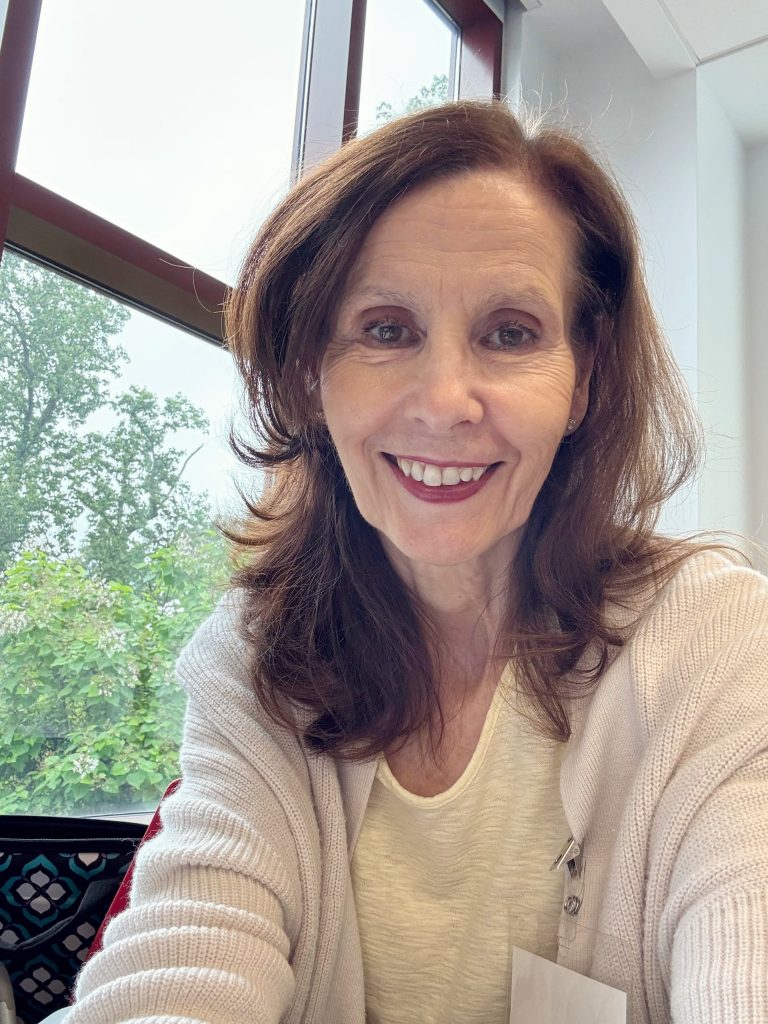
Marilyn Petrokubi is a librarian, essayist and fiction author of middle-grade fantasies. A graduate of Rutgers University, School of Information and Communication with an MLS degree, she is founder of TimeSteps Productions, Inc., a video production company. Marilyn lives in West Orange, NJ with her husband, Rob, and their support-cat, Miskit (short for Miss Kitty.) Their grown son, Matt, is making his own stories, sharing his heart, and rocking the world one day at a time.
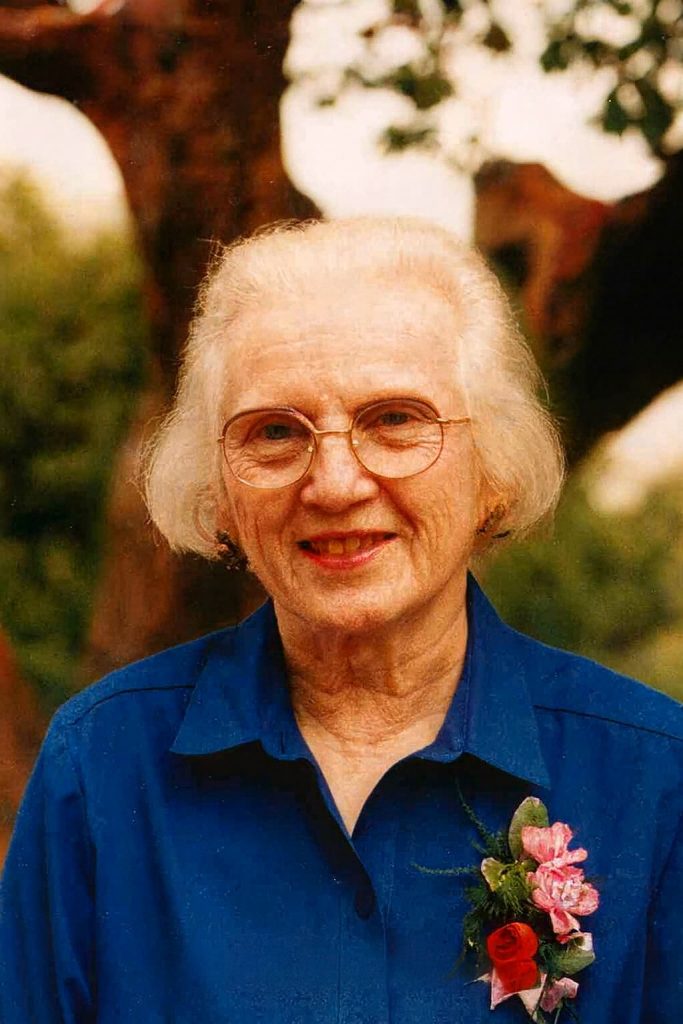
Mary Butchkosky Petrokubi (1912–1989) was a respected New Jersey artist known for her award-winning watercolor, mixed media, and oil paintings. She exhibited widely with the Livingston Art Association, Visual Arts Center of New Jersey (formerly Summit Art Center) and New Jersey Watercolor Society, earning consistent recognition for her technical skill and contributions to the regional art community. She was married to Stephen Joseph Petrokubi with whom she had one daughter, Marilyn.