A Review of Michael e. Casteels “Furthermore, the Lake”
by LIT Social Media Editor, Grace Dignazio
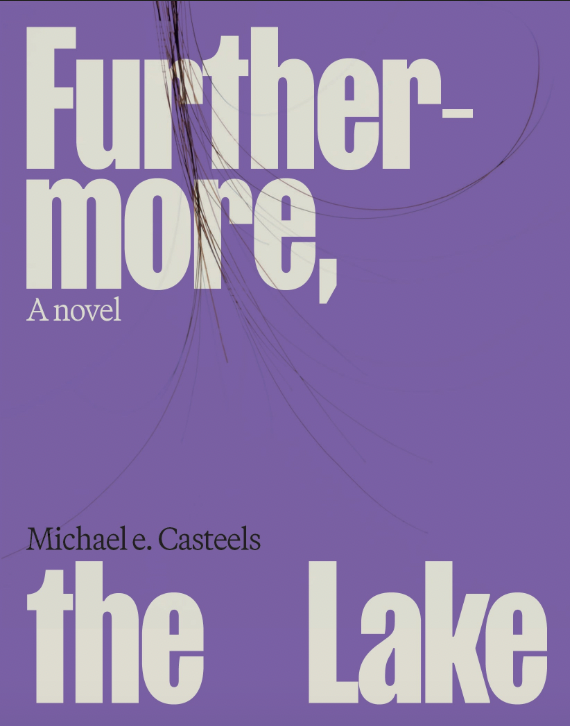
Michael e. Casteels’s Furthermore, the Lake is a stunning traversal of a haunted cityscape, narrated by a deeply disoriented, unnamed speaker. Straddling prose-poetry and surreal narrative, the text conjures a setting at once recognizable as New York City and then not—rippling like memory itself: unstable, refracted. The narrator wades through subway cars and foggy streets in a dreamlike state of liminality, his identity a muddled reflection.
The early vignettes usher us into his psyche as he moves through the banal rhythms of daily life—commuting, ordering breakfast—where anxiety quietly laps at the edges of routine. Even a choice between muffin or scone threatens existential collapse. Casteels captures this with sharp, surreal clarity, showing how the smallest decisions can spiral into ontological doubt.
The pulse of the novel lies in Casteels’s treatment of doubleness and dislocation. The speaker exists in constant conflict with both self and environment, eerily aware of their splintering identity yet unable to reconcile their myriad selves. This fragmentation of self—at times echoing the dissociative logic of Apple’s Severance—generates a prickling sense of the uncanny, prompting us, alongside the speaker, to reconsider the spaces we move through and the selves we perform:
A man looking out a subway window, catching his reflection in the glass—the words above his head read ‘You are Who?’ I didn’t know what it was selling. I looked out the window, caught my reflection looking back, likely reflecting on that very same question. (10)
Here, the speaker’s doubling with his own reflection blurs interiority and environment. The signage above him becomes less advertising and more interrogation. Identity is no longer a fixed center but a question hovering just out of reach.
Casteels’s prose shifts deftly between stark interiority and haptic, sensory renderings of the speaker’s encounters with the natural world. As the title suggests, the lake emerges as a central metaphor, not only for escape but for the turbidity and amorphousness of the speaker’s whirlpooling thoughts. It is at once a reflective surface that invites contemplation and a murky, destabilizing force that threatens to pull him under:
Deep within the lake exists the inside of my head. I look up into the blue. Everything is a mirror. Some days I’m a frog. Some days I’m the lake. Some days I’m the blue. (54)
Contributing to the underlying sense of disarray and disorientation is the prolapsing of time, where memory converges in nonlinear ways, and the ‘present’ becomes layered in dreamlike unreality. In “that space between tick and tock,” a temporal distention forms: pockets of alinear existence, in which the speaker is trapped, struggling to chart a navigable path either backward or forward. It is this utter strandedness that feels so uncannily familiar—the sensation of waking and suddenly wondering When did I arrive here? How did I become this version of myself?
For the speaker, there appears to be a tentative solace in the possibility of (re)construction—that is, in the uneasy attempt to assemble multiple selves and cast forward a vision of who one might become. In the novel’s final moments, the recurring tension of doubleness takes on a new shape: the act of observing oneself from the outside provokes a fragile reckoning with transformation as the speaker hurtles into the present:
My feet started, and I followed them onto the train and down the aisle. Every seat was occupied by me—a younger me, an older me, a ghostly me, a woman me, a you me…
I selected the last vacant seat and sat down, pressed my hand to the window. With one loud wail, the train hauled me toward the present. (91-92)
Attuned to the strange, quiet ruptures of the self, Casteels weaves a text that, above all, feels profoundly relatable. Furthermore, the Lake offers an unsettling yet poignant reflection on our multiplicities and the negotiation of selfhood amid the disorienting currents of late-stage capitalism. In doing so, Casteels captures something essential about what it means to exist in an era marked by uncertainty, flux, and the ongoing search for coherence within fragmentation.
Furthermore, the Lake by Michael e. Casteels is published by Guernica Editions, March 1, 2025
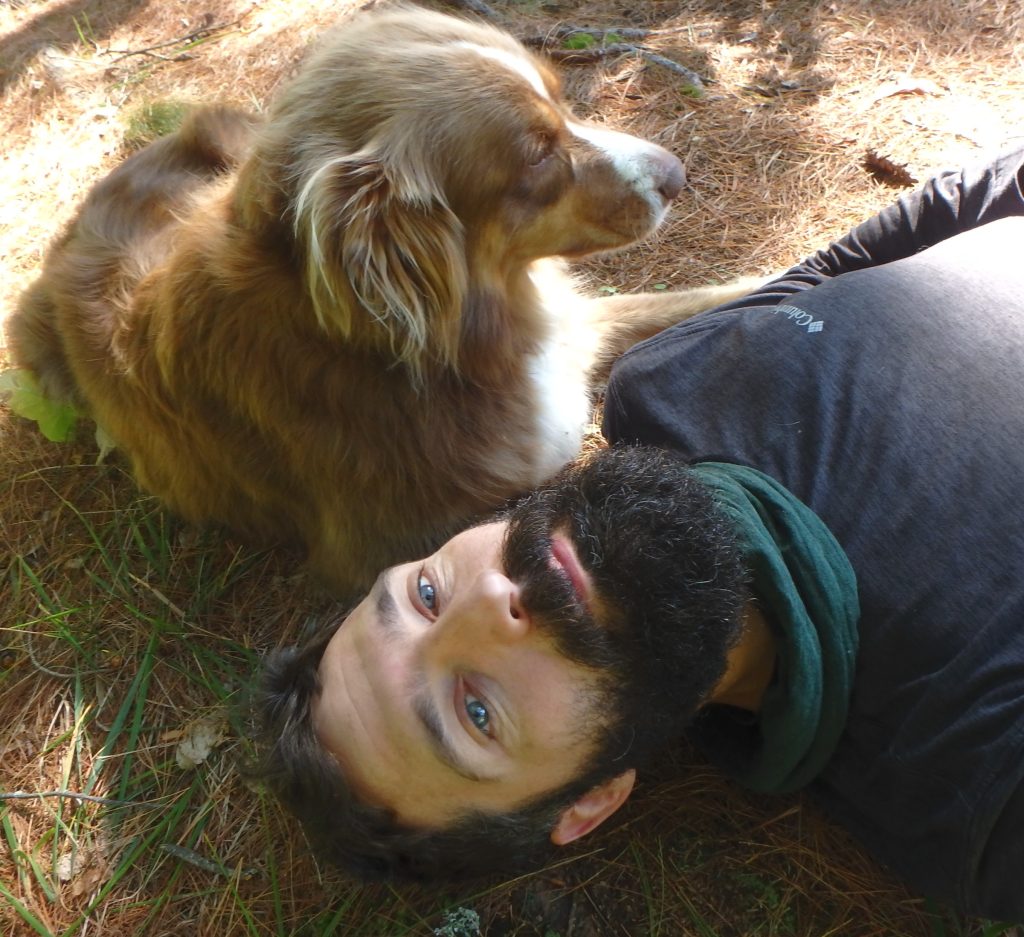
Michael e. Casteels is a writer, musician, collage artist, outdoor enthusiast, part-time massage therapist, and stay-at-home dad. He is also co-curator of the Arbitrary Islands Island Archive, a library on Lumpy Denommee’s Island. His work has appeared across Canada and internationally—most recently, the collage Westerns ONDO (nOIR:Z, 2022) and The Man with the Spider Scar (Puddles of Sky Press, 2020). His poetry collection The Last White House at the End of the Row of White Houses (Invisible Publishing) came out in 2016. Michael is the editor, designer, and bookmaker at Puddles of Sky Press in Kingston, where he lives, as he has for the majority of his life, within walking distance of Lake Ontario.