My Father, Still
by JV Dias
art by Virgil Suárez
January 8, 2023[1]
I – 09:15 AM – WAKE UP!
My father enters the room in a disordered manner. The door swings open with excessive force, slams against the wall, then recoils a few inches, trembling before surrendering to the weight of its own wood. The impact tears me entirely out of sleep. I do not wake gradually, but all at once, my body rigid and my heart racing from the shock. For a few seconds, I do not know where I am. The ceiling, which I recognize every morning, seems displaced. The strip of light escaping through the gap in the curtain suggests that the day has barely advanced.
My father remains by the door, breathing with an intensity that suggests urgency, although there is, apparently, no fire, robbery, or death in the family.
“Get up,” he says, without preamble.
The word hangs in the room with enough authority to make any further explanation unnecessary. He is already dressed in the green shirt that only leaves the closet on specific occasions. Though not special, there is something ceremonial in the choice of clothing, a care that contrasts with the abruptness with which he wakes me.
I rub my eyes and sit up in bed. My room, which the night before had seemed too small for my thoughts, now feels too exposed to his presence.
My father was never prone to physical intrusions. Fortunately, he respects closed doors, knocks before entering, and precisely because of that, the violence of the gesture acquires an importance that perhaps even he does not recognize.
“Did you forget?” he asks.
I do not answer immediately. The question is not accusatory, but it carries an expectation that embarrasses me. Then I remember the conversation from the night before, the words mixed with enthusiasm and warning.
“I’m getting up,” I finally say.
He nods, satisfied, and fully enters the room, walking around the chair where I had left my clothes thrown. He opens the window without asking permission, and the morning air invades the room, cold enough to remind me that I am still in my pajamas. Outside, in the distance, I hear an impatient car horn. The city woke before I did.
My father looks toward the horizon visible between the buildings and, for a moment, his profile seems illuminated by something I cannot immediately identify. Pride, perhaps. Or anticipation. He turns back to me with a half-smile that does not quite reach tenderness.
“You need to see this with your own eyes,” he says. “A man has to know where he was when things changed.”
The sentence hangs suspended between us. I am sixteen years old and I do not consider myself a man, though he insists on the word whenever he wants me to take part in a decision he has already made alone.
II – 02:05 PM.
There is a moment before the gesture that is rarely narrated. A moment still devoid of action, retreat, or choice. It is only a suspension, an invisible fold in the fabric of experience. It is there, within that minimal interval, that I find myself. We walk.
The city offers itself openly, horizontally, with its broad axes and calculated distances. It has always seemed to me that Brasília was built for oaths. There is something in its lines that demands posture, something that compels the spine to straighten.
My authorities maintain a regular and steady pace. I never see them hesitate when crossing a street, parking the car, or shaking someone’s hand. The owner of my surname functions like an instrument tuned by certainty, a discreet mechanism that never loses tempo. Beside him, I move at another frequency: delayed reverberation, an echo that understands the sound only after it has already been emitted.
There is so much noise.
I remain squeezed between strangers. Even so, I keep pace with the movement. That collective machine absorbs me, and I avoid disrupting its order. Breaking from the contagion feels impossible. When someone slows down, the flow corrects it. When someone stops, the gentle shove of the crowd resolves the hesitation. I realize, then, that the city and the multitude share the same principle, both designed for alignment. Thought arrives after sensation. First comes the warmth of nearby shoulders, the involuntary collision of arms, the shared breathing. It is a closeness that dispenses with intimacy. Individual recognition becomes irrelevant. It is enough simply to occupy the same space.
Alone, I know my limits. I know the width of my shoulders, the reach of my voice, the extent of my breath. There, compressed among so many others, those measurements lose precision. My voice, blended with the others, gains thickness. My step, added to hundreds more, becomes the mimicry of a giant. A diluted presence acquires volume. That dimension depends on the flow. A single step backward would be enough to restore the old smallness. The dependency remains silent and obvious. Growth has conditions.
A group ahead begins chanting slogans; the rest respond. The sound travels through the moving mass in waves back and forth. The unison lacks perfection, yet still creates rhythm. When someone raises their voice, the others adjust their volume. I find myself shouting too. The phrase comes easily, repetitive, simple enough to fit in any mouth. As we advance, the government buildings appear in the distance, small yet recognizable. White architecture, straight lines, domes. The hairs on my skin rise, and they are shouting the name of God.
Then, in the distance, the straight line opens. The Esplanade reappears in architectural revelation, ministries aligned in disciplined sequence, white mirrors beneath the sun. At the far end, the geometry of Congress: twin domes, one concave, the other convex. The boundary between symbol and matter seems subjected to a test. Buildings designed to represent balance now stand before an energy that exceeds symmetry.
The barricade emerges. Metal fences aligned in rows, agents holding transparent shields, helmets closed. The line imposes itself, straight and unmistakable. The contrast between the organic flow of the crowd and the rigid mathematics of containment takes on an aesthetic quality.
The march slows. No one wants to make contact first. Even so, the advance continues. Those behind keep walking and press against those in front. Within minutes, only a few meters remain. The final distance transforms into static pressure. The air grows heavy. The sound echoes between the official buildings, amplified by concrete. The compression intensifies. Shoulders press against shoulders. My mother grips my shirt tightly.
On one side, us. On the other, them. I accept the division easily. The thought emerges that every gathering carries, within its invisible fold, the possibility of a gesture that no one would assume alone. By myself, I would have stopped many meters earlier. The owner of my surname does not stop. I follow. In that instant, I understand something about greatness. It is a matter of scale. When a gesture is repeated, the movement acquires importance.
There is something profoundly human in the desire to belong.
III – 03:46 PM.
We enter the space and, against the white wall, a small group approaches one of the surfaces and, with a container of black paint, quickly writes a phrase in large, irregular letters: “INTERVENTION!” And as soon as they finish, they throw the can upward, letting the paint spread through the air, splatter across the walls, the ceiling, the floor, even onto people. The youngest of the officers is covered in it, and my forearm becomes almost entirely coated in the dark color. It is cold.
We keep moving. Along the way, tables are overturned, vases thrown to the ground, plants trampled. Telephones are ripped away. I even see my father, André, doing it. He pulls a fire extinguisher from the wall and releases it, the red cylinder pressed against his chest and the hose in his hand, finally breaking away from me. Foam spreads everywhere. I watch him run, trying to enter a room, but the door is locked. He steps back and kicks it with an aggression I have never seen before. Three consecutive kicks until the lock gives way and the door flies open. I hear the foam spraying and, when I approach, the desk, the computer, the chairs are all submerged beneath it. He leans over the desk and sweeps his arm across it, knocking everything to the floor. The monitor is dragged along and hangs by its wire, striking the side of the desk. With the shell of the extinguisher, he smashes the corner of the desk and breaks it apart.
I cannot do anything. I only watch him. There is no fury on his face, only indifference. When I see that he is about to turn around, I step away from the doorway and retreat to the middle of the corridor, where I then watch him continue walking and throw the empty cylinder against a painting on the wall.
The lighting comes from continuous strips across the ceiling, spreading a uniform brightness that creates no deep shadows, only a constant clarity that accentuates the sense of spaciousness and seems to play against the bluish floor. The walls cease to be clean and pale. They acquire smears of dirt, shoe marks, because they are kicking even the walls, interrupted by panels and visual works that introduce color. But, like André, the others are attacking too. All of them are undone.
Standing still, I watch him move on and, moments later, another young man appears and pulls a large painting from the wall. It is a geometric composition of broad planes of color arranged in angular forms intersecting in clean diagonals. The colors are saturated. Blue, red, yellow, and green. Once the artwork is on the ground, he takes his keys from his pocket and, holding the car key between his fingers, strikes it. He drags the key across the canvas, tearing it open.
I run, trying to catch up with my father, but the size of the place makes it impossible to know whether I can still find him. So I move toward wherever the greatest turmoil emanates. The chamber opens in a wide semicircle, organized in curved rows of desks and chairs facing the larger table at the far end. I see two men dancing on top of it. The space is dominated by rigorous geometry and a restrained palette… shades of wood, black, and beige repeating themselves in controlled fashion, reinforcing the institutional atmosphere. At the upper center of the main wall, behind the command table, long and narrow vertical panels rise upward, interspersed with small green and yellow rectangles.
I see one of the desks being struck repeatedly. The impact is dry. At the sight of it, my mouth involuntarily parts open. The movement of the arm changes rhythm, and only when the hand rises again do I perceive what had escaped me before. There is blood. He punches the desk again. I do not know whether he is breaking through anything at all. The scream comes next. The man steps half a pace back, instinctively shaking his hand, the energy around him faltering.
Someone brushes against me, nearly knocking me over, and behind him more people flood into the space. Two of them carry iron bars. One is thrown toward the panel behind the great table. It is at that moment, following the arc of the metal through the air, that I realize one of the men dancing on the table is André. Beside him, another man balances himself on the same surface, laughing loudly. Between the two of them there is an improvised coordination. One looks, the other understands. One climbs farther forward, the other clears space with his foot. I remain incredulous until the decision takes shape.
Abrupt movements beneath their clothes, and the two turn toward the front of the table with a shamelessness that petrifies me. For one absurd instant, it seems as though nothing exists outside that room. A pale yellow stream runs across the polished surface of the presiding table, carving its path among the displaced objects. The other man follows almost at the same time, side by side with André, laughing as they deliberately urinate there, turning it into a spectacle.
I feel my jaw lock. I leave the room. Near the entrance, I press myself against the cold wall and try to draw air into my lungs, as though I needed to relearn an ancient mechanism. It does not come properly. My chest works in short, irregular motions. Because there had been no blind fury on André’s face. No visible loss of control, none of that collective vertigo that sometimes allows the body to claim ignorance afterward. There had been choice in the banality of the gesture.
I rest the back of my head against the wall and close my eyes for a second that provides no rest at all. The sentence returns whole, insistent. It was him. And at the same time, something inside me refuses to accept the simple equivalence between the face I know and the man I saw moments ago standing on that table. That fatherhood feels utterly foreign to me. There is a strange pressure in my chest.
It cannot be that somehow it belongs to me too, that it crossed the boundary and left inside me this strange residue, while the scene still breathes within. A part of me insists on pushing everything into the bubble of unreality. And so refusal becomes the only possible path. Beyond denying what happened, I seek to preserve some internal continuity, some idea that it is still possible to separate clearly who someone was from who someone, under certain conditions, decides to become, as though recognizing the excess already came accompanied by a kind of prior surrender.
The problem is that the scene insists.
IV – 10:37 PM.
I lay the phone against my chest as though trying to restrain a small, electric animal. It still vibrates in my memory, not in matter. I stare at the ceiling, that white surface that offers no response, and let the air conditioner pass through me with its disciplined coldness. The cold is precise. My heart is not. It beats like an old gate: it jams, groans, then suddenly gives way with a snap that sounds like a decision made too late.
It is him.
I repeat it, but the sentence refuses to settle. It continues repeating itself in constant succession inside my mind. Not to confirm anything; the image has already confirmed itself. It serves only to measure distance. Between the man in the video and the man who taught me how to tie my shoelaces. Between the man from before and the man who walked past me in the living room just now. There is a distance so vast that space itself becomes distorted, and suddenly I have learned to judge.
It is him.
It is him. It is him.
It is him. It is him. It is him.
It is him. It is him. It is him. It is him.
It is him. It is him. It is him. It is him. It is him.
I close my eyes and the hall returns. An unannounced invasion. Overturned benches are animals with their legs turned upward. The floor breathes shards. There is an echo that is not sound, but suspended gesture. Yesterday, I could not have imagined this. Eve, that antechamber of the event. The day that has not yet become itself. The instant before the door opens. Today is still eve.
Tomorrow, perhaps his face will move across screens with the speed of things that burn. Perhaps the word “repercussion” will cease to be abstract and sit with us at the dinner table, lean against the salt shaker. Perhaps someone will say his name aloud. Perhaps my own name will come attached to it, dragged behind like a shadow I never asked to inherit. There is no longer the comfort of doubt. Doubt was a kind of thin blanket. Truth is metal.
We will all be looking at the video and saying the same thing.
It is him. Entirely. Concentrated. My father.
The word “father” weighs differently now. It emerges soaked in another substance. I stand up slowly, because any sudden movement might make the world realize that I know. I open the door. The hallway is a tunnel of disciplined shadow. There is a faint light tracing the crack beneath their bedroom door. Or perhaps I invent that light so I do not have to admit complete darkness. I stand there listening to the silence the way someone presses an ear against another person’s chest to know whether there is still a heartbeat. The house breathes. Refrigerator. Pipes. Filtered wind. Nothing betrays itself.
I return to my room. I do not knock.
Between knocking and not knocking there exists a small and definitive abyss. I choose the side where I can still pretend I did not see. I lie down again. The phone is silent now upon the desk. But inside me the video continues to play, frame by frame. I think about that crowd of people. Alone, would he have chosen the extinguisher? Or was it purely the invisible chorus guiding the gesture? It does not matter. The camera captured his face. What must pass through me is something else: the awareness that tomorrow will not resemble today.
My father. My father. It is him. My father. It is him.
My white skin has never seemed so white as it does now beneath the strain of holding back the scream. It is almost a fright reflected in the wardrobe mirror. Shame acquires cold temperatures. The video opened the house. Opened my face. No wall remains.
Father, all those people who killed you must be sleeping now, I think. I do not correct the sentence. What I thought would be my personal bard is scattered across the internet now, and I will have to share it with strangers…
The crowd spilled outward. It passed over everything that stood firm. It tore away whatever lacked deep roots. Some things remained crooked, wounded forever; others vanished entirely, dissolved. Later someone sweeps. Washes. Straightens the chairs. The grass grows again, blind and obedient. They call this order. The camera shows only what gleams, what shines. History preserves only what fits within its frame. The crowd wants spectacle, dried blood. The rest rots outside the image. And you, Father, remain absent in the middle of all this. Your name will not remain there. What will remain is our memory. The story here, of what still survives.
I always believed crowds were made of accumulated matter. Now I realize they are made of permission. One man approaches another and suddenly the gesture that was once unthinkable acquires thermal authorization. Heat distributes itself. Responsibility dissolves like sugar reflected in hot coffee. In response, your death does not explode or announce itself. It infiltrates, silently, like urine sinking into wood, leaving a yellowed stain behind. Beyond that, the captive evil you carried did not leave with you. It remained suspended in the air, trapped in our flesh and our memory, a presence coiling itself within the body’s shadow.
“God is brazilian[2]” The phrase returns without grace and without faith. I think of Cain waking the next morning with his hands still warm. And now that phrase settles over everything, carrying an entire history compressed inside it.
I kneel. The floor is hard. I rest my forehead against the bed.
“Lord, sometimes I have the impression that I end at the skin, but other times I spread without noticing, and my fear barely fits inside this room. Then, without my permission, it expands, while my will is usually born small, yet there are days when it encounters other noises and, before I realize it, I can no longer distinguish what came from me and what merely passed through me. I fear the exact second when everything seems displaced and the sensation arises that something must be compensated for, though I do not know by whom, nor whether by me, and that second is discreet and fertile, entire projects can fit inside it. If that moment visits me, Lord, teach me to recognize it before I begin calling it justice, because what I want is rest. I want someone to draw clear lines upon the ground and say: it is here. I want an explanation that surpasses me and at the same time shelters me. I realize I possess too many longings. But I have also realized that when one desire encounters other desires, the sum can become something else entirely. Even so, there is hope. Not the hope of victory, but of interruption, of accepting one’s own smallness without transforming it into a scream. I wish I could allow shame to serve me as measure rather than mask. I oscillate, Lord; I ask for justice and immediately distrust what I myself understand as justice. I desire peace and discover that I only recognize it after something has already broken. So do not let me learn through ruin what could have been learned through lucidity. If there is within me a ground that trembles whenever many footsteps approach, steady it. If I am a construction too proud of its own lines, incline me gently. If I carry echoes whose origin I cannot identify, grant me enough silence to distinguish between what is voice and what is mere repetition. Unfortunately, I cannot say I was innocent, and because of that I must learn how to think within refusal itself. And as for my father, Lord, I do not know how to pray for him without judging him, so I pray anyway, confused. If he was blind, let him see; if I was blind, let me see more clearly. Do not let me love less because I disagree, nor disagree out of fear of losing love. Stay with me in the interval, because it is there that I exist, and I do not want to pile up reasons until no one else can stand beside me. If there is within me the temptation to stand above someone else, diminish me. If fear seeks a noble disguise, reveal it before I applaud it. Protect me from the comfort of being right. I am small, Lord, but what I feel sometimes seems far too vast, and because of that I must ask You to organize the mixture. Amen.”
Eve is this: the final day of possible ignorance.
V – 00:01 AM
The land said to be ours may never truly have been one of clean possession or tranquil belonging, but rather this other one, emptier than promised, made of a forced coexistence between what we can grasp and what still slips through our fingers; a land where one walks already aware of one’s own incompleteness, where the life called beautiful does not shine but persists, continues breathing softly even when justice arrives crooked and affection always comes mixed with residue. And: men are killed, paintings destroyed, streets infested, houses left barren and, without even brushing against the center, the sovereign escapes. Perhaps the deepest weight resides precisely there, in that untouched nucleus while we, at the margins, continue trying to fit ourselves inside it. There, still with the face turned upward, the body recognizes itself as small, and recurrence no longer frightens it. Recurrence no longer terrifies me, nor this constant rediscovery of the notion of everything. After all, the world, stubbornly, insists on presenting itself again. From this gentle fatigue is born the silent permission to continue.
Sleepless, there is nowhere to go except toward the other scene, the larger one. The crowd climbing the concrete ramps. There is a particular geography whenever many bodies desire at once. The geography of the multitude is the engineering project of the Tower of Babel. Brick upon brick, language upon language, a project of ascension whose ambition was not to destroy heaven but to reach it. Error petrifies itself in unanimity, in the sophisticated, and therefore more dangerous, belief that many people together purify the impulse. It is, in the end, the imprescriptible danger of the crowd itself. That driving force transforms what, in one man, would be recognized as a breakdown into a movement when multiplied by thousands. What alone would resemble loss of control acquires aesthetics in the mass. There is an almost liturgical seduction in the idea that ascending together makes us purer. Perhaps every collapse begins this way, in the comfortable illusion that resentment itself is sufficient foundation upon which to erect something lasting.
Perhaps true judgment does not fall upon the act itself, but upon the language that sustains it. Upon that intimate grammar that renames hatred as zeal, that calls cruelty toward what I do not understand a defense of order, that shelters resentment beneath the varnish of protected faith, under the fallacy that protecting God were the same as authorizing myself to wound. Upon the body of the other, which does not belong to me and which, because I fail to understand it, I declare impure, impossible to embrace. Upon the Abel who bleeds not only from the hand that strikes him, but from the narrative that transforms his death into historical necessity, all in the name of the private justice of a man who imagines himself too pure to recognize, within his own chest, that which lies at the door waiting only to be given voice.
I try to decide upon the sentence that persecutes me and fail. I helped write that instant of violence. My father urinated upon a table. Panic persists. And in the middle of all this, love still seems capable of finding a place. In the end, he is my father. Still my father. Shame, yes, but my father.
[1] January 8, 2023, was the day when supporters of the then far-right former Brazilian president Jair Bolsonaro invaded and vandalized the nation’s capital in response to the results of the 2022 presidential election and Bolsonaro’s defeat to Luiz Inácio Lula da Silva, attacking the headquarters of the Three Branches of Government in Brasília.
[2] The phrase “God is Brazilian” references the song “Sujeito de Sorte”, by Belchior. In the song, the expression carries an ironic and melancholic tone rather than patriotic celebration. Belchior invokes the phrase while reflecting on historical exhaustion and the fragile hope that persists in Brazilian life. As a reader unfamiliar with the cultural context, you would probably not immediately recognize the reference, because “God is Brazilian” may sound merely like a literal statement in English. In Brazil, however, the phrase has become culturally loaded: it suggests the idea that the country survives almost miraculously despite chaos, inequality, violence, and recurring crises.
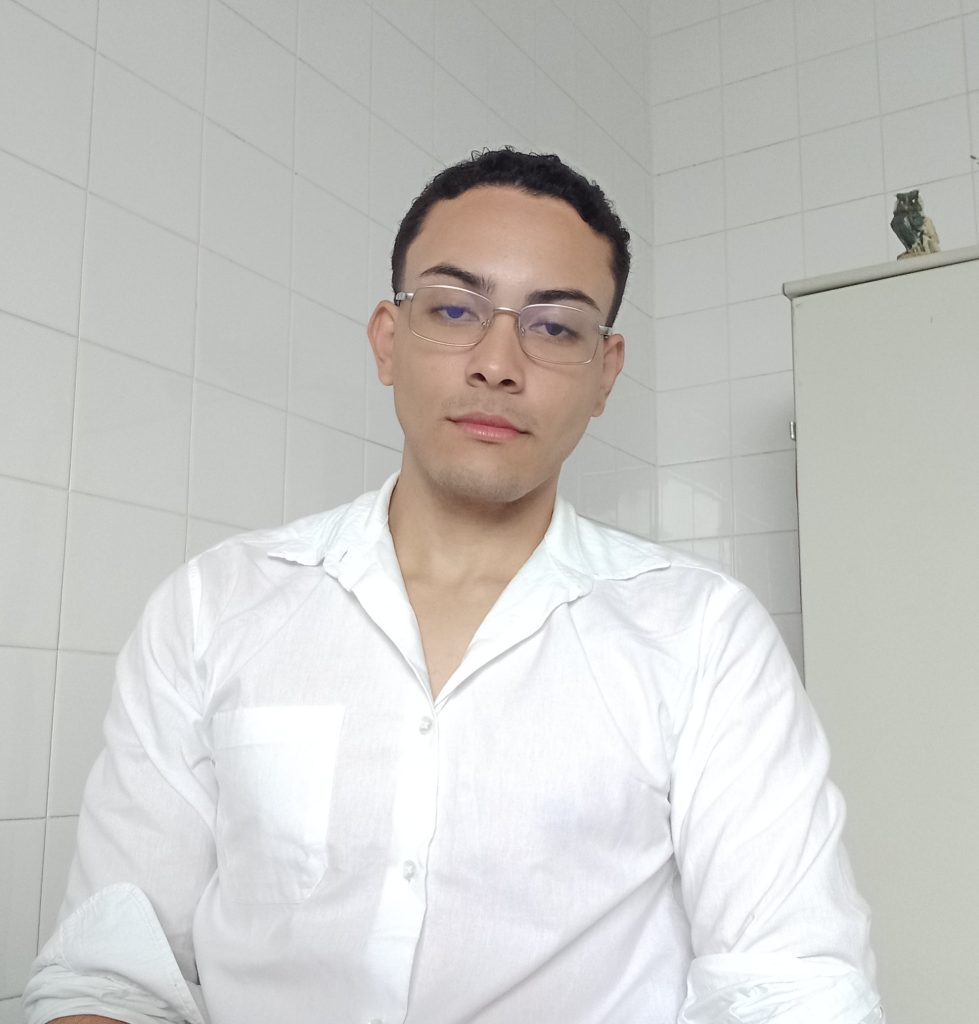
JV DIAS is a Brazilian writer. He is currently pursuing a Law degree at the Universidade do Estado da Bahia (UNEB). In 2023, he made his literary debut with the poetry collection My Emotions Are Dawn Nights.
Instagram: @jovidiol
Virgil Suárez was born in Havana, Cuba, in 1962. At the age of twelve he arrived in the United States. He received an MFA from Louisiana State University in 1987. He is the author of eight collections of poetry, most recently 90 MILES: SELECTED AND NEW, published by the University of Pittsburgh Press. His work has appeared in a multitude of magazines and journals internationally. His 10th volume of poetry, THE PAINTED BUNTING’S LAST MOLT, was be published by the University of Pittsburgh Press in the Spring of 2020. He is also the recipient of a National Endowment for the Arts Grant and an Individual Artist Grant from the State of Florida and a Latino Book Prize.