Cliffside
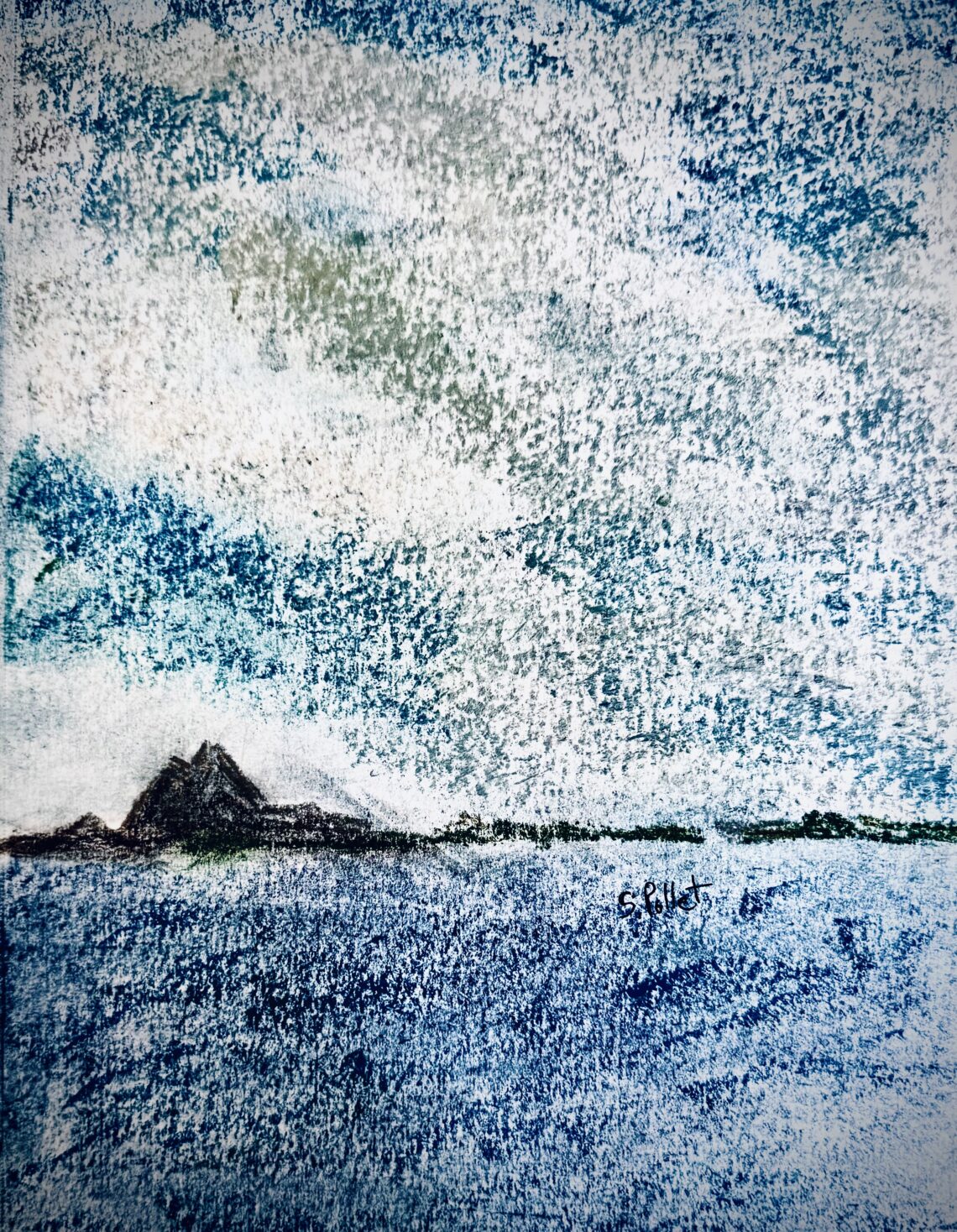
art by Susan Pollet
by Roan Regan
The lake was black, its surface rippled and torn by jutting rocks. Islands were speedbumps in the smooth eyeline that stretched to the sprawling, clean lawns of cabins. Wild forests abutted their properties, threatening to overtake with their unorganized yet elegant, curly-headed blueberry bushes.
At the time, I kept my hair short, as I have most of my life. The hair stylist at the mall couldn’t make sense of my curls, blaming cowlicks and poor maintenance. They clipped and tucked each lock in an effort to feminize the cropped cut I requested. My hair jutted out at odd angles from my face, greasy and unbrushed. The lake water and sweat created a pomade which allowed me to press each strand skyward between my fingers, unburdening my head.
Nell had one of those paddle boats powered by kicking your feet, operated half-distractedly as your free hand swiped away errant spiders tickling your knees. It was bright red, bleeding the twig-laden sand as we pulled it across the small beach at the edge of Nell’s family property.
Ian—Nell’s baby brother—dragged his feet behind us as we spoke.
“You see the island over there,”
I extended a piano-player’s boney finger towards the rock which peaked its slick, wet, head above the black. It was flushed, compared to the greyer rocks around it, adding to the singularity that Nell and I ascribed to it.
“That island,” Nell pointed, “is cursed.” Her eyes flared wide as she bent her own sandy head down to his eye level. Ian guffawed, rolling his eyes, landing them squarely on the rock once more with uneasiness.
“No way. That’s not even an island. It’s way too small.”
“That’s because it was mostly destroyed,” I added, peaking my head into the footwells of the pedal boat for insects which I not-so-secretly abhorred. I tried to hide this weakness from Nell, on account of her immense bravery.
I wish I could remember the witch story we weaved that day in its entirety, I do remember a fresh-water folk tale interpolated from Grimm’s fairytale books I read as a kid. Not the overly sanitized ones—I read from a book with a pastel illustration of the little mermaid reduced to a pile of seafoam on the shore by the end of her story.
My inspiration for our watery witch story was the craggy cliffside to my right—the roots of trees and plants hanging victim to erosion and centuries of rising and falling water-levels. Once, when scaling a section of that cliffside barefoot, I sprained my toe landing on it with full force. I split it open and bled all over the white bath mat in the cabin’s bathroom in an effort to prevent infection. That night while my toe ached, I heard the rainwater washing away the stain I left on the limestone, removing the evidence of human interference from an unforgiving landscape.
The green spattering of spruce trees atop the fossil-pocked cliff-face hinted at a hidden-village, one which bore a cultish, oppressive religion that allowed the witch’s difference to serve as central conflict in my story.
The island she built for her own isolation was reduced to rubble by the collective force of her village, embracing the magic they feared so much to defeat her.
“That’s why there’s so many islands on this lake—all different sizes. A huge explosion sent big chunks of the island everywhere.” Nell’s tree-climbers hand spread wing-like, calloused and capable.
I liked Nell’s explanation, her creative mind indulging in the violence of our surroundings. The same violence I attributed to the torrential downpour a day earlier while the two of us canoed on the lake. Water meeting water, only obstructed by our floating bucket. I believed that I would die out on the endless lake—I always felt like it would be some water-related accident to take me out. I had no evidence to support this, only a deep gut feeling.
“Then why aren’t all the islands cursed?” Ian pursed his lips, standing some feet away from the pedal boat, as though it could capture him in its open jaw. His posture was familiar to me, and I sympathized with him. I watched Nell falter, failing to think of an answer to Ian’s question, and sprung to my feet.
“That’s because that rock—I mean, island—is the witch’s tombstone. After the explosion, she sank to the bottom of the ocean, but her body was so full of rage that it radiated up through that rock, making it curse anyone who touched it.”
“This is a lake, not an ocean.” Ian crossed his arms.
“Yes, it is now. But billions of years ago it was part of the ocean.” I could’ve admitted I misspoke, but I learned early that admitting any kind of defeat to a younger sibling meant ostracization, or at the very least a loss of confidence in the tall tale one was spinning.
I’m not sure how we convinced him to go touch the island with us, probably a dare or maybe even a double-dog-dare, but we pedalled out there, and on a count of three, we placed our hands on the cool-surface of the large rock. Up close, the surface of the stone was smoother than I imagined, its mix of infinite grains of different coloured ore making one warm-toned image. Despite knowing my own witch story was false, I felt mesmerized, watching the stone slope down on one end and disappear into the dark. No snails were glued to its flatter surface which dropped severely into the lake. My own imagination was a powerful force, one which told me it was time to pedal away from this rock, which perhaps should have remained untouched.
While we pedalled back from the island—only some hundred feet from the shore—the sky seemed to darken and grimace under the pressure of persistent, stormy air.
Then, the unthinkable. I felt a lick of cold on my still-sore toe, causing me to bash it upwards against the boat. Before I had the chance to react, I heard Nell cry out,
“We’re taking on water!”
My throat closed preemptively as I anticipated inhaling water until my lungs were full. There was a ghost story I read a few years back at the school library that described the experience with such detail, it was like I’d already experienced it.
Panic broke out in the boat, Nell jokingly proclaiming the curse was to blame, but ceased her laughter at the sight of Ian’s wet eyes and trembling, slender, shoulders. I believed I would surely be pulled under by the witch’s hand.
The water rose quickly, but I kept pedalling against all my instincts to freeze. It was the curse. There was no other explanation. Nell’s voice became soft and sisterly as she worked to convince her brother to abandon ship with her.
“But there’s seaweed by the shore! The witch is gonna get us!” Ian began to cry.
“It’s just seaweed, and you’re a good swimmer. You’re gonna be fine.”
Nell jumped into the water with hardly a splash.
“I can almost touch the bottom here, come on Ian.” She said nothing to me, but used an arm to beckon me in as well.
I stopped pedaling to start bailing with the tiny bucket we had aboard, making a small, but noticeable difference in the pool which muddled the stop-sign red of the boat in a layer of sickly green.
By the time the siblings were back on solid land I was halfway there myself, pausing between bailing and pedaling to assess.
“What are you doing?” Nell called to me, pulling her brother into a tight hug against her leg.
“We can’t just leave the boat!” I lied, wishing more than anything to be brave like Nell, to swim to shore, to not see the seaweed which tickled the surface of the water as long witches’ fingers. I wished that I wasn’t so capable of convincing myself of magic, of impossible things. That I didn’t feel the water inside me turn frigid, locking my arms, causing my fingers to tingle and my head to feel heavy.
***
The temperature dropped significantly overnight, though my leg muscles continued to burn from the effort of returning to shore. Nell’s dad was grateful I saved the boat—a small comfort as I lay in a sleeping bag on the floor of the treehouse he’d built. He was a carpenter, and built a magical forest world for his children with his hands.
His fae daughter used her tree-frog hands to hoist herself up as she affixed a thin net around the circumference of the door and windows of the structure before returning to her own sleeping bag. The excitement of the day left me less than enthusiastic about the challenge of ostensibly sleeping outdoors overnight. I was weary of ticks and mosquitos, my brain still conjuring horrors both domestic and fantastical.
“Why didn’t you just swim to shore earlier?”
Nell’s voice melted into the sound of cicadas in the distance, water lapping at the same shore which threatened to drown me earlier that day.
I telegraphed the truth to her through my lie, which thinned and fell unsupported through the floor of the treehouse. The dry air couldn’t hold my humid breath for long, replacing it with a thirsty whisper. She was silent in response.
“Is it because you’re afraid to swim?”
As many excuses rolled around my brain as grains of sand still stuck between my toes. I could swim only in perfect conditions, like from the shore of a sandy or gravelly beach like West Hawk, where seaweed dared not grow because the earth was split open by the sky. I couldn’t jump from a tall rock or a short dock or pier into any water. Could hardly tempt myself over the edge of a diving board into a pool. But I could swim, so long as no one touched me, and no foreign body left my skin crawling after grazing my skin.
Instead, I nodded, which Nell felt more than saw in the dark, her shoulder pressed against mine. She replied a familiar tune, that she was a great swimmer, she wouldn’t let anything happen to me, that there was nothing to be afraid of. She sounded like my dad, who’d been a lifeguard among other athletic endeavours. His voice replaced hers, and I couldn’t think of an unemotional response to her assurances. No way to convince her that this fear was more than irrational, it was innate, near-spiritual, even. No matter how safe she made me feel, feeling safe meant nothing against the unforgiving truth, as sharp as the rocks at a cliff’s base, as immense as the entirety of Black Sturgeon Lake—an ocean compared to my pinky finger, which I used to scratch a mosquito bite on my thigh. Some things were bigger than us, like curses, or islands, or fear. Nell had a way of seeing herself as part of the bigness, whereas I always felt like the moth trapped by the net surrounding the treehouse.
Nell fell asleep with her back pressed against my side through her sleeping bag. It gave me a little extra warmth, but not enough to convince me I wasn’t completely alone, hundreds of feet off the ground. Her snoring breaths betrayed that she couldn’t hear the loon call that echoed, the sound bouncing against the water, absorbing into leaves, needles, and cones, where it would enchant the forest with its singular loneliness. But above it all, the loon’s song was haunting and loud, breaking my lucid dreams of water rising and falling to the rhythm of Nell’s breaths.
***
I rolled blueberries between my fingers, inspecting them for bird poop, weary after having eaten saskatoons from my mom’s backyard without washing them and suffering the consequences the previous summer. One berry squished, staining my palm with a purply-red I saw only as the bush’s blood.
Nell was within view, though quite a distance from me, her bathing suit a brighter green than the rest of her surroundings. This island was enormous compared to the cursed rock of the day prior. It was just the two of us, which I preferred. The island was remarkably untouched by humans, at least within the last few years. Nell’s dad told us to leave it that way, and in his voice I heard my own dad’s for the second time in two days.
The trees seemed taller on this island, though just as dense as where Nell’s cabin nestled.
“Come look at this!” Nell beckoned me, and I trod a careful path towards her, the needles on the earth’s floor sharp on my bare feet. Jumping between felled logs and patches of softer grasses, I felt light and unburdened by clothes beyond my swimsuit. The breeze cut the warmth of the air, but fell short of me behind the canopy of trees.
I let the berries fall where they lay when I saw what Nell pointed out. It was a paw print, clearly defined in the mud. A paw print that looked as large as a bear’s, though I had no foreknowledge of what a bear’s print really looked like. We stood, then dropped to squat next to it in silence for a while. As I glanced at Nell’s expression, it was obvious to me that her pondering wasn’t a worried one, like mine, wondering where the bear might be, but one of pure curiosity.
After a stretch, I wandered out to the edge of the island. The land grew out of the lake in a sweeping wave, one side a gentle slope into the water, small pools dotting it where it dipped deeper. The other side was metres above the water’s surface, which rushed, curling around a second island not far from where I stood. Something orange, then a bright pink caught the corner of my eye, I swivelled my head to see the two kayaks we’d taken out had become loose from the rocks I’d affixed them to.
“Nell!” I cried out, watching them begin their great escape towards where the water whipped itself into a current.
Nell ran up, feet surely sore after taking the shortest path through the brush to reach me. I pointed towards the kayaks, which caught momentarily on the elbow of a rock.
Nell sighed and hesitated for a second, before announcing,
“I’m gonna go get them,” and pushing her own short hair from her face.
My own frailty—my pale, sunless, unmuscular body—became apparent to me as I watched Nell jump, her arms sweeping out beside her before arranging into a perfect point. Her form struck the water like an arrow after soaring through the air an impossible distance from the cliffside. My jaw became loose with awe, yet re-tensed with worry until her head and shoulders popped above the water again.
She swam with strong arms, and an easiness that was foreign to me, disappearing around the bend to where the kayaks were being swept away. Again, I felt a magic rise up in me, this time one much warmer and kinder. We used to play mermaids growing up, but here, she was more than that. Some kind of hybridized human-fish that went beyond any little mermaid I’d ever read. I was sure she had gills, and fins that stretched the length of each arm, or even wings to assist her expert diving. A seabird that transformed, a changeling that knew her own power well, only employing it to be heroic.
She reappeared not long after, swimming hard against the current, the ropes attached to both kayaks tied around her hand like boxing wraps. In the fight against the water, she won, handing off the ropes of the kayaks to me as soon as the cliff was low enough for me to reach her outstretched arm. Pulling the kayaks up securely, I stumbled, distracted by Nell’s somehow human body laying heavily on a pale, grey rock. Her body conformed loosely to the uneven surface, muscles relaxing into the stone, darkening it with her dripping form.
“That was amazing,” I said, without thinking.
Nell giggled, giving me a thumbs up before letting her arm fall again with a thump. I sat next to her, watching the sun’s low UV slowly shrink the beads of water on her tanning collarbone. Once again, I couldn’t get myself to confess the magic I perceived radiating from her, only let my posture crumple apologetically before she was ready to kayak back to the cabin—strength returned.
***
What felt like half a lifetime later, I jumped from a cliff into a lake for the first time. That night, it rained as though all the fear I’d harboured my whole life was loosed, and the ensuing pressure change brought on the cold front which conjured the storm. Just shy of adulthood, it was my last qualifying summer to attend “gay camp” with my girlfriend, who loved that camp like home—a home she could only visit once a year for a week at a time.
I hadn’t been that happy in a long time, surrounded by people like me. I still think of that week like it was a dream, the best one I ever had. A utopic world of dancing, nature, and unadulterated acceptance. A corner of the world carved out for just us odd-balls—queer kids.
We laid on the deck outside of our cabin, our neighbours on either side and beyond them all fled their cabins, woken by a pattering sound that grew to a roar. Camp counselors watched on wearily, trying to account for all their wards, yet I could see them tilting their chins upwards and letting their mouth’s taste the sky’s offering.
Amira’s hair turned into black strings that disappeared into the dark wood deck. I felt my own hair, which had overgrown, begin to curl in its familiar pattern, no longer arid from the heat of the day. Her lips were all water, and we drank each other awkwardly the way that teenagers do when they first fall in love.
I didn’t close my eyes when I leapt from that big rock, but I could see Nell in my mind’s eye. We weren’t friends anymore, not because of any loss of love. Just loss of magic, the way some friendships are bound up in the make-believe and can’t survive the harsh realities of growing up.
But, she was there, in the sky with me. Her arms—my arms—flailing wildly like the fledgling bird I was unaccustomed to being. My gills only half-opened as I fought against the water that struck me back. My back, not as strong as hers, though twice as broad as it once was with the weight of slick, waterproof feathers. Fins propelling me upwards with a frantic kick, the light of the sun not far above.
And the face of a beautiful girl, about to jump, herself, far above me with an expression of pride and adoration haloing her.
The images melt together into a vague symbol now. These periods of magic wax and wane all too frequently, easily forgotten, tied up in the strain of my neck bent over my laptop, the labour of work, and the endless screen of interiority that projects an idealized beauty into my brain without any of its tangible power. Sometimes I have to dig my hands in the mud to find it, other times it washes over me against my will and sweeps me away.
Despite my most rational mind, I know the story of the witch is partially true. That the lakes all used to hold hands, all as immense as oceans, all of us as little as my pinky finger. Or maybe smaller, a particle, just a whisper in the wind, a mistaken voice calling out a forgotten name. In that big body of water, a loon calls. A song so lonely it finds a girl in a sinking ship, and against all its best instincts to preserve the secret of its magic, guides her home.
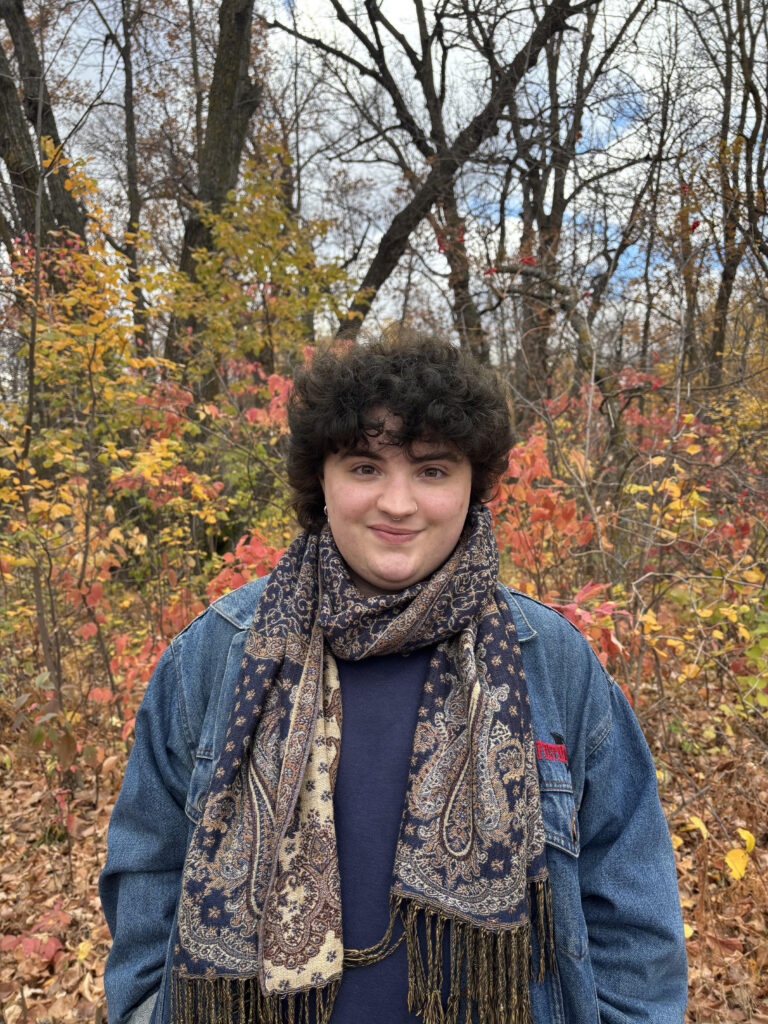
Roan Regan (he/they) is an emerging author hailing from Canada, where he is completing an English Honours program at the University of Winnipeg. Roan loves to play with form, exploring the intersections of poetry, fiction, and non-fiction. As a trans person, his writing deals with subjects of transformation, identity, and connection. Currently an editorial assistant with the student literary journal “Juice”, Roan hopes to work in the literary field and pursue a master’s in creative writing. Aside from writing, he spends hours at cafes, plays tabletop games with friends, and hangs out with his darling cat, Pretzel.
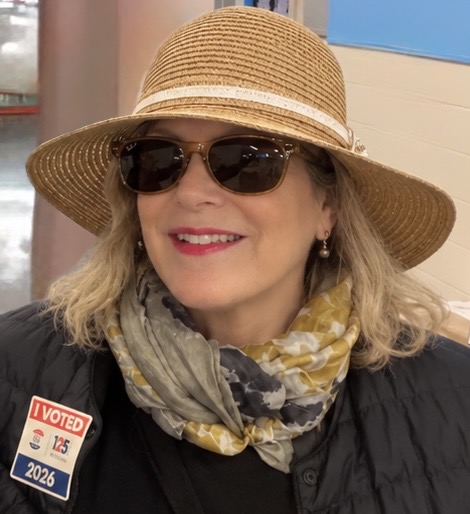
Susan L. Pollet is a visual artist and author whose works have appeared in many art shows and literary publications. Seven of her paintings were covers of seven different literary magazines, and in 2026, one was nominated for Best Of The Net. She was chosen as an Illustrator for a Literary Magazine issue. She studied at the New York Art Students League, has been a member since 2018, and resides in NYC. A published author in multiple genres, her titles include three children’s books, which she both wrote and illustrated. She can be found at susanpollet.com and susanpollet.substack.com