Ghosted
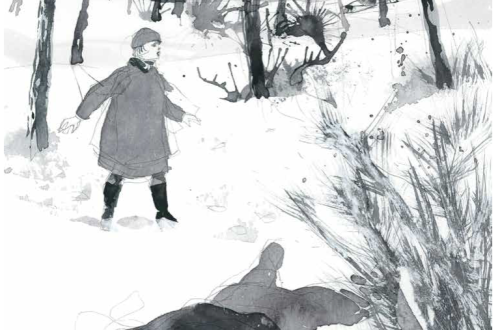
art by Abbie Doll
by Sue Allen
A pair of jewel-green macaws raced above Sara and David’s heads as they began their hike. The first of the hanging bridges, puentes colgantes, swayed like a giant hammock strung across the gorge below. Sara shaded her eyes and watched the birds vanish into the treetops.
“They mate for life,” Sara said.
David had already stepped onto the bridge, now wobbling beneath him as he reached for his phone. Sara took a deep breath and placed one foot on the planks. She kept her eyes fixed straight ahead, avoiding the view below. David, twenty feet ahead, didn’t look back. Sun flashed against the phone in his hand. He was already pondering camera angles and frames, proof of having been here.
He stopped in the middle of the bridge, over the deepest part of the gorge. When she reached him, they stood shoulder to shoulder, her legs trembling, his steady as posts.
“Let’s get a selfie,” he said, slipping an arm around her back.
The bridge shifted. Sara stumbled and caught herself on the rope railing. David grabbed her, pulling her hard against him.
“Whoa girl. I’ll have to cash in that life insurance policy if you keep this up.” He kissed her on the forehead as if the joke had landed well.
“Give me your phone,” she said.
She zoomed in on his face, on his green eyes, crinkled at their edges, calm in a way she both loved and distrusted. What lay beneath that calm? Was he thinking about how life would be without her, the kind of freedom he’d have with a half-million dollars in cash and no wife? She had a very bad habit of terriblizing reality, a big, fat, imagination. Stop it, girl. David loved her, and she loved him. It was that simple.
She glanced at the photo on the screen. The grey in his hair looked sexy; in hers, dowdy. “I look older than you,” she said, and handed the phone back.
They crossed the bridge together, Sara just inches behind him, her fingers hooked through his belt loop. By the third bridge, she’d overcome her doubts about David, and her bridge phobia had become more manageable. She stomped hard on the planks to prove she wasn’t afraid.
Costa Rica was growing on her.
It had taken some time. On the day of their flight everything went wrong. The cat threw up. The Uber driver got lost. Halfway to the airport, she realized she’d forgotten her phone, and they had to turn around, nearly missing the plane.
David remained patient through it all, smiling subtly, holding back the grin she knew blossomed inside him, so happy to be en route to Central America.
The flight was uneventful. One paragraph into a highly recommended novel about a female lighthouse keeper, Sara’s eyelids began to droop. Soon she was asleep, as was her habit on planes. David, meanwhile, pawed though guidebooks until he could no longer contain his excitement and elbowed her awake.
“Look,” he said. “The Arenal Volcano. If we get to the lodge early enough tomorrow, we can join an expedition up it.”
She yawned. “Hmm.” Her knee throbbed and she knew she’d opt out, but why tell him now? It would only disappoint him, and she was trying to be good, trying to keep her mouth shut so she didn’t begin the trip as the wife who spoiled things.
For weeks, she’d carried the trip in her stomach. The newspaper cancellation, the cat sitter’s instructions, the passports, the chargers…had she remembered the blister-free socks and diarrhea meds? But as the little plane on the seatback monitor inched toward Central America, the acid in her stomach began to settle. By the time they landed in San José, she had a guidebook open on her lap and sticky notes attached to a dozen pages.
Travel had always come naturally to David, as if his family passed down wanderlust along with eye color and cholesterol. Christmas, spring breaks, summers, they were always going somewhere—Europe, once to Alaska, but mostly to Mexico. “David can’t stay put,” his mother had once told Sara. Sara had smiled, privately suspecting it was David’s mother who hated staying home with three kids.
Sara’s own family had gone to the same rustic cabin every summer, a place with damp towels, warped playing cards, and a lake too cold to swim in before July. She remembered the same beds, the same smell of mildew and pine. Vacation, in her family, meant returning. In David’s, it meant escape.
Still, her mood was bright when the plane landed in sunshine, and they cleared customs in exactly ten minutes. The agent, a long-faced young man in a crisp white shirt looked at their passports, glanced briefly at their faces, and said, “Welcome to Costa Rica. Pura vida.”
Later, at the hotel in San José, David stood at the window and reached for her hand.
“Wasn’t this a great idea?” he asked.
He began gathering up passport holders, wallets, guidebooks.
They whirlwinded downtown in six hours, starting with the Teatro Nacional de Costa Rica, where an enthusiastic guide offered them a tour in Spanish or English.
“Español,” replied David, just as the word “English” was forming in Sara’s mouth.
The guide looked from David to Sara and smiled. “Let me do English for the señora.”
David sighed and turned away, but only for a second. By the time the tour began, he’d put his good traveler’s face back on. When they stopped beneath the ceiling mural, The Allegory of Coffee and Bananas, he leaned toward Sara and whispered, “Sounds so much better en español.”
Late that night, Sara lay awake beside her husband, lightly snoring, content in the little nest he’d made of the hotel pillows. His chest rose and fell and she reminded herself how lucky she was. They had money for vacations like this, a faithful marriage, two financially solvent adult children.
Their son appeared happily wed, with a job helping nonprofits raise funds. Their daughter was less settled. Her last fling, a bartender-actor, had “ghosted” Kirsten. Sara had asked what that meant.
“Vanished,” Kirsten had said. “Didn’t even bother to say goodbye.”
Sara had found the word theatrical, though now, lying in the dark she wasn’t so sure. There were many ways to disappear. A person could leave, of course. But a person could also stay. A person could remain beside you for decades and still become harder and harder to see.
David shifted in his sleep, then settled again.
No grandchildren yet. No catastrophe either. At fifty-eight, Sara was in good health, as was David. If they kept along this route, theirs would be a comfy long life, sliding into old age still holding hands, becoming softer, paler, less distinct. Until, she supposed, they would become ghosts together.
They still had sex, but now it was down to twice a month, three or four times if you threw in a vacation. Five years earlier, Sara had suggested light pornography, some harmless experiment to stimulate their marriage. She blushed now, remembering how she’d worn a black lace corset and garter belt like some saloon gal, then stood in the bedroom feeling foolish and hopeful, waiting for David to look at her as if she’d startled him back into desire.
Instead, he’d laughed. “I don’t think it’s you,” he’d muttered, and handed her the old grey T-shirt she usually slept in.
She knew he’d meant to be kind. Maybe he had even meant to reassure her, to tell her he loved her just as she was. Still, she couldn’t help feeling as though some private version of herself had stepped into the room and been asked to leave.
They still loved one another, she was certain of that, though neither would have used the words in love to describe their relationship. Now it was the three Cs: comfortable, compatible, contented. The fireworks, like the Poas Volcano to the north, were reduced to a soft plume of smoke, an occasional spurt of molten rock streaming down the edge of the cone.
On their last evening in Costa Rica, after their long hike, they dined at a restaurant on la playa, a less touristy place David had found in a guidebook that praised its appeal to locals. This proved more or less true. When they arrived near sunset, the tables were filled mostly with Costa Ricans, except for a German-sounding couple in the corner, and an American family whose two towheaded daughters ran around the sand just a step down from the patio.
The bar at one end was bustling. Sara sweated in her cotton dress, but the breeze from the ocean fanned her legs and armpits. They were both famished from the hike, and ready to dive into drinks and platters.
David settled back into his chair with that look of contentment he took on when he was comfortable. Sarah envied his ability to hunker down inside the present, while she was off somewhere else in her mind making lists, organizing, rehearsing calamities. Someone had once told her the average person had thirty-eight thoughts a minute. Sara suspected she had closer to a hundred. David, meanwhile, appeared able to ride one long thought for a full minute.
Sara followed his gaze to the sunset on the Gulf of Nicoya, a glorious golden event. On the darkening arm of the peninsula to the south, lights began to appear in Puntarenas. A few figures moved along the beach, silhouetted against the sun as it lowered into the sea.
Sara looked into her pink glass of Guaro; David raised his beer.
“To sunsets,” he said.
“And macaws,” she added.
Their glasses clinked.
The waiter brought two platters of el pollo, succulent and shining, with rice and beans heaped beside a salad sharp with cilantro. They ate greedily, with the pleasure of knowing they’d earned their hunger.
Afterward, Sara felt too full. She had eaten too fast, and the guaro had warmed her face. She remembered seeing a sign for el baño by the kitchen, somewhere out back. David had started speaking Spanish with a group at the next table, his voice expansive and pleased with itself. She leaned into his arm.
“Be back soon,” she said, nodding toward the bathroom.
“Si, mi amor,” he replied. The people at the table laughed and one man raised his glass. “Those are the three most important words if you’re married to a Costa Rican.” The table laughed.
After using the toilet, Sara did not return immediately. The air was damp and warm, and the waves sounded closer than they had from the patio. She walked toward the shore, away from the restaurant lights, away from David’s Spanish, away from the laughter that had gone on perfectly well without her.
The sand gave way under her heels. She bent to remove her sandals, and dangled them by their straps on the edge of her thumb and forefingers. A wave slid over her feet. The water was startlingly cool compared to the still-warm sand, and for a moment she felt younger than she had in years.
She dropped the sandals, lifted her dress above her knees, and stepped farther in.
Another wave came. She jumped over its lacy edge. Then another. She laughed once though no one could have heard her. The ocean pressed against her shins, her knees. It was stronger than it looked from the table, muscular and insistent, tugging at the hem of her dress.
She took one more step. Then the water changed. A wave struck her sideways. Her foot slipped out from under her. Before she could right herself, another wave hit, harder and the shore vanished. There was no time to cry out. The ocean swallowed her whole body at once and drove her under.
She remembered her father’s voice from long ago: If you get caught in a current, don’t fight it. Hold your breath until it lets you go.
So, she held. Water and sand rushed through her hair. The sea turned her upside down, right-side up, upside down again. Her lungs tightened then burned, but still she held her breath. She could not tell where the surface was. It was all too dark.
The macaws were there suddenly, absurdly, their bright bodies disappearing behind the treeline. David’s steady hand on the bridge railing. Kirsten’s voice, flat with humiliation. Vanished. Didn’t even bother to say goodbye. Then Sara’s face slammed into what felt like a wall of sand.
This was it, she knew. Soon she’d be fish food, another careless stupid Americano dragged out to the Great Beyond.
From a great distance, she heard voices calling, heard her name. Hands closed around her arms. Someone was dragging her. Someone else was calling for help. David was on his knees in the sand, wet to the waist, rubbing and squeezing her hands, his eyes anything but calm.
“Sara,” he kept saying. “Sara. Sara.”
She could feel him again, holding her tightly, and she knew he had helped her, had saved her life. Just as she knew that some part of her remained far out beyond the breakers, turning and turning in the relentless dark.
Michigan native Sue Allen is an author, editor, and former educator with a lifelong love of travel, reading, and writing. She is the author of the novel Water Beyond the Bridge, set on Michigan’s historic Mackinac Island, and the nonfiction book Lilacs on Mackinac Island: A Fortnight of Fragrance. A graduate of the University of Michigan with a BA in English, Sue went on to become a National Board-Certified instructor in English as a Second Language in Fairfax County Public Schools. She now enjoys editing and helping others find their own distinctive voice. Visit her at sueallenauthor.com.
Abbie Doll is a Columbus, OH writer with an MFA from Lindenwood University. Her work has been featured in places such as Door Is a Jar Magazine, The Journal, and 3:AM Magazine and is forthcoming in; and has been nominated for The Best Small Fictions, Best Microfiction, and the Pushcart Prize, as well as longlisted for The Wigleaf Top 50. She serves as a Fiction Editor at Identity Theory. Connect on socials @AbbieDollWrites.