Global Voices Interviews
Québec
Chloé Savoie-Bernard
in conversation with LIT Translation Editor JP Apruzzese
“Any desire for totality is fascist.”
— Chloé Savoie-Bernard
There is something in Chloé Savoie-Bernard’s work that resists easy classification, as though her language had learned, somewhere along the way, how to elude capture. Each book, each poem, carries the sense of a writer circling the edges of what can be spoken, revealing what lies beneath the surface.
Born in Montréal, Savoie-Bernard has, over the past decade, built a body of work that unsettles categories and unravels inherited scripts. The poet, novelist, and critic writes at the threshold of opposites – between intimacy and the collective, tenderness and rupture, the weight of history and the refusal to be defined by it. Across her books, including Des femmes savantes, Royaume Scotch Tape, and Sainte Chloé de l’amour, she charts the architectures of power – familial, colonial, systemic – with a precision that never collapses into abstraction. Her words arrive like something whispered just for you, yet carry the full force of a voice unwilling to be silenced.
At LIT, we were proud to feature her poems from Royaume Scotch Tape in Issue 38 of Fall 2024, a collection that distilled her gift for balancing the piercingly intimate with the deeply political. What strikes you first in these texts – and throughout her work – is the clarity of her images: how a single, seemingly minor detail can shift the emotional gravity of an entire page. Beneath that clarity runs an undercurrent of disruption, a quiet reimagining of what the lyric can hold. Her writing is unafraid of fracture or ambiguity, tracing the hidden seams of language. It acknowledges how words, even at their most tender, can wound as easily as they mend – and it lingers deliberately in that tension.
As a literary critic and academic, Savoie-Bernard is attuned to the histories embedded in form: who has been allowed to speak and who has been erased; which voices are amplified, and which remain unheard. That awareness saturates her work, yet never reads as theory alone. Instead, it becomes an aperture, widening the page and inviting the reader to glimpse structures that often go unnamed. She writes through the body – its vulnerabilities, pleasures, and memories – carrying forward a belief in the possibility of other futures, even when the present feels unforgiving.
This conversation with Chloé Savoie-Bernard is part of LIT’s Global Voices series, dedicated to amplifying the work of writers who move across languages, geographies, and forms. Our exchange explored belonging and dissonance, the place of poetry in a world increasingly hostile to nuance, and the radical act of imagining otherwise. What follows is a portrait of an artist whose work continues to chart new territories – linguistic, emotional, and political – with unflinching clarity, generosity, and care.
JPA: Let’s start with Royaume Scotch Tape. We were thrilled to publish your poems from this collection in LIT 38. The voice there is deliberately unstable – stitched together, yet always ready to break. It reminded me of audio cassette glitches, or even traumatic responses. Was this fragmentation a formal choice from the outset, or something that emerged over the course of writing?
CSB: From the outset, as I was writing Royaume Scotch Tape, the title appeared to me, and with it the concept of the book: the desire to build for oneself a kingdom from the ruins that make us who we are. A Royaume Scotch Tape is the place one builds after fragmentation, after disaster, with whatever materials are at hand, unafraid to show the sutures that hold together the space we inhabit. The idea was also to pay tribute to the citational collage that cements the collection, which was important to me: I wanted to show everything that is replayed in our writing from our prior readings. The home of the collection – the space that shelters us, however imperfect – was for me also immaterial, infused with literature.
JPA: In Fastes as in Royaume Scotch Tape, you often refuse linear narratives. Your poems end suspended, or unravel. Do you see this as an aesthetic of the unfinished, or as a way of reflecting the complexity of lived experience – memory, emotions, the body?
CSB: Poetry is the ideal place not to be in narrative – beginning, middle, end. That’s a relief for me because my train of thought is generally not very linear, so I think that’s why poetry is the genre I’ve invested in most. It feels natural for me to focus on image, on rhythm, rather than characters. I think in a restless way, my ideas often collide with one another, and I believe my poetry reflects that. I work on my poems very intensely, but the idea is never to arrive at a “perfect” form – rather a form that accurately reflects the images moving through me. For Fastes, it was the idea of a body impossible to gather, to bring together. It was a collection founded in a mortuary movement, in a morbid dance.
JPA: Fastes has an almost cinematic texture – montage, fragments, sudden ruptures. When you work on form, do you think about rhythm, visual construction? How does a poem take shape for you in its raw state?
CSB: I always think about rhythm. I read my poems aloud – but I read everything aloud, at least in part: my essays, the books I translate, in both the original language and my translations, as I try to transmit a rhythm, a tone. It’s hard for me to think about the “raw state” of a poem because I systematically rework my poems dozens of times. I would have trouble even finding the first versions. I write bits in notebooks, I keep fragments of lines in my head. Then I assemble, I move things around. I try. One can rework a text endlessly, but I’m also relatively comfortable with finishing, with telling myself it’s enough. I feel both perfectionist and a bit scattershot. Knowing a text is finished is hard, it’s not an exact science, and I don’t really know how I arrive at that certainty. I tend to conceptualize the poem on the page as a sculpture, and from the very short lines of Fastes to the long, winding lines of Sainte Chloé, there is a clear difference. At the time, that difference was intuitive, but now I better understand the dryness of Fastes, which is a book I have trouble rereading, and the mocking languor of Sainte Chloé, for example.
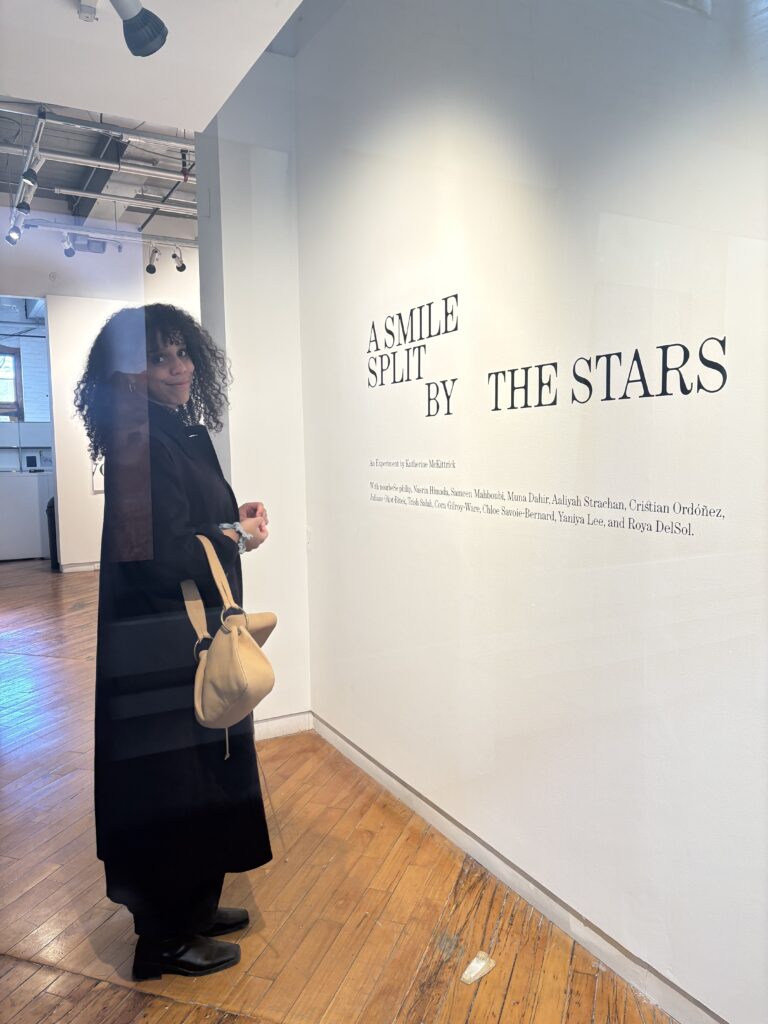
Photo by Natasha Bissonauth
JPA: There’s a profoundly bodily dimension in your texts – fluids in Des femmes savantes, flesh marked by wounds and grace in Sainte Chloé de l’amour. How do you write the body – its violence, desires, exhaustion – without reducing it to mere metaphor?
CSB: I’ve thought a lot about the body, and that has to do with my socialization as well as my circumstances – as a queer Black woman living in a white context and with chronic pain. Having a body like mine means one’s experience is systematically questioned – am I really sure I experienced this or that? Am I exaggerating? My body has often felt out of place. Displaced, yes, in contrast, and above all an excellent space for others’ projections, so much so that I had to learn to name it for myself, which didn’t come easily. Literature helped me give myself form. I wanted to write from that place over several books. It’s a way of interrogating both the internal gaze on oneself and the external gaze. It’s been a strong presence for me – how to inhabit a body, my own but also any body – but I now feel somewhat elsewhere. Not that I’ve exhausted the subject, but I think I approach it differently now.
“Having a body like mine means one’s experience is systematically questioned – am I really sure I experienced this or that? Am I exaggerating? My body has often felt out of place.”
JPA: Your poems are full of objects – scotch tape, mirrors, microwaves, silk – that take on almost magical power. How do you choose what enters the space of the poem? Do you collect images and textures, or do they arise on their own?
CSB: I’m quite a materialist person. I love objects, especially secondhand ones whose histories I can trace. I accumulate furniture, photographs, and clothes from friends – sometimes friends of friends – who don’t want to throw out or donate a lamp, a chair, a table, a coat to a stranger, but no longer want it in their home either. I also try to care for my possessions, to repair them when they break. I feel responsible for them. Of course, this is connected to the environmental context, to my desire not to consume excessively, but it’s also almost spiritual: I feel connected to my things, and they to me. I mend my clothes, I send them to the tailor. That this love of matter is reflected in my books isn’t necessarily conscious. Objects are my talismans, and I’m not possessive about them – I love when my objects go to others, when they’re used, when there’s an ecology of objects, words, poems, when people appropriate what I’ve loved and cared for. All this to say, I’d never really noticed the proliferation of objects in my work, but it doesn’t particularly surprise me!
JPA: In Des femmes savantes, we sense a confrontation with inherited femininities – mothers, muses, mythical women. Do you write to build a lineage of “savantes,” or rather to fracture the archive?
CSB: This text reflects my desire to think about the notion of “knowledge” among women – what we knew of life and literature, and also, theoretically, of leading a feminist life, but also how knowledge doesn’t always protect us from ourselves or from anti-feminist behaviors. It’s a text where I wanted to observe contraction, fissures. I think my gesture is double, and that double gesture has been true from my first texts (Royaume Scotch Tape and Des femmes savantes) to my current projects: I want to carry certain memories but also interrogate the very act of their constitution to expose their contradictions. The archive, when we engage with feminism and Black studies, is necessarily punctured, problematic, under reconstruction, because the history of women and Black populations has historically been written by people other than those most directly concerned.
JPA: Your texts are marked by political urgency, but never in a moralizing tone. In Sainte Chloé de l’amour, there’s a sacred, almost mystical tension – as if love became refusal, insubmission. In Royaume Scotch Tape, that resistance takes the form of a precarious collage, a broken yet insistent voice. Do you think poetry can be an act of resistance precisely because it resists clarity, linear enunciation, controlled discourse?
CSB: That’s a certainty for me. It’s funny because, given who I am – my layered identities – some people at various points in my career have wanted to paint me as an uncompromising, black-and-white person, when my work, on the contrary, seeks nuance, the microscopic, refuses didacticism. That just means those people have never opened my books! They’re fully entitled not to, but it reflects a lack of intellectual curiosity on their part. My books aren’t clear, they flow, they’re liquid, broken, imperfect – I think that’s why I write them. I’m driven by clear political ideas that hold me, that I believe in firmly, but they also come with the conviction, paradoxical or not, that humans are fallible, they fail, they contradict themselves – myself first of all, of course. I want my work to reflect that.
JPA: You’ve written extensively – both criticism and poetry – on multiple marginalities: linguistic, racial, sexual. Does your position as a feminist, queer, Québécoise poet influence the forms you choose, the risks you take?
CSB: I don’t see how I could not take risks. My presence in the literary world is at once a miracle and an accident, a failure of the system, an anomaly. Girls like me don’t become writers or university professors. No one in my family has a path similar to mine. I’m aware of my privilege, I know it reflects my work but also a lot of luck, coincidences, rolls of the dice. So if there’s one thing I owe myself, and all the other little girls “like me” who may never have my chance, it’s to use my voice with firmness and truth. I have nothing to lose: I was never supposed to be here.
JPA: Throughout your books, we sometimes feel spiritual echoes – not in a strictly religious sense, but in a quest for meaning, transcendence, perhaps repair. Does spirituality (or its absence) occupy a place in your writing? How do you navigate that terrain?
CSB: Literature, in what I love most about it, has always had a relationship with the sacred. I love poems where you feel grace, transcendence (I’m thinking, in Québec, of voices like Marie Uguay, Carole David, Stéphane Martelly, or someone like June Jordan in the U.S.). Poetry has a great power of intimation. I often want to make that breath heard in my poems (I first wrote “my prayers”). I wish for poetry to cast spells into the universe. I don’t see why that wouldn’t be possible.
“My presence in the literary world is at once a miracle and an accident, a failure of the system, an anomaly. Girls like me don’t become writers or university professors.”
JPA: Which literary landscapes inhabit you – from Québec, France, or elsewhere? Are there writers who accompany you in the shadows when you write, voices that resonate or provoke you?
CSB: Of course! Many voices inspire and support me. I think in literature we must feel well-accompanied by other voices when writing. It counters the isolation of sitting at a computer writing. I really admire the voice of Marie-Célie Agnant, her unshakable dignity in life and in literature, for example. Katherine McKittrick, Dionne Brand, Christina Sharpe are also essential for me. The conversations I have with my writer friends, sometimes ones I’ve known for a long time, are also crucial. There’s writing, and there’s also literary life, which can be complicated to navigate for very practical reasons (negotiating a contract, knowing who to avoid because they have bad practices, etc.), and we also need a network of solidarity to face that.
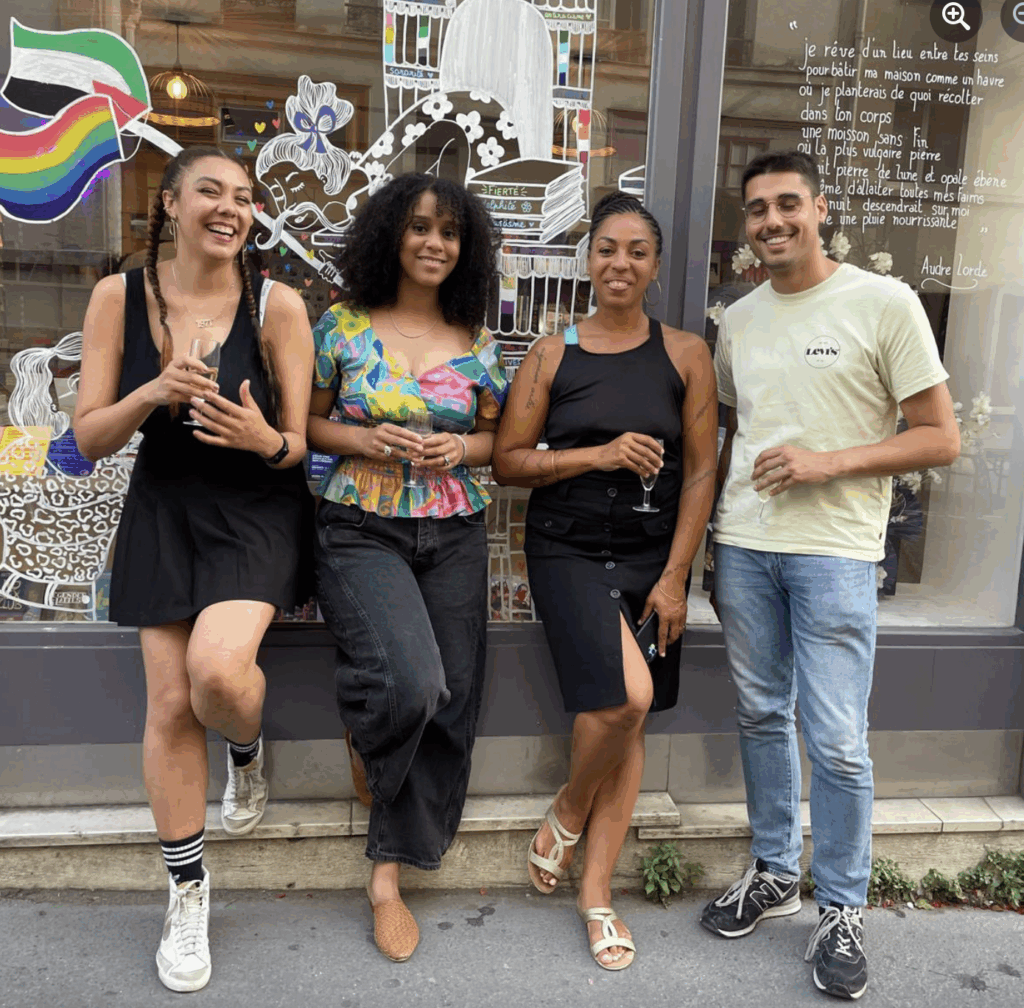
Photo by Natasha Bissonauth
JPA: Your language seems porous to multiple traditions – feminist, poetic, political. Have certain literary figures, Québécois or otherwise, allowed you to write like this, in that tension between lyricism, the sacred, and revolt?
CSB: I think I’ve knitted my revolt together from different stances, readings, from my own experience and the various learnings I’ve made, and continue to make. I do think it’s a patchwork, and my revolt is traversed by aesthetic and spiritual questions…and a few jokes too. From Sara Ahmed to Chester Himes and Réjean Ducharme, the readings that shaped me are quite eclectic. I was first trained at university as a specialist in Québec women’s literature up to my PhD, and Black studies arrived in parallel with my studies in my intellectual journey. These are two strands that have, until now, very rarely been in dialogue with each other. I’m also inspired by many different things: the reflections of light on walls, insects moving through the city, the intonations of voices, an attention to the details of the living. Similarly, the visual arts inspire me a lot, which I approach without any desire for specialization, just through sensitivity: visiting a museum or gallery is always one of the first things I want to do when I arrive in a new city.
JPA: Let’s talk about language. In Royaume Scotch Tape, your French is porous, fractured, even haunted. Do you write against the institutional language? Or are you exploring a more intimate, fractured relationship with French itself?
CSB: I think I write pretty much the way I speak, the way I navigate the different layers of French that are mine. I don’t really care about institutional language – I hate the pressure to “speak properly,” and I know I’m not immune to it, that I speak differently into a microphone, on the radio, or in an academic context than when I’m with my friends. I wonder what “good French” or “bad French” even is, and who those categories serve. The formal and its lack of authenticity bore me. I always have small iconoclastic urges in writing, to break things, even if only the syntax, a little, to let different registers of language, even different languages, coexist. I think you have to break language if you want to make literature. Otherwise, you’re just writing books that tell stories – and that’s great – but I don’t think that’s literature.
“I think you have to break language if you want to make literature. Otherwise, you’re just writing books that tell stories – and that’s great – but I don’t think that’s literature.”
JPA: Some of your texts have already been translated – poems from Royaume Scotch Tape by April Yee, a short story by Natalia Hero. How does it feel to see your voice move into another language? Do you prefer to be closely involved in this process, or to let the text live its own life? And is there a collection you would particularly like to see fully translated?”
CSB: I’m a translator myself. I’ve translated and co-translated several books (by Robyn Maynard and Leanne Simpson, by Audre Lorde and Pat Parker, by Myriam Chancy, etc.), and that’s been a big part of my work in recent years. So I love being on the other side of the table, seeing my work change through contact with another language and another relationship to the world. I care a lot about precision in language when I translate for others: I want what I’m trying to say in French to be carried into English. That’s my only real request. Beyond that, I want the person translating to remain free in their work and able to express their creativity. I would love for Sainte Chloé de l’amour, which I feel is my most fully realized book, to be translated into English. I just moved back to Québec, where we speak French, but I spent the last three years in an English-speaking city, in an English-speaking work environment, building certain relationships and opening up my perspectives and my work, which had previously been very oriented toward the Francophone world. So I would be delighted for my work to be available in English and for my Anglo friends to be able to read me.
JPA: Your texts often seem to address someone, but this “other” changes constantly – lover, mother, reader, ghost. Do you write with a specific person in mind, or more toward an emotion, an absence, a memory?
CSB: I never think of a specific interlocutor when I write – that would inhibit me. I try to stay focused on my desire for meaning, on trying to translate my whirlwinds of images or sensations in the most evocative way possible. Even if I sometimes write about people in my life, my books aren’t meant for them, or at least I don’t think they are. I only think about potential readers once the book has gone to the printer.
JPA: You inhabit several roles – poet, editor, researcher, public intellectual. Do these roles feed each other, or do they sometimes come into tension?
CSB: Everything feeds everything else, everything collides! Academic life, translation, research, teaching, creation, my work in performance. I should note that at first, when I “learned” to do these things, it was also out of a desire to get out of financial precarity and to exist in the artistic world. Today, that’s no longer the case because I have a stable income, but I continue to learn things from these different positions that I infuse into the others. I’m not someone with a huge capacity for concentration, I’m easily distracted and get bored quickly, so diversifying my activities strangely allows me to keep my head above water. Of course, I end up running out of time, unsurprisingly, and things can become anxiety-inducing, but I’m grateful for the multiplicity of things I do.
JPA: What I admire in your work is your refusal to explain everything. The opacity seems intentional, assumed. Is this a political stance for you, especially as a woman writing in the public sphere?
CSB: It’s a matter of taste, first and foremost: the books I love know how to keep an aura of mystery, and I love reading things I have to unpack for a long time, that resist me. I adore Nicole Brossard, for example. I want part of my writing to remain hidden from myself, to surprise me, to frustrate me. I prefer questions to answers. Maybe it’s also a kind of surrealist mimicry: I loved reading the Surrealists at a certain point. There’s a strong taste these days for truth and extreme transparency, for nakedness in everything, in public and literary spaces, which, if I dig a little, always seems fake to me. We never know everything, we never reveal everything; part of ourselves will always remain mysterious, inaccessible, veiled. I want my writing to transpose that. Any desire for totality is fascist!
Photo by Anthony Francis
JPA: Your latest book, Sainte Chloé de l’amour, has a title that is at once ironic, mystical, and autofictional. How did this figure of the “saint” come about? Is it a critical posture, queer autofiction, poetic provocation, a true spiritual quest – or all of these at once?
CSB: It’s a joke that’s not a joke: I tell this anecdote in the book – when I was little, I truly wanted God to take me while I was praying, and I was really convinced that would, as if by magic, make me a saint. It’s a title I find funny, grandiloquent, which also shows the power of literature in my eyes, to create things that can only exist in art: I will only be a saint because I call myself a saint in this book, never in the “real” world, and everyone agrees on that. Thank you, God, for making me a poet and thus fulfilling my desires for sainthood, because it’s not the Church that’s going to canonize me – I’ve talked a bit too much about sex, and often queer sex, in my books for that! I find it both funny and very beautiful to be able to become this version of myself in poetry that has always been me anyway, in my desire for purity, for excellence, for transcendence, to be “good,” to “do well.” To be a saint, you must love, whether it’s God, whether it’s the other, in great self-abnegation, in forgetting yourself. All saints are saints of love; perhaps the title is a pleonasm. In the book, the love of flesh is important, but I think even more I’m asking what the very substance of love is, its texture. What is love made of? What carries it, transports it? This book allows me to interrogate all these elements, to densify them, to complicate them.
“I wish for poetry to cast spells into the universe. I don’t see why that wouldn’t be possible.”
JPA: Each of your books marks a very different stage. Des femmes savantes asserted a voice, Fastes exploded it, Sainte Chloé de l’amour transfigured it, and Royaume Scotch Tape tries to glue the pieces back together. What’s obsessing you now – formally, emotionally, poetically? Is a new project already inhabiting you, or is it still fallow?
CSB: I’m working on a project I’ve had for a very long time. This project has been working on me for ten years, and I ended up publishing other books before I could complete it. It’s a nonfiction book about my relationship with my father, with my wider paternal family, reflecting on the legacy of the Duvalier dictatorship among members of the Haitian diaspora who didn’t experience it directly, but who still bear its marks. It’s also a book about death, and about those who remain, and about what remains of our dead.
•••••••
Dr. Chloé Savoie-Bernard is a writer who works various forms: poetry, short story, literary criticism, and translation. As an editor she works at L’Hexagone, a publishing house in Montreal. She is also developing a practice in performance. She has published several books, most notably “Des femmes savantes”, (Triptyque, 2016) and most recently “Sainte Chloé de l’amour” (Hexagone, 2021). Her current book project focuses on fragmented kinships and constructions of memory between fathers and daughters within the context of first generation Haitian immigrants in francophone Canada.She has contributed to magazines including Granta, Spirale, and Lettres Québécoises. She lives in Monteal.