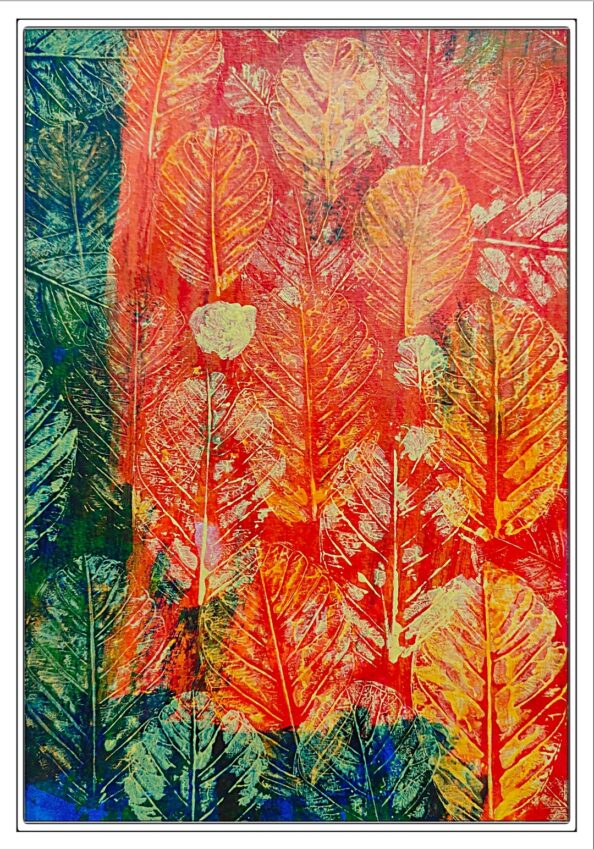
Redhead
art by Reena Choudhary
by Matthew Partney
My mother was abducted from the Free and Sovereign State of Tamaulipas in Northeast Mexico in 1964. She was one of three. Her older sister was abducted with her, but did not survive the journey north. The bounty placed on them allowed for an acceptable level of attrition.
My mother’s sister was just the cost of doing business. She never saw her younger brother again.
My mother told me the only thing she brought with her was her name. My name. Parangaricutirimícuaro. A word that felt like it demanded the tongue move in opposite directions simultaneously. My mother’s “friends,” particularly this one noisy hen in St. Andrews Square called the name ugly. My friends, all second and third generation, called me “Gary.” My mother hated it. She insisted I use my full name. It was who we are, she insisted. It connected us to our family far, far away.
I suspect there was another reason. The tongue twister was her calling card. Throughout her life, as kismet allowed, she would come across someone who recognized her unique name and knew of her family. With every drop of her name came the hope that someone would have a story to tell her about her family back in Mexico.
She learned she had cousins that settled in Florida. It wasn’t clear if they came of their own volition. She heard tell of her father, my grandfather, back in Mexico leading a migration after their home was destroyed and community displaced. By what forces was never made clear, but my mother has always been prone to imagining the worst-case scenario.
What disturbed her the most about this news was that it was never about her mother.
What was her fate? Was she destroyed? Or displaced? Maybe she, too, had been taken. Maybe she was somewhere here in the States. Out in the San Gabriel Valley where population had exploded. But my mother wouldn’t search for her. Ever the pessimist, she knew better. She knew her mother was gone.
My mother always had a complicated relationship with her new home. She assimilated, but never let go of where she came from. I only heard her speak Spanish when I was in trouble. She missed where she came from, even though her life, her family was here in California. She met my father in 1971 at Busch Gardens, a theme park in the San Fernando Valley that boasted a riverboat cruise, its own monorail, a working brewery. That place closed decades ago, well before I was born, but it remained alive in my mother’s memory. She spoke of it with affection, as a place that had offered safety, security, and most of all, community. Even decades later, the smell of yeasty hops transported her back to simpler times. But I always picked up something else in the stories she told from this time. A kind of trauma. Our move to Van Nuys in the early eighties was short-lived, I believe, because of the odor from the Budweiser plant.
She passed this trauma down to me. My formative years were filled with lessons of fear and survival. We lived with and amongst strangers here in Los Angeles, but even the kindest of them weren’t to be trusted.
The young always think they know better than their elders, she would say.
She was talking about me. She was warning me. She would tell the tale of how her own poor judgment resulted in her sister’s death, in her being taken from her family. She acknowledged that I would make mistakes. Her hope was that I would learn from them before making one as costly as hers.
In the late 1980s my mother and I left St. Andrews Square, near the big houses and old trees of Hancock Park, for the San Gabriel Valley. I was eager for a change. My mother was hopeful she would find someone else who recognized our name and had stories to tell of her family. She found neither, but I found a friend.
Her name was Gyeong Lee. I called her Gladys, like everyone in the neighborhood did. She took me in. She offered me a mother’s warmth free of attached strings and trauma. Her approach was gentle. She fed me well and made me feel free. My mother wanted nothing to do with her.
I pulled away from my mother, who settled into a new routine of her own with others her age and their grandkids. Pajaritos, she said, kept the old, spry. I settled into my independence. I still checked on her, but I felt ready to be on my own.
She told me that I wasn’t on my own, that I had simply found someone else to take care of me. She probably wasn’t wrong. Perhaps I should’ve listened to her.
I couldn’t understand a word Gladys said, but I understood her. The tilt of her head, the way she leaned close when she sang. She made you feel like you were her favorite. For a while, I stopped listening to my mother’s warnings in the back of my head, that frightened voice telling me the world could close around you in an instant. Then, when I least expected it, it did. Gladys betrayed me. I found myself trapped, unsure of what had already been decided for me. And I realized my mother’s trauma had equipped me to recognize the moment freedom disappears.
My abductors spoke Spanish. I couldn’t understand them. My Spanish was about as good as my Korean. Perhaps they were the same ones who took my mother from Mexico. Perhaps they were taking me back.
These were my racing thoughts as I was locked up and taken on a dark, endless ride. When the burlap was pulled and light flooded my cones and rods, I recognized the place only from stories others had told me.
The air smelled of fried food. A Kentucky Fried Chicken stood across the street. I joined three other redheads. They only spoke Spanish. I found it comforting. It reminded me of my mother.
The Mayor was an elder MacCaw of great esteem who looked over all of us birds in the shop from his roost adorned with tropical plants, both painted and actual. He facilitated conversation and adjudicated disagreements with a stark shriek.
My caretaker was Hsung Lee, a middle-aged man who spoke Korean and English. I picked up a handful of phrases, including “All sales final.” Hsung Lee was stoic, like the Mayor. But that spring, he became nervous. He spent his days and nights listening to news on the radio. No music. Just humans talking. When he was cleaning fish tanks, when he was serving customers. He discussed what he heard with neighboring shop keepers. The Mayor said the humans were worried about looting and riots south of the shop, but reassured us we were safe. The helicopters overhead, shaking the shop with their chop and wake, suggested otherwise.
The noisiest of the Spanish-speaking redheads returned to the shop under circumstances I didn’t understand. Hsung Lee shouted “All sales final!” at the man who returned the bird, but the returned goods stayed, describing fire and smoke. Agitación, he kept repeating along with the mimicked sound of sirens.
Hsung Lee closed the shop early. People threw objects at passing cars. A man was attacked in front of the Radio Shack. Hsung Lee watched the helpless man, looking helpless himself.
Hsung Lee arrived the next day with a gun. He didn’t open his shop. He stood guard, fending off bat-wielding outsiders with threats of his own weapon. He fired shots into the air. And when the outsiders broke his window, he took aim. An armed friend joined him, firing at assailants that the other redheads thought were attempting to free us. Maybe it was my English, but I knew this had nothing to do with us.
Something crashed through the front window of the shop, just missing our cage. The bottle landed in the soft cushion atop a cat tree. A tiny flame melted carpet. I didn’t recognize it at first, but the redheads knew it instantly. “Coctel Molotov!” they screeched. Turns out that’s pretty universal in any language.
Hsung Lee doused it with bottled water. I recall wondering if that bottle, with its Korean label, had come as far as my mother had. I hoped she wasn’t anywhere near this Agitación. The sounds of it surrounded us now. Hsung Lee paced the shop, frantic, as he accepted reality.
He began the evacuation with the mammals and reptiles. We watched along with the fish as the geckos and kittens were ferreted out the back. The actual ferret, an “illegal,” was next, exiting the back door to audible gunshots outside. In that moment, it felt safer in the shop. One of the redheads repeatedly shouted, He’s got a gun! It was the first English I’d heard him speak.
The next Molotov did as it was designed to do, flying through the window and further shattering what was left of the glass. It exploded near the back of the shop, opposite the fish. Hsung Lee covered his face with an arm as he came back in, running to the fish. He didn’t hesitate before pulling over the twenty-gallon tank holding the nameless feeder fish no one ever got to know. The glass tank exploded into granular chunks of glass, fish and a deluge of water that didn’t reach much of the fire. He cursed, I believe. His tone suggested profanity, desperation at least. We were all going to burn alive.
He grabbed a short hose he used to fill the fish tanks, but it was useless against the growing conflagration. Hsung Lee cried a wail I had never heard from a human. Mournful of a loss as it was happening. It called us to attention, though I don’t think that was his intention. The redheads clung to the side of the cage, screeching, pulling at the metal with their beaks. I thought of my mother again, of my dead father.
Hsung Lee started opening cage doors. He pulled Anton, the African Gray, out of his cage and threw him toward the back exit. Anton caught the hot air with his wings, narrowly missing the wall and darted out the back door. Hsung Lee flipped open the large cage door letting the finches pour out to fend for themselves. He opened our cage without looking as he opened
the next and the next. The redheads crowded the opening, flapping into each other as they fought to escape. I held back, afraid. Hsung Lee yelled at us in Korean. Another phrase I had learned from my time with him. Nagaseyo! Get out!
The last thing I saw as I escaped my cage was Hsung Lee unlocking the leather band that kept the Mayor in place on his jungled roost. The Mayor watched us all take flight as he clung to his keeper. Even now, I imagine he’s still bound to Hsung Lee, somewhere.
I didn’t follow the other redheads and they didn’t give me a second look. I took refuge in a woody neighborhood not far from the unrest. The people hiding in their homes were nervous, but the streets were quiet, untouched by fire or looting. I watched a family load into their caravan like finches taking flight. I watched an armed man hug his family goodbye while he stayed behind to protect what was his, like Hsung Lee. I rested.
I gorged on dates.
The next day I set out for my mother.
She was in Temple City. The largest population of redheads here in California, or anywhere if you believe the stories. Finding her wasn’t easy, but our name helped. It didn’t take long for someone to recognize the tongue twister and point me in the right direction.
She didn’t recognize me at first. She said I looked unhealthy and insisted on feeding me nectar. She introduced me to her flock. Adult offspring of some of those she knew during her time at Busch Gardens. Surrogate children that stepped in to support her where I was absent. I tried to deny the pangs of guilt. I told her about Hsung Lee, the Mayor, the All sales final.
I eased back into flock life. It was noisy and chaotic. Bickering is our way of life. We bond in pairs and find comfort in numbers. But it didn’t last. Free once again, I felt the need to set out on my own.
I settled into a flock in Pasadena. I kept to myself mostly, but roosted at night with the others in a date palm that towered over a donut shop with large plate glass windows. It was still dark when our flock was awakened by a quiet push. A disorienting wave of fear washed over us. Every redhead called out with alarm. A cacophony that felt different than usual, the cause indiscernible, the tone irrational, beyond the bickering or warning calls when a hawk was nearby. Other animals joined in, other birds. Dogs bellowed. The humans, coming and going with cups of coffee and fresh yeasty food appeared oblivious to our terror.
A man wearing bright orange stopped on the sidewalk and looked up at us, puzzled. A woman bundled up for the LA winter cold pulled at her dog who was losing his mind like the rest of us. For eighty-seven seconds, we all knew something was coming. We could feel it. The humans could not. And then the earth shook. The woman was knocked to the ground as we took flight from the jutting tree.
There was safety in numbers, and yet, I followed no one and no one paid me any mind. The sky was filled with every bird imaginable. Noisy crows argued and screamed. The Oxnard seagulls that arrived the day before squawked for refuge from a storm their barometer bird brains couldn’t sense until it was upon them. Discombobulated sparrows dipped and yawed unintentionally. The hawks that had threatened us the day before were now only interested in their own survival.
The shaking lasted less than 20 seconds. In that time, buildings crumbled, freeways collapsed, gas and water mains burst. What followed were days and weeks of human unrest. Life more or less went back to normal for us. I was shaken loose from my roost twice more, but nothing like that first time.
The next day I met another redhead with strikingly similar stories. He smelled of fire. Feathers on his wings were singed. He had just escaped a pet store that had caught fire after the earthquake. His captors had attempted to pull him from his cage and he’d taken flight.
Like my mother, he had been abducted from Mexico. He recognized my strange name. Unlike my mother he hadn’t been here long enough to adapt. He had picked up our local tongue from the others he was caged with at the shop, none of whom he knew to have survived the fire. We were survivors. It bonded us.
I took him to Temple City to meet my mother. She had felt the earthquake too. Both the shaking and the awful penetrating sound that preceded it. She had experienced it before and knew what had been coming. If I’d stayed with her, she would have warned me. When she reminded me there was safety in numbers, she meant it was safer with her.
She approved of my new mate. Parangaricutirimícuaro rolled impossibly off his tongue. But her approval had its limits. She didn’t like us venturing away. And away we did. Farther and farther, until we settled with another flock in Pasadena and eventually Westwood.
My favorite thing about Westwood, besides the concentration of theaters and ample errant popcorn, was the community. Things were different there. There was no flock. My mate and I were free to dart around with other like-minded pairs, but there was no expectation that we’d crowd into a tree at the end of the day. Maybe there were fewer raptors in Westwood.
I saw the Pacific Ocean for the first time in 2015. My mate and I had followed others out west to the Palisades. Far too many raptors for my taste, but the view of the endless sea almost made the risk of becoming some red tail hawk’s dinner worth it.
The year I turned the age my father had been when he passed, I faced my life’s greatest challenge. My mother went missing. Those who knew and loved her understood she was dead.
I returned to my mate in Westwood, which was different than I remembered it. Fewer premiers (less popcorn), more buildings. The roost I had made years earlier had been replaced by human construction. My flock darted between palms on campus and lush gardens on properties up the hill.
My next captor was a scientist with kind eyes. She caught me, my mate, and seventeen of my flock in a net none of us spotted draped in a tree. She brought us to her windowed lab on the tree-filled campus. The familiar view gave us hope that she would one day return us.
My mate wasn’t as hopeful. He screeched in vain. I thought of Hsung Lee’s mournful wail. I thought of my mother’s warnings. She told me so. I thought of Gladys and her sweet, deceptive smile. My instincts told me the scientist didn’t mean us harm, but they had said the same thing about Gladys.
Our time in the lab was long stretches of quiet existence punctuated by moments of sheer terror. The scientists handled us. They drew blood. After several weeks, only twelve, including my mate, remained. I don’t know what happened to the others. I thought of my mother.
I eventually came to understand my circumstances. The humans called us red-crowned amazons. Pure, not the product of interspecies reproduction. We were as unique as the few of our kind left in Mexico. For this reason, we were sent there to help the waning population survive and flourish. Our kind-eyed captor referred to the trip as sending us back, though I had never been to this place, the home of my parents, my grandparents, my mate.
In my fifty-sixth year, I was released from a small metal box into the wilds of Northeast Mexico, onto the branch of a strange tree in a foreign land, surrounded by others who spoke a language I only half understood. But I had the most handsome translator: my mate.
Not long after my arrival, I made an acquaintance over palm fruit. I forced myself to use my adopted tongue. My Spanish needed the practice. Her name was Tranquilinia. Tranqy, for short. A nickname like my own.
Mi nombre es Palomar Parangaricutirimícuaro, I told her.
She recognized the tongue twister immediately. She knew of my mother’s family. Mi familia. She took me to them. Most were younger than I was, save for my mother’s brother whose eyes pinned to the sight of me.
Perhaps he recognized my mother’s features in me. The shape of my beak, the pattern of my feathers, some familiar expression. I saw her immediately. He looked just like her.
I had traveled farther than I thought possible, across countries and history and all the silence my mother had left behind, only to arrive at her face once again.
Matthew Partney is a native Oregonian and lapsed Angeleno who now lives in Washington state with his husband and two kids. A television screenwriter and producer by trade, he recently completed his first manuscript, a novel that reckons with an inevitable geological event on the West Coast and the vulnerability of the place he calls home.
Reena is an artist from India she believes that art has no limits and is a powerful way to express emotions, imagination, and the beauty of the world. Biggest inspiration is nature, she enjoys capturing its colors, landscapes, and quiet moments, which often influence her creative process.
Her artwork has been published in numerous print and online publications, including The PERCH Journal, The Climate Art Collection, Aunt Lute, Judy Magazine, Farm Girl Magazine, Art Axis Project, January House Literary Journal (T-Art Press), Wildscape Literary Journal, A Journal of Literary Oddities (Ringling College of Art and Design), Hiraya Literary, The MacGuffin, and Club Plum.
She was awarded the Silver Medal in the Khula Aasmaan India Art Contest (2025) and received a medal and certificate at The Indian Art Fest (2026).