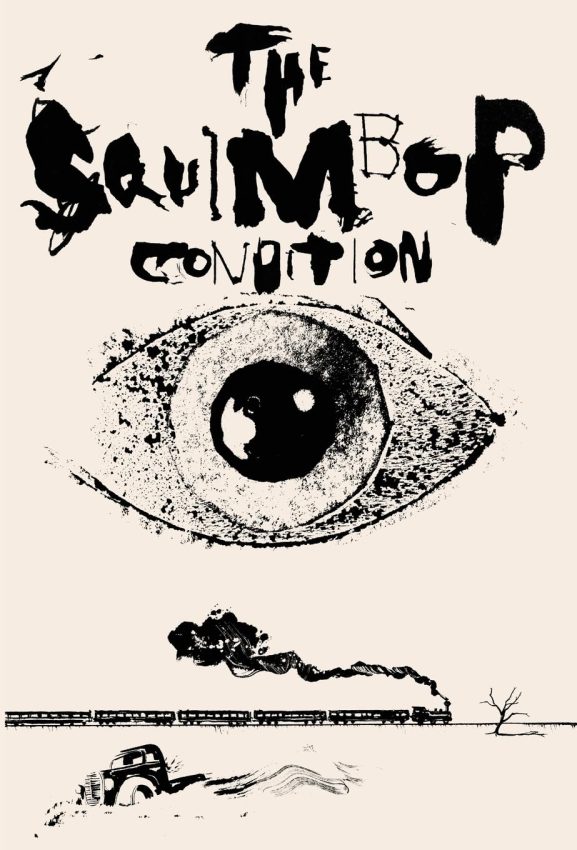
The Squimbop Condition: An Interview with David Leo Rice on his Latest Novel
by Isabel Piazza Risi
In The Squimbop Condition, the newest novel from David Leo Rice, the New School alumnus crafts a surreal story of myth, madness, and an everlasting quest.
While first ideated as a series of interconnected short stories, The Squimbop Condition threads together years of writing into a complete fable-like narrative. The novel follows two brothers, Jim and Joe Squimbop, as they slip and slide through time, realities, and history. From Hollywood to Europe to Dodge City and all around the globe, the bizarre duo reshape reality in their endless mission to bring about the Golden Age in this sometimes-slapstick, sometimes-violent saga. Although a standalone novel, the Squimbop brothers first appeared in Rice’s novel Angel House and they stumble into Rice’s fictional version of Dodge City where he set his series A Room in Dodge City. Rice’s relentless imagination culminates in this crowning jewel of a book.
The Squimbop Condition came out this past September from 11:11 Press. David Leo Rice sat down with LIT to discuss how he distilled years-worth of short stories into a novel.
LIT: You’ve been working on The Squimbop Brothers as several short stories for quite a while now. What was that time — and the experience of going from publishing short stories to putting them all together into a novel — like? What was the change from the first ideation to this now extended edition?
David Leo Rice: It started with this book called Angel House, which came out in 2019, but I started in 2011 when I lived in Germany. And that was always a novel. I don’t know how self-contained it was, but I knew that was a singular project. And then, I’m trying to remember the timeline, I think after it was finished and had been accepted by a publisher, but before it came out, I started adding to it or I started having other stories about these characters. And basically then in terms of just publication history, a different collection of stories called Drifter came out, which actually contains the first two stories from this book.
Once that was out, Southwest Review and Dallas reviewed that book, but then the editor wrote to me and asked if I had another story to send to them. And maybe I had just written another story about these characters, or somehow I had the idea that I could pitch them like an ongoing series. And so we worked that out.
And then the rest of them basically came out in Southwest Review over the past five years or so. Once that started happening, I had more of a sense of not necessarily what the shape of the book would be, but that it would be a good opportunity to work toward something that could be complete, and that I would do the series with Southwest Review until it reached a narrative conclusion and then publish it. I always had the idea that it would be a kind of novel where each chapter was its own story, basically. And I think it’s part of the world of it because it’s not exactly like an oral tradition, but it’s like a saga of hearsay and legends.
So that was something I was playing with, with these stories, the idea that even the narrator isn’t necessarily the same person in every story, and they cover an indefinite, but potentially huge amount of time. That was some way to make it into a novel that I think is coherent if you read it from start to finish, but is also porous.
And part of the story is that there are these gaps and missing pieces or added pieces that don’t belong there. And you can’t really get a handle on what the true story is. Which is part of the story.
LIT: In that vein, the typical novel has this sense of setting or placement. Did you find that the sense of displacement was actually important and inherent to the brother’s narrative?
DLR: Displacement is a key aspect of it. I suppose it’s a chicken-and-egg problem where they never know if they’re creating the places that they’re coming to. If they exist, if they’re kind of gods, if they’re creating worlds at wherever they show up — or if the opposite is the case, if the places are creating them, if they’re summoned into these places that already exist, which is how the writing process always feels, right? That you’re discovering something that feels like it’s already there, even though it’s not there until you write about it.
But I tend to believe that imagination is a somewhat passive faculty, or it’s something that you’re reacting to rather than actively making it up. Or maybe you are actively making it up, but it doesn’t feel that way when you’re working on it. To me, it’s usually a sign that the work is going well when it feels that way, when it feels like you’re discovering something that’s actually there.
If it feels like the work is not going that way, when you’re pulling teeth or when you’re trying to decide should it be this way or that way? It’s like the ball’s not quite rolling yet. I like writing to feel like a waking dream where one thing’s happening after another and it all makes sense, but only within its own context. As soon as you step out of it, it doesn’t make sense.
The same way in a dream, you’re never confused. But if someone’s telling you their dream, it’s almost impossible to understand. It doesn’t make any sense because it’s not your dream, right? To me, the goal of fiction is for it to feel like it’s the reader’s dream, to induce a dream, essentially.
LIT: As a matter of craft, I’m really curious about what you said: that imagination is passive. Did you approach writing like this? It’s a very complex novel, I found. Did you approach writing it with the typical writer’s outline, something more complex, or were you throwing spaghetti at a wall and hoping that the shape it made was interesting?
DLR: Yeah, the characters are prospectors, right? They’re looking for opportunity in the world. And I guess as a writer, that’s the position you’re in too, right? You’re trying out different things and trying to see what sticks or see what reveals something behind it. It’s like the idea of knocking on the wall, trying to find a hollow place where you could go through into the secret room behind it. When you find that room, that’s always where you want to go. I’m excited about a story that grows or that reveals something that I didn’t know was going to be there.
I never have an outline exactly, but I usually have a list of notes or a mental concept. The story usually feels complete before I start working on it, in the sense that I may or may not know the actual ending, but I feel there’s something that I’m working toward. I don’t tend to write without a sense of where it’s going, but I also don’t write with a fixed outline.
So it’s some kind of intuition where I have to feel like there’s some kind of a there there, but I also want to be surprised by what that is. I want to upset my own intuitions or my own assumptions. Maybe it’s how like a mathematician might feel if you’re working through a proof and you want to see if it works out and you don’t know if it will or not. But you feel there’s something you’re doing that is approaching a solution, it’s an honest process.
LIT: What do you think has been your biggest surprise within your own writing where at the end, you thought, “Oh my God, this went off the rails”?
DLR: I don’t know if there’s a specific moment that’s more surprising than other moments, but it’s always this idea of — to use the way you put it up — what’s on the rail, and the book has a lot of trains in it. Trains, I think, are a very American image. I’ve taken a lot of long train journeys. I really enjoy being on trains and reading on trains. There’s something very literary about the world of train, and so many stories are also set on trains.
To me, what’s most interesting is the feeling of it going off the rails, but then revealing that there’s actually another set of rails that you didn’t know was there. And that feeling of order and chaos, not necessarily being what you think it will be. What you assume is chaos reveals a kind of order and maybe what you assumed as order reveals a kind of chaos. There’s almost a theological aspect to that, like you become most aware of some kind of order in the universe when you feel most lost. Or, only when you don’t know where you’re going, do you start to feel, maybe not a benevolent presence, but that there is some architecture that you’re navigating that you didn’t think was there. I like that feeling when I’m writing, that there’s more than you think.
Joy Williams, who I like a lot, said in one of her interviews, “the story is smarter than I am.” And I think that if you can get to that place, where you feel like you’re beyond your own intelligence, that’s a good feeling. The opposite is probably also true. If you’re just demonstrating your own intelligence, that becomes a sterile exercise eventually.
I had a mentor who I went to see for years in New York. And I remember I gave him some story. He gave it back to me the next week and said, “I get that you’re smart, but the story doesn’t do anything for me. What are you telling me other than that?” He said, “I don’t care that there’s some smart guy out there. I care if the story is good.” Internalizing that feedback was super important.
LIT: Going back a little, you mentioned this professor, you mentioned Joy Williams. I found the style of your writing very interesting, very unique. I’m curious as to how you developed it, how you first conceived it? Do you draw a lot from other writers or is this more of an immaculate conception situation?
DLR: I don’t think I draw from other writers consciously. It’s not something I’m thinking of when I’m doing it, but by that same token, I’m never afraid of the influence of other writers. I know some writers who will say “I don’t read anything when I’m writing,” and I’ve never felt that way.
I feel very omnivorous. My only limitation is time. I’ll read as much as I can. My desire to read is always beyond the time I have. Anything I can take in that I think is good, I hope comes through in some way. I don’t feel as though there’s a school of thought I belong to. I want to tell the story in the way that makes sense, and then whatever the influences are, they’ll probably come through.
At least among prose writers, I believe that people at heart either tend to be more filmmakers or more poets in the sense that you either start with an image and a vibe and maybe a setting or a certain atmosphere, and then you try to render that in language, which would be more of the filmmaker side. I would say I’m more on that side.
Other writers are more poets or maybe more like musicians in that you start with a certain phrase or a certain cadence or a certain title, something that already is language. Then your job is to try to use that to tell a story. Wherever you start, you’re working in the other direction. Which means you have to work against your own instincts.
In terms of specific influences, I would say it’s very influenced by modernists. There’s something about being in the 2020s now, thinking about the 1920s, there’s something about a century that feels important. A lot of my favorite authors are from that time. So Bruno Schultz, probably my number one favorite author, Faulkner, Kafka, Pessoa, and Proust. The idea that there are these people in the twenties who were making their own weird subjective world into something objective. Maybe Kafka is the most famous person who was doing that.
My sense of “What is the purpose of a story?” is basically to make the world be — to make the world in the story be the way the world in the rest of your life only seems. I think part of the discomfort of normal life is that we have intuitions about things that are beyond what seems to actually be happening. I think a lot of people have this feeling that there’s something just behind everywhere you look, but you can’t see it. It’s like the nature of the shadows, as soon as you turn on the light, it disappears. But if you turn off the light, you see that something is there. To me, the beauty of writing is that it is this kind of twilight zone. It’s someplace where there’s not a hard line between waking and dreaming.
Speaking of the twenties, I always teach Freud’s essay, “The Uncanny.” The idea of the uncanny has always been important to me and that there’s some mismatch between what you think should be familiar and what you actually feel is familiar and in a weird way, it cuts both ways. The things, the people, and the places we think we know might be shot through with a lot more mystery and a sinister dimension that we always feel, but can’t tease out. Vice versa, we know more than we think we do. You go to a brand new place and it feels familiar, or you meet someone for the first time and you feel like you’ve always known them, and that is common in dreams. But when you wake up you tell yourself that you’re not supposed to feel that way. Or you tell yourself it must not mean anything. When I’m writing, those things definitely mean something. I want those things to signify, I want those things to happen in the story. It’s an idea becoming a thing, the word made flesh, a concept taking on real life. That’s what all writing is no matter what. That concept within the story is important to me. A lot of characters are like embodied ideas, basically. So those writers, I would say, are important to me. And yeah, I could go on and on in different directions.
LIT: I wanted to ask something kind of related to what you were saying. The brothers are in this constant pursuit of the Golden Age, of recreating it, and it never quite seems to be defined. Is that ineffable quality what makes it such a holy grail for them? What is the Golden Age to them? What is it to you?
DLR: Yeah, they’re always both pursuing it and feeling pushed toward it. Part of the nature of the brothers is that they’re not sure if they’re puppets or not. They don’t know if they have any agency. They keep trying these different schemes and scams and guises and have these different kinds of shticks and they never know whether they’re originating that or whether they’ve already been compelled into that by something set in motion before their time. Whichever it is, something is pushing them toward the idea of the Golden Age.
Maybe ironically, the Golden Age is the moment of clarity about those things, or the moment when you would know why you’re doing what you’re doing and would therefore be free to do it in good faith and think “this is really what I want to do,” or freed from it to say, “I don’t need to do this anymore.”
There is the story later in the book called “The Brothers Squimbop Golden Age,” which is a meta story about that idea, because it is the Golden Age, but even within it, there’s this sense of them undercutting it. They end the Golden Age, almost by choice because they can’t bear to be within it.
The nature of the Golden Age is that it’s always somewhere else. It’s like if you ever got to heaven, you would leave, because the nature of heaven is that it’s elsewhere. The worst thing that could happen to someone seeking heaven would be to get there. Because the story’s over at that point. If you think of the Garden of Eden, the whole story is about wanting to get back to it. There is no story if they don’t get kicked out. There’s no narrative of hanging out in there; that’s not a story. The story is only once they eat the apple and leave, or get sent into exile.
The idea of exile is really interesting to me. Coming from a Jewish background, I like the idea of wandering or being lost, or there’s something you thought was there in the beginning, but you can never return to it. And therefore, maybe you take solace in books and stories. There’s this sense of portability and mobility and something beyond this, that the whole world is a state of exile. It’s not a uniquely Jewish idea, but is a very Jewish idea.
Almost all of my books have characters who are wandering in search of something. I think it’s also a very American idea. America is full of opportunists, but also with people revising their own story, or selling a version of their story that may or may not be true. And this bizarro reflection between Dodge City and Hollywood, because there’s some way that the actual Dodge City, the real town exists, and these real events really happened there. But then almost instantly, it got turned into a set of itself. It became the set of all these Western movies that are sort of telling real stories, but in this completely fabricated way. And that’s like the Wizard of Oz, too. These American stories reveal some ultimate fakeness, but also revel in the kind of strange beauty of that. Revealing the wizard behind the curtain ends Dorothy’s journey, and makes her regret even going to Oz maybe, but it’s also the revelation she was seeking the entire time. It’s a deeply American story of endless optimism combined with endless disappointment. Each of those things are about the hidden corruption of it all, yet the characters have the will to continue anyway.
LIT: I want to circle back a little to what you were saying earlier, about this “once you reach a definition, it’s not that anymore.” I really started wondering about how you define morality, and if that is an ineffable quality. The brothers, in their journey to find this unreachable, undefinable thing, they do reprehensible things. And in your previous novel Angel House, the Squimbop brothers were the villains of the story. How do you deal with these things? How do you view morality working for the Squimbop brothers? Is it undefinable for them? For you? And I guess a sub question of that is, what draws you to writing characters like them? What do you think they reflect from our world?
DLR: Yeah, that’s a great question. In Angel House, it’s just Professor Squimbop. So he’s a singular being who recurs in this book. Sometimes they’re twinned and sometimes they’re separated and there’s just one of them. But yeah, in Angel House, he’s clearly the villain, and there are some other characters who are definitely good.
And yet, even in Angel House, Squimbop is a kind of demigod. There’s always something beyond him, who he calls his distant master. There’s some worse figure or someone who’s more powerful. And I think I like that kind of character of villains who are not, it’s not that they aren’t responsible, I guess everyone’s responsible for what they do, but it’s not the originating point of that impulse. There’s some other thing that is pushing them in that direction.
Part of it is wanting to participate in this genre of Western crime and violence, there’s a sense of that’s a classic kind of American story, and I think all mythology is violent. If you think about the mythology of any culture, or even fairy tales, there is some sense that it’s about meaning through violence, and I think that that’s a concept that really interests me. You could look at it in either direction, if you think about a contemporary world, I think people feel that violence is basically meaningless, there’s a proliferation of violence that’s awful. It doesn’t feel great, there’s no grandeur to it, it doesn’t feel mythic, it doesn’t feel like there are villains. It just seems squalid and sad and purely negative. And I think that’s an interesting question. What happens within a culture when violence is either wrongly thought to be a source of meaning or is no longer a source of meaning, and yet persists anyway? It’s like reenacting an awful ritual without whatever catharsis that ritual is based on.
That interests me a lot, rituals that become meaningless through repetition. The idea of Genesis 22, Abraham and Isaac, God telling Abraham, “you really have to sacrifice your son,” and Abraham says, “why would I do that?” and God’s like, “you just gotta, if you believe in me,” and so Abraham agrees. He’s gonna do it, and then because he’s serious he calls God’s bluff, God says, “okay, you don’t really have to do it, you can sacrifice this goat instead,” According to Girard and Kierkegaard that moment is meaningful, because there’s real commitment, real faith led to real mercy, and both of those were sincere and genuine. The problem is once everyone else hears about that, and they say, “when God tells you to sacrifice your son, don’t believe it, sacrifice some goat instead.” The more people do that, the less meaningful it becomes, and then you’re killing goats for no reason, and you don’t really believe in God. The entire thing degrades. So I think that idea is really interesting, what does it mean to put something on the line, and what does it mean when that becomes a degraded or cheapened idea, and you have senseless violence for no reason.
LIT: It can be a violent narrative at times, but there’s a lot of humor in the story tied in with the bizarre. How do you see these three things working together or fighting against each other in the work?
DLR: I always want to discover humor. I want to find situations that are intrinsically funny. I don’t think you can make something funny, but it’s the situation itself can be funny. I tend to believe that the things I like most and the things that I think are the best works have a humorous dimension. The great epic, whether it’s Quixote or Dante or Rabelais, there’s always some sense of the absurd. If you really take the human condition seriously, it’s a tragedy and a comedy at once. Shakespeare has deeply profound plays that are also absurd. You’re limiting yourself if you think it’s only one or the other.
LIT: What’s next writing-wise?
DLR: There’s something that’s coming out next year, which is a sequel to my book The New House, and there’s another one coming, which is called The Chapel of Humiliation. It’s going to come next year.
LIT: What are you reading?
DLR: Oh, man, I’ve always got like an infinite list. I got the new Pynchon, it came out yesterday, I’m going to read that. I’m reading the new Ian McEwan book, What We Can Know, which I think is good. He’s an old comfort blanket; you can’t go wrong with his books. The best thing I read recently is The Course of the Heart by M. John Harrison; it’s a legitimate work of genius. It’s a really beautiful book about people’s desire to feel that there’s something more to their existence, and yet it’s also written with this really heavy British realism. There’s something incredibly dour and miserable about the situation the characters are in, and yet there are also these sparks of incredible enchantment. Harrison is a truly special writer.
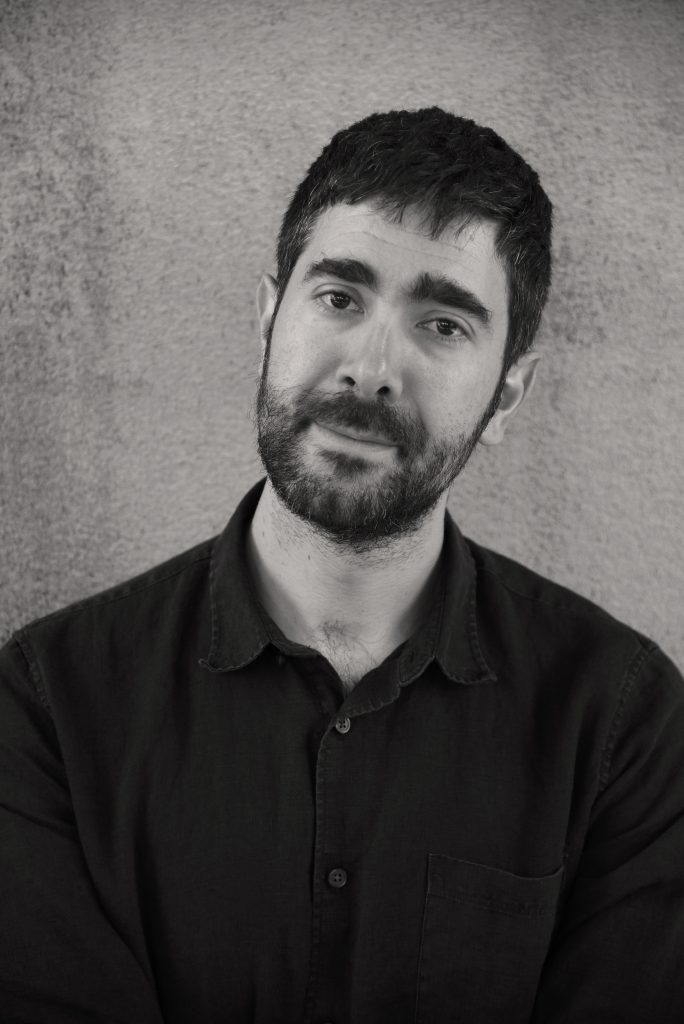
David Leo Rice is the author of the novels Angel House, The New House, The Berlin Wall and the Dodge City Trilogy, as well as the story collections Drifter and The Squimbop Condition. Originally from Northampton, MA, he currently resides in NYC and is online at: www.raviddice.com