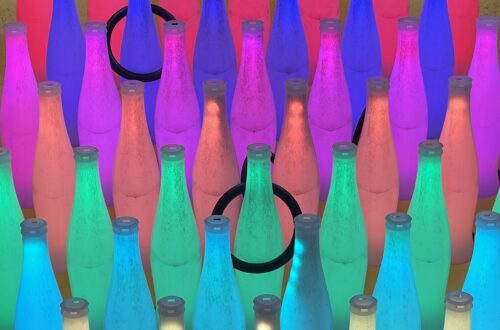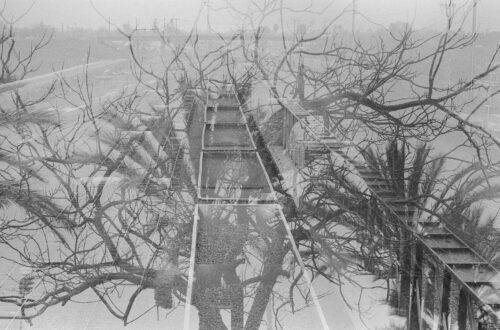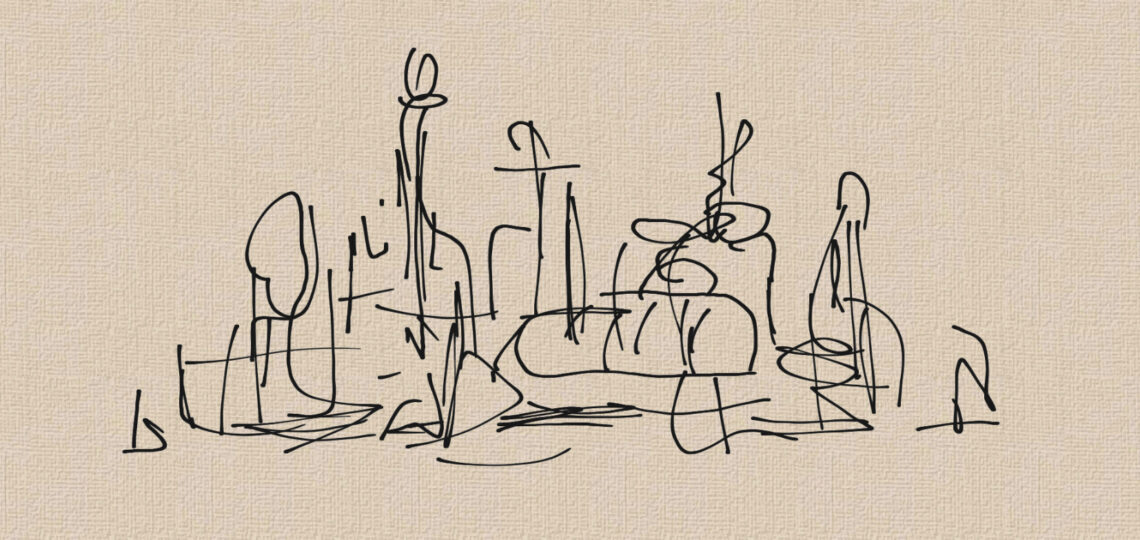
Three Models of a Completely Empty Notebook
art by Suzana Stojanović
by Marushka Rose Grogan
Section 1: Introduction
For years, I’ve sensed my life colliding with the snapped-string signs
That used to tie
Atoms, you, and me.
The first thing you must know is that this book is completely empty
It’s the only way I was able to keep it all
Organized
The first thing you must know is that these pages are now full.
Nothing between the spine except pages
I simply must find a way to keep them organized.
And nothing between the pages except –
Words
Hold what can be described
Or organized;
And beyond – lies everything
Never formed, at least by current models
Of communication.
The newly-symboled thing becomes
An object minds can share.
From sharing, understanding;
And now, it’s different than it was –
As things now stand, I believe my current work
Cannot be shared.
Although this body of knowledge almost breathes, I lost my firstborn tongue –
Now, I form only new-made sounds.
That’s not to say this book isn’t full
I’ve left so many pieces here between pages but
These are what must be placed
In order.
Words send them all scattering to hide so
It’s very important to keep quiet as you look
You must never use words.
The clearest I can say is this:
It is like holding in my hands a book that was never written.
Like turning my eyes towards understanding that is tasted only through
The overflow
Found in any truly
Blank
Page.
Section 2: Precision & Accuracy for Missing Things
Here are some things stored between pages.
2.1 Measurements of the holding capacity of silence
I’ve been dropping sounds in each second, my whole life, and
It’s still not full.
My calibration sometimes fails, and then I think of frogs and wells.
Imagine then this well, built so frogs can fall –
Can leap, as liquid,
The surface-tensioned fullness of
All polar bonds’ rush to meet
Non-polar lovers
(Sparks are no right word for such
Concentric
Meetings –)
The echo-walled smack of drops in shimmer-oiled fling when
Air gives way to frog-fraught oscillation. Frogs know, in their mimic of –
(But just before:
Just before it smokes, oil
Is all stillness. Just ripples inside clear
Clear as ripples in space that a frog makes,
Leaping – )
That is a true mimic, and that
Is what I
Polar substance that I am
Have been dropping into, this whole time
Of –
(And I know the heat is smitten with the drop-tensioned embrace of
Poised
Collision – )
How much more can these all and I
Fit/collide inside?
2.2 Worksheets of point problems in space (you, there; I, here)
For years, I’ve had the sense of my life colliding with perfect silence.
But not – you –
You’re there, my non-polar quality who knows all I don’t, and
My only point of contact is
Speechlessness.
Out of my resolve/dissolve, a graph:
Here’s a thumbtack, there’s a string
Push. Through the cork.
The distance between these elements means
Everything.
Somewhere, it’s measured through numbers’ eyes
Which means
A solution (resolution?).
But: I get lost in “x.”
Because a variable is
Too wide a swing of
Uncertainty
So it’s just a circle.
Just a line with bias towards
Concentric ordered state –
Well, look around: that’s a solitary fate.
And I just trace around you
On a string.
Instead of ever
Solving for –
Anything.
2.3 Schematic of a tool for making measurements
Part A is the first part. Part B is the second part.
Part B must fit into Part A.
Here is the challenge:
Part C is a party that circles both of
The above like
Gravity, so that
All are caught.
(Here, my notes are
Fractal.
My thoughts aren’t caught.)
To summarize:
Part A is of a shape that
Is indescribable. One (1) is included.
Part B is of a shape that is
Deeply frustrating. One (1) is included, my apologies.
Part C is not included.
Part C is
Utterly essential.
My apologies.
(Fig. 2.1) Here is space to draw a 2D model of a 3D frog colliding with silence.
(Fig. 2.2) Here is a clearly labeled diagram of Part C. It is utterly essential to this understanding.
Section 3: Ambiguous Taxonomies for Unseen Things
Here are some things that are missing from pages.
3.1 Circular pocket dictionary of ambiguous terms
Words impose a method of organization. Once a meaning is agreed upon,
That thing becomes an object that minds can share. But:
I get lost in “x.” The point where meaning gives birth to
Itself. To itself and –
I can’t use the right words, even ambiguous ones fail. Variables
Are invaluable, in this regard: therefore, we will designate “a” for me and
“b” for you and “c” as that third point which
Every system
Must hold/behold/be held by like
Gravity – and to understand that –
But instead, like gravity
These variables sling me back towards words – words – That impose a method of –
3.2 Dartboard-shaped copy of The Ethics of Attention (rare special edition)
In the course of my research, Variables served well for a long time. Thus:
Part A was always at the center.
Part B was always that which fit into
Whatever
Part A made the center of.
And Part C –
I cared only this: that it was the part at which
Variables
Stuck. Like
Snapping the end of a string pierced by
A thumbtack –
And one day, I felt myself to be that string pierced
By a thumbtack. And knew I was transcribed by –
Some
Circumference
Of collision, concentric variables.
And so now I seek –
3.3 Notes on three geckos re-balancing a wall
When one is here, the other is there, and the third is
Not to be seen. The third is
Deeply essential to this structure
The third is the foundation outside the wall.
What point in a wall if there’s no outside?
What point in outside, if I see it?
And what point in these words, for
They aren’t the pieces I tried to hold. But
Polar substance that I am, all walls have sides
Like a circle of string
Like the circle is made by all
Outside –
Like geckos make walls
Visible
By balancing.
(Fig. 3.1) Imagine a diagram of a wall shaped like a variable.
(Fig. 3.2) Imagine a diagram of a wall made real by space.
(Fig. 3.3) Imagine the third gecko.
Section 4: Variables of Containment
Here are some things from the outside of pages.
(Fig. 4.1) Diagram of a box that is a hole in everything and holds: frogs geckos string one
thumbtack a hole a box the inside of a box butterflies
A variable is a hole cut perfectly in a page.
See, here’s the page with the scissors.
I tried to keep this notebook empty for variables
I tried to leave these theories so full of holes that –
That I will never know answers.
One day I heard about a box that held everything and nothing
Until opened.
I filled my words with holes, for butterflies to fly through. Thus,
Part A could be everything, Part B could be nothing, but
Part C is likely to be
Chrysalis –
Cut into this page just so; cut here and here and here.
Fold like this, and crease like this.
Slide your polar nail down the non-polar edge and weigh all butterflies not within
Then wrap these pages into a box. Or –
Forget, partway through
How corners collide: edge plus edge plus edge makes three
(Sparks are no right word for such
Concentric
Meetings -)
Butterflies, in this model, are always the third thing:
As good a word as variable, and
Better than words
When language
Takes flight.
This box was folded from a poem written in butterflies.
The poem was about anything
At all, until the butterflies flew in. It was while you and I passed
Mismatched letters –
They poured up past the pages’ spine,
Landing where the 2D tripped,
Tasting with their string-like tongues the petalled meanings
Paper
Couldn’t measure, nor Any longer
Fit –
Except by flexing free
Its cornered edges
To make wings.
And that’s exactly what it’s like.
Us, discovering all words are butterflies, taking flight.
So that’s why this notebook is full of pieces
That’s why to read, you must set down your box,
Cut a hole in this page,
And –
(Fig. 4.2) Imagine a completely empty notebook in three parts
(Fig. 4.3) Taste with string-like tongues the sound of atoms, and two hearts
(Fig. 4.4) Then make a chrysalis
Section 5: Afterword
In the library of chaos, there is
Just one title
And it is always
Missing
A hole
A variable
Balancing
Empty
Hatching
Taking flight
…
If you can read butterfly wings, you’ll understand.
Marushka Rose Grogan lives and writes in Austin, Texas. They work where fluidity collides with objective documents to examine how language fails or fulfills identity, self, and the sacred. They also publish online as Skeleton At The Feast.
Suzana Stojanović, an artist and writer, studied literature at the Faculty of Philosophy of the University of Niš in Serbia. She is the author of the book “The structure and meaning of the border stories of Ilija Vukićević” and many literary, artistic, and philosophical texts, short stories, satires, essays, and poems. She is the recipient of the 7th September award of the city of Vranje, public recognition for exceptional achievements in the category of education, and for the numerous prizes won in the field of art, musical, and literary creativity. Many of her artworks are to be found in private and public collections in the USA, Switzerland, Italy, Denmark, Croatia, Montenegro, Slovenia, and North Macedonia. Her work has appeared in “Cardinal Sins”, “Your Impossible Voice”, “Fiction International”, “Mount Hope”, “Barnstorm Journal”, and elsewhere, and has been nominated for the “Best Small Fictions 2023” anthology.
 https://www.suzanastojanovic.com