The Pool
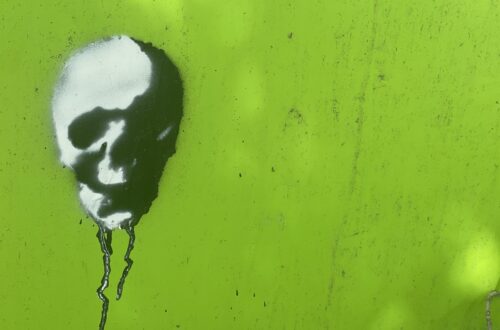
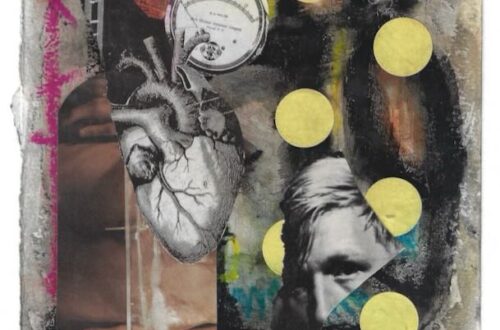
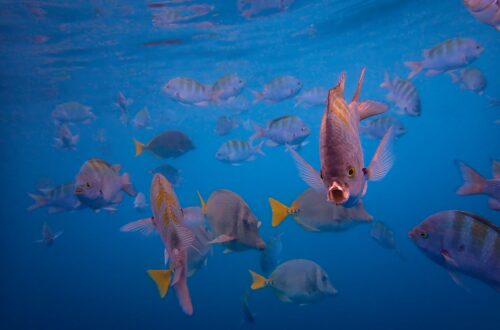
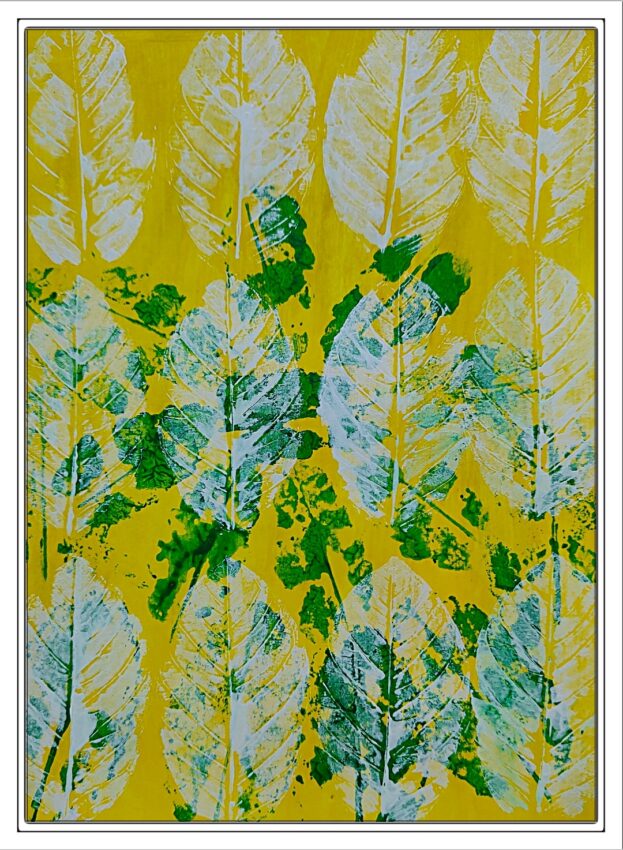
art by Reena Choudhary
by Joan Schweighardt
It was a quarry long before it became a pool, a huge pit site from which mortal men plundered Mother Earth for her sand and gravel. The booty was used to make concrete and asphalt, which in turn became buildings and roads. The locals who knew about the quarry called it “the pit.” Those who lived near it—and there weren’t many back then—warned their children not to play there. But some of them did anyway.
Vertical sand walls—even those propped up with timber—are unstable and known to cave with the slightest provocation. Sometimes they swallowed heavy machinery that had been left to sit over a weekend. Sometimes they swallowed children, the bad kind, the ones for whom DANGER/KEEP OUT was a taunt, as enticing as hearing their own name in the mouth of the right person.
Eventually the quarry was abandoned and it began to fill up with water—contaminated water. The town was expanding by leaps and bounds by then, and there were more and more houses going up in the vicinity of the pit. In spite of the risks, or maybe because of them, teenagers began to swim there. They liked the fact that the water was a moderate temperature in one place and frigid in another. And wasn’t it a thrill when the sand beneath their feet shifted and they had to fight to keep from being sucked under? Some of them cut themselves on abandoned machinery. Some simply disappeared, never to be seen again.
By the time my family moved to town, wise men had already determined that the only way to keep wayward kids from dying in the pit was to transform the pit into a pool. This meant draining the water and the sludge, filling in holes and covering rusted machinery with dirt and rock, reshaping the landscape to have a gradual lake-like entrance on all sides, adding a thick coat of fine sand to the pool floor, and creating a filtration system to circulate the water.
How we loved our pool. My best friend Elle and I walked there almost every day in the summers when we were ten and eleven and twelve. There was a half wall on either side of the grand entrance, and not knowing exactly what time her mom would pick us up, we climbed it and sat up top where we could see her even before she parked her car. She liked that; she liked us to be ready and waiting, leaving her not a single minute for worrying thoughts. You had to have a badge to swim at the pool; to get a badge you had to live in our town. True, everyone wanted to swim in our pool and sometimes people loaned their badges to out-of-town friends. But for the most part, the people at the pool were our neighbors, our schoolmates. Whereas once the space was a dreaded danger, now even moms as uptight as Elle’s were willing to let their kids roam free.
The people who drowned in the pit over the years were soon forgotten—except by my father, Big John, a quiet man who worked the nightshift, and, but for Sunday church, slept on weekends. He was a stranger to me; I hardly knew him. But I saw his eyebrow shoot up with interest on the few occasions when my mother mentioned my visits to the pool, and once, when I was in bed, I heard him tell her that the pool used to be a pit and that he knew someone whose son drowned when the pit began to fill with water.
I almost drowned myself once. Weeks before the summer between junior high and high school, my friend Patti fell in love with Robbie, a boy she hadn’t yet met but felt sure she was destined to spend her life with. Patti was beautiful, the most beautiful girl in our school. Robbie was a god, a shy boy with sand-colored hair falling over one eye and the physique of an athlete, which he was not; he was in fact a thespian, as was his girlfriend, Kay, the second most beautiful girl in the school. The big difference between Patti and Kay was that Patti was popular—a leader of cheers, a twirler of batons, an organizer of school rallies, whatever the occasion called for. You could not as much as whisper her name without envisioning the flash of her bright white smile, her short-pleated skirt and oversized white sweater with its huge S, a chenille varsity letter designating the name of our school (and town), red with a black border. Kay, on the other hand, was known mainly for her emotional instability. She and Robbie, said people in the know, had a highly turbulent relationship. She was always breaking up with him and then insisting they give it another try. She got good parts in the school plays but never leads, possibly because her voice was thin, more likely because every now and then an ambulance came screaming into our consciousnesses during school hours, and those of us who sat near the windows saw attendants rushing in the door that led to the nurses’ office and coming back out with a girl whose straight platinum-blonde hair was so long that it hung over the side of the stretcher like a silk shawl. That was Kay. The rumor was that she sometimes didn’t want to live, that sometimes she tried to slit her wrists. Envisioning Robbie and Kay together, the depth of the secrets they must have shared, the intensity of the sex—or what passed for sex in those days—was enough to make Patti swoon with desire, as were the amazing reconciliations she imagined they enjoyed with their break-up-to-make-up routine. Who didn’t love drama at that age? Who didn’t live for that rush of feeling, that burst of passion that felt like the meaning of life itself?
I made the mistake of telling Patti I knew Robbie, which was not quite a lie. He was in one of my classes, and while I had never spoken to him, we did share half smiles when we passed each other in the hallways.
That was all it took. She insisted I introduce them. But in order to do so, we would all three have to be in the same place at the same time, and given our class schedules and the size of our school, that wasn’t possible. However, I had seen him the summer before at the pool, several times, sitting quietly on a rock with a few of his fellow thespians, thespians and poets, all of them, back near the tree line, passing cigarettes, or maybe joints. We were nearing the end of the school year by then, so Patti resolved to be patient. Secretly, I hoped she would fall in love with someone else before the time came when I would have to introduce them. But that didn’t happen.
And so it came to pass that Patti and I went to the pool as often as possible that summer. I walked, as I always had, alone, because Elle and I had outgrown each other by then, and Patti, who lived on the other side of town, got her older sister to drop her off.
The pool that had once been a pit of death was swarming with life when I arrived each day, usually in the early afternoon. People of all ages sat on towels or in canvas beach chairs chatting with friends while they gazed out at the water. Older women wearing white bathing caps stood in it, up to their knees. Young moms, ankle deep, toddlers, their pudgy faces deep in concentration as they shoveled wet sand into plastic buckets, at their feet. Older children splashing and yelling. Blow-up rafts. Swim tubes. Umbrellas here and there on the beach. Lifeguards, all boys I knew, sitting on their high white thrones watching we girls stroll by in our bikinis. People coming and going from the concession stand with its blue canvas awning edge fluttering in the breeze. Blue sky. Hot bright sun. The center of the universe. Our pit turned pool. And there in the middle of the blue-brown lake, painted such a bright aqua that you could hardly bare to look at it, our dock.
I had only to stand still and look around when I arrived each day to spot the girls I knew from school—some sitting, some standing, thin arms crossed under small breasts, long straight hair in every color—and locate Patti. She was usually at the center of the cluster, talking, because everyone wanted to hear what she had to say. But she kept an eye out for me even as she entertained the others, because I was her best friend that year, her side kick for reasons that were unclear to me, and when she saw me, she picked up her towel and her straw beach bag and headed my way. Once we were together, we positioned ourselves so that we had a good view of the kids who sat up by the tree line—and we watched. If we talked at all, it was in whispers. Sometimes Robbie was not there. Sometimes he was but he did not come down near the water. And a few times when he did come down, it was to stand at the water’s edge and talk to one or another of our lifeguards. Once Patti suggested we walk up to him, just wander into his private space where he sat with his thespian and poet friends over by the tree line. I would have sooner jumped off the high dive with my bathing suit on backwards—a fact that was likely evident in the way I shook my head and mumbled no way because Patti never asked again.
And then one hot day in late July it happened; Robbie left the shelter of the trees and the company of his fellow thespians and walked down to the beach and past the lifeguard stands and into the water and swam to the brightly-painted dock and climbed up the wooden ladder and sat there, on the edge, his feet dangling, staring at nothing. This was it, the moment we’d been waiting for; Patti would meet Robbie, and I would get the promised introduction behind me for once and for all.
We got up together, shared a look that confirmed our shared purpose, walked past the moms and the toddlers, past the old ladies in their white caps, past older children splashing, screaming laughter. Deeper and deeper we went, beyond the few serious swimmers, until we were up to our necks, and when our toes no longer touched the smooth floor of fine sand that covered the corroded machinery and the bones of the dead, we began to swim. We were both good swimmers. Every kid who spent summers at the pool was. Look left—the scene at the beach, so many smiling faces—look right, Robbie, pensive, perhaps thinking of Kay—look left, bright sun, couples strolling hand in hand—look right, pensive Robbie, the brightly-painted dock. Left, right, left, right, and finally, the ladder. Patti, confident, ready for action, climbed up first and stood there, somewhat behind Robbie, in her light blue bikini, her brown-blonde hair dripping, her green eyes twinkling with anticipation. Then I climbed up. “Robbie,” I said, as though surprised to see him, as though he was a long lost friend. He jolted out of his reverie and looked my way. Perhaps he didn’t recognize me with my hair wet. He seemed confused, and I thought he was about to say, Who are you? Do I know you?, and how I would answer remained, in spite of seconds ticking by, a mystery to me. But then Patti stepped forward, and somehow the words dropped from my mouth with the grace of rough-cut stones. This is Patti, this is Robbie. And deeply shaken by my ineptitude, I jumped back into the water.
I swam out seven or eight feet, then turned and glanced their way. Through the blur of my water-logged eyes I saw him say something through his shy smile; I saw her flash her wide bright one and sit down beside him. I smiled too. Mission accomplished. Anyone could see … And then … Then.
Someone beneath me grabbed my leg and began to pull. I threw my arms in the air and tried to scream. I glimpsed Patti and Robbie, talking, smiling. Then nothing. I swallowed water. Kicked madly. Could not get free. I was being tugged away from the surface, away from the light. I threw an arm up once more. Through the black distance I saw Patti then, her face looming, disturbed now, Patti propelling herself from the dock and into the water. Patti, coming closer, reaching for me, grabbing my shoulder.
And all at once the culprit was gone. My leg was free. I rose to the surface, coughing, choking, crying, snot bubbling out of both nostrils. Patti shaking me hard, saying words I could not hear. Robbie, on his feet, shouting down from the dock, raising his hand to shade his eyes from the hot white sun, looking beyond me, turning left, right, reporting down to Patti. Nothing, his face said. I see no one. Her response just as obvious. Keep looking; the culprit has to rise to the surface. But that’s not what happened.
There were times that summer when the dock was full of young people. This was not one of them. It was only the three of us. I saw nothing as I climbed shaking back up the ladder—except my father, a man I hardly knew, lifting his eyebrow. I heard him say, It used to be a gravel pit. A guy from work, his son drowned there.
The incident gave Robbie and Patti something solid to puzzle over, Robbie the boy god on one side of me and Patti, the most beautiful girl in our school, on the other. Patti kept her hand on my back, but she leaned forward, her eyes on Robbie. Robbie leaned forward too, his eyes on her. I hugged my knees to my chest and rocked; Had I been younger, I might have sucked my thumb, or at least bitten my fingernails. I was that frazzled. It was hot on the dock, and though we sat there for what seemed hours, I couldn’t get warm. My jaw wobbled side to side, like a gross mechanical thing. Someone had tried to drown me. Yet I had never said to myself, I might drown, I might die today. That surprised me. I supposed the fear that shot through me did not leave room for thoughts or words. But I was thinking words now. I had no enemies. Whoever had tried to drown me had simply wanted to kill, perhaps the way Patti wanted to love, the way Kay wanted to maybe die. The answers—we all know when we are young but sometimes forget when we grow older—are always right there, at the very extremes of human behavior.
Or maybe—I thought that night, safe in my bed, I think now, safe in a life already long and well-lived—the energy that engulfs a pit, a pit full of shifting sands and corroded machinery, a pit that swallows children whole—remains in place, even when you drain it and cover it over with dirt and rocks and a thick floor of fine sand—waiting for a chance to manifest again. Energy, every school kid knows, cannot be created or destroyed; it can only change from one form to another.
We all have our own version of what happened that day. For Patti and Robbie, that was the day their relationship began—and a thing of great beauty it was, though in truth it did not last that long—and my almost drowning, if they think of it at all, is merely incidental, a footnote, a sidebar. But for me that day saw a burst of evil energy rise up through a body of water tamed by reason, a force, one might say, for thespians and poets to coax it into subtler forms.

Joan Schweighardt’s fiction includes a historical trilogy Rivers, based on the South American rubber boom, a novel The Last Wife of Attila the Hun, based on the intersection between the known history of Attila and legends from the Poetic Edda, and more. The Art of Touch, an anthology she conceived and co-edited published by the University of Georgia Press in 2023. In the Wonder, is a historical novel based on the life of a 17th century naturalist and artist that is forthcoming from Regal House Publishing in 2027. Her essays have appeared in Halfway Down the Stairs, Women Writers, Women’s Books, The Coil, Hypertext, Lit Reactor and more.

Reena is an artist from India she believes that art has no limits and is a powerful way to express emotions, imagination, and the beauty of the world. Biggest inspiration is nature, she enjoys capturing its colors, landscapes, and quiet moments, which often influence her creative process. Her artwork has been published in numerous print and online publications, including The PERCH Journal, The Climate Art Collection, Aunt Lute, Judy Magazine, Farm Girl Magazine, Art Axis Project, January House Literary Journal (T-Art Press), Wildscape Literary Journal, A Journal of Literary Oddities (Ringling College of Art and Design), Hiraya Literary, The MacGuffin, and Club Plum. She was awarded the Silver Medal in the Khula Aasmaan India Art Contest (2025) and received a medal and certificate at The Indian Art Fest (2026).