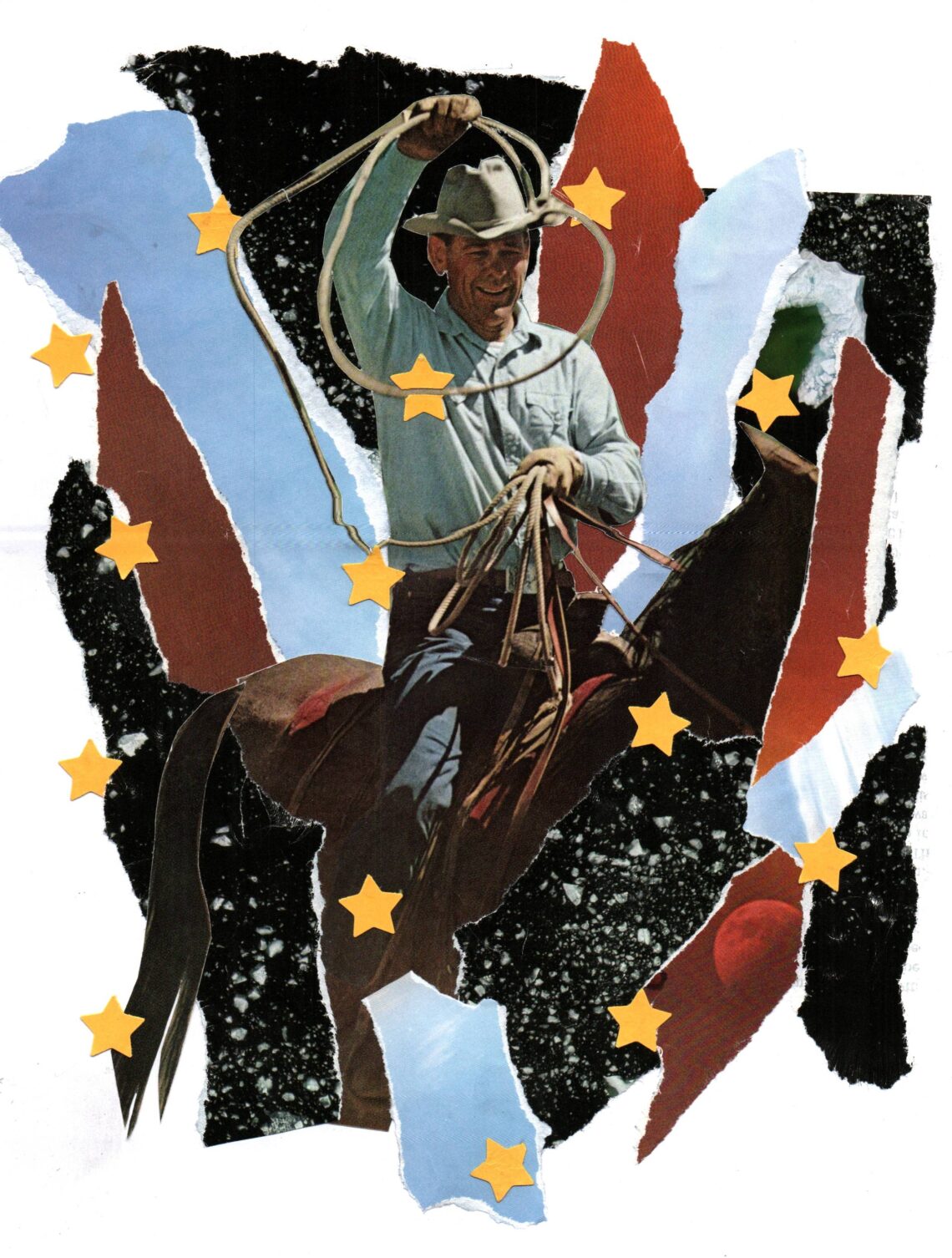
A Life in Reverie
art by Kale Hensley
by Joseph Gilbride
When I was ten, my imaginary friend was born. I was lying on the sofa in my parents’ living room, struggling to sleep amid a thunderstorm. During strong storms, I would retreat downstairs from my bedroom to put more walls between myself and a potential bolt of lightning. At that age, I believed in God and was frightened of thunder, understanding that, when punishment needed meting out, lightning was His weapon of choice.
What punishment I deserved related to my tendency to fib. In the schoolyard, I spun tall tales that exaggerated my prosaic home life, if only mildly. I told kids I owned a pet parrot (my family had a dog and cat), I had three older brothers (I only had one younger one), my backyard had a large in-ground swimming pool, complete with a diving board and tube slide (we only had a swing set and a plastic, turtle-shaped sandbox). Basically, I was that kid. The “my-uncle-works-at-Nintendo” kind of fabulist whose lies are so easy to refute it calls into question the intelligence of the liar.
However thick, my thinking stemmed from a belief that the characteristics of my life—stripped of the flourish of fibbing—wouldn’t interest anyone. If my yard didn’t have a super-cool in-ground pool, who would bother to visit? After a while my lies began to bore me, as they did my peers, so I started to construct an elaborate fiction that I wouldn’t share with anyone else. I made myself a friend.
All children play make-believe, and many have imaginary friends. That night on the sofa, as thunder crashed overhead and I tried to escape to a safer place in my mind, I fabricated an alter ego whole cloth. This friend wasn’t really a friend; we didn’t talk or interact. He was a boy whose life would parallel my own, who would do all the things I couldn’t, go places I could never visit, and become someone I could never live up to. This boy would grow into a man, and the continuous daydream that constituted his life wouldn’t stop playing in my head until I had reached an embarrassingly late age.
His name was Kyle. Over the years, the details of his being changed so frequently and so wildly that he’s tough to describe. One trait that never wavered was his height. Where I was the shortest kid in my grade—shunted to the front of the crowd on picture days—Kyle towered over his peers. This lent him credential enough to play basketball on his bizarre school’s team. At recess, where basketball was the sport du jour, I made for a hopeless athlete. Because I was so short and my arm strength so feeble, I couldn’t sink a basket on the court’s ten-foot hoop, nor could I retain the ball while dribbling. Sometimes I was “benched” even though I was my team’s fifth player. Kyle, however, excelled. His game was a hybrid of Kareem Abdul-Jabbar’s and Allen Iverson’s, except he was white. (Within the logic of my daydream world, he was actually half-white, half-Pacific Islander. He claimed heritage from Gwaquesia, a fictional archipelagic nation borne from a mélange of Polynesian and Caribbean influences. In real life, I had a friend who often vacationed to the tropics with his family, and he was always boasting about his adventures in Aruba or Jamaica or Maui.) Other real-life influences inflected the Kyle World I was building. While I grew up in suburban Pennsylvania, Kyle lived in exotic L.A.—where I had cousins whose California coolness needed no assistance from fibbing.
The more I toyed with the variables of Kyle World, the more my daydreams morphed into delusions of grandeur. Kyle became so good at basketball he was recruited to a top college team, wherein he won several consecutive NCAA championships. Then he was drafted by an NBA team, wherein he won several consecutive MVP and Larry O’Brien trophies. At one point, when I was deepest in my adolescent devotion to God, Kyle moonlighted as a preacher and returned to his ancestral archipelago to convert Gwaquesian heathens who still clung to their polytheistic faith. As Kyle World matured into a broader Kyle Cinematic Universe, Kyle became a frequent news item. He achieved glory as a sports legend, a rock star, a Che Guevara–like revolutionary—all before the age of 30. By the time he was ready to have children (with his, naturally, smoking-hot wife), Kyle had conquered enough pop-cultural and political territory to rival Alexander the Great. It was at this point I realized I had a problem.
In real life, I wasn’t doing so well. Social anxiety had stalked me from high school to college. As a freshman I failed to make friends on campus and developed agoraphobia. Come winter I couldn’t leave my dorm. I would camp on the bed in my triple for days on end, accumulating absences and skipping meals to the point of severe malnutrition. My roommates said nothing; we didn’t talk. By the end of my second semester, I had failed each of my five classes. I was so paralyzed with fear of the outside world I wouldn’t even visit my counselor to request withdrawals prior to the deadline. My rock-bottom GPA landed me on academic probation, and I moved back home.
I was aware of people who had mental health issues that involved imaginary people and things, voices in the head, stark breaks with reality. My IRL island-hopping friend had taken pills over several years for his ADHD, for which mind-wandering is a noted symptom. My mom, who worked several years as a psychiatric nurse, told stories of patients who suffered from schizophrenic delusions and dissociative identities. I suspected my Kyle-centric scenarios were abnormal, but my daydreams seemed too peculiar and embarrassing to explain to anyone. Or maybe there was nothing unusual about them at all. Maybe my daydreams were just that: daydreams. After all, doesn’t every child—and many adults—play make-believe?
*
Over the past two decades, a campaign has grown in corners of clinical psychology and the internet to recognize a new type of mental disorder called maladaptive daydreaming, or MD. Those championing the new disease’s classification within the DSM-5, the taxonomic bible of psychiatric diagnoses, insist it is distinct from other recognized disorders that involve fantasizing or hallucination, like schizophrenia and bipolar disorder. Maladaptive daydreamers drift into vivid recurring fantasies as a compulsion, most often when bored or upset, and especially when listening to music, which intensifies the experience. These flights of fancy become so entertaining they erode everyday life. Stuck in hours-long trances populated with imaginary figures and real people transposed into imaginary scenarios, daydreamers put off their real-life obligations to the point that they suffer professionally, academically, and socially.
Much of the research into maladaptive daydreaming has been conducted by the psychologist who first coined the term in 2002. Dr. Eliezer Somer, who studies the psychological effects of stress and trauma at the University of Haifa in Israel, noticed in his clinical practice that six of his patients exhibited unique yet similar symptoms that he had never encountered before in combination. It was clear they weren’t schizophrenic, hearing or conversing with disembodied voices, nor were they cultivating a dual personality, as someone with a dissociative identity disorder might. In their heads, Somer’s patients had each constructed their own elaborate fantasy worlds featuring parallel versions of themselves, their friends, families, celebrities, and fictional characters, and they retreated to these worlds with great frequency over the course of their lives. Although they each found the practice unhealthy, none of them felt they could stop. Daydreaming, to many an idle pastime, had become, for Somer’s patients, a drug.
Often the fantasies emerged following a period of trauma or prolonged negative feelings. They nearly always began in childhood, when inhabiting such fictions is nothing out of the ordinary. The seeming ordinariness of the condition—“it’s just a dream”—might explain its obscurity in the mental health field until recently. Nearly everyone has engrossing dreams, children play make-believe and talk to imaginary friends with aplomb—and who doesn’t get lost in wishful thinking every now and then? An earlier phenomenon, the fantasy-prone personality, was first studied in the 1980s by psychologists interested in hypnosis. Researchers found about 4 percent of people were disposed to an “overactive imagination” and such people were also, as a consequence, “highly hypnotizable”.
But the odd traits many of Somer’s patients shared led him to theorize they had something more adverse than active imaginations. His patients would retreat like monks to their bedrooms or bathrooms and play out scenarios while rocking back and forth atop a stool or toilet (none of this with the aid of narcotics or psychedelics). Some would pace around the room while daydreaming. Others spun like dervishes and displayed other physical tics that resembled obsessive-compulsive disorder or autism. Because of their habit, patients grieved over missing great chunks of life—some said 60% or more of their waking hours were spent in dreamland—and, as a result, felt deeply unfulfilled or lived precariously. Many had suffered abuse as children. Many had suicidal thoughts as adults.
In any mental health diagnosis, boundaries blur between what constitutes an outright disorder, what is only a symptom of one, and what is simply an unwelcome but harmless mental state. Feeling sad sometimes isn’t a disorder. Depression is. After Somer identified excessive daydreaming as an as-yet-undiscovered disorder, others in his field countered that the symptoms didn’t sound as novel as he described and might more accurately equate to a type of obsessive compulsion or a form of addiction, like alcohol or gambling. Some of Somer’s peers are wary that maladaptive daydreaming may be a figment of the medical imagination.
Dr. Jonathan Raskin, a psychology professor at SUNY New Paltz, criticized a 2022 recommendation by Somer and his colleagues to add maladaptive daydreaming to the DSM, writing in Psychology Today that the proposed disorder represented a clear case of the “DSM-ing” of everyday life.
“Many of us work long days and don’t exercise sufficiently,” Raskin writes. “Do we have ‘work-focused lack of exercise disorder’? Others of us stream television shows more often than we’d like. Are we suffering from ‘Netflix preoccupation disorder’? How about those of us who don’t eat as balanced a diet as we should and find ourselves with less energy to accomplish goals? Are we afflicted with ‘dietary self-sabotage disorder’? The list of prospective mental maladies is endless.”
Within psychopathology—the study of mental dysfunction in and of itself—the process of legitimizing a new disease can be as agonizing as experiencing one. Modern medicine relies on batches upon batches of clinical trials, long-term studies, and peer-reviewed research to establish a consensus on any novel idea. Scrutiny and suspicion are to be expected. But while doctors deliberate, patients throw up their hands. After Somer publicized his daydreaming research, his inbox bristled with accounts from people around the world struggling with the lonely feeling of having something wrong with them that no one had yet found words to describe.
“MD is ruining my life,” complained a 20-year-old German student, in an email, to Somer. “It’s always there, every second of the day. It’s like a parasite in my brain and I just can’t get rid of it. However, when I experience what I call moments of silence (when suddenly my inner TV shuts off) I am overcome by a drastic fear and always start crying uncontrollably. It is taking me apart slowly.”
A scroll through the r/MaladaptiveDaydreaming subreddit, host to more than 120,000 members, reveals a steady stream of woolgatherers discovering for the first time that others share the strange experience they’ve had for much of their lives. Users discuss not only their symptoms but the ambivalent response of the medical community to them. There is consternation at professional misdiagnoses, frustration over failed treatments, and disgrace when doctors laugh off patients entirely. A baffling aspect of the recurrent daydreams and their correspondence with everyday life is that they feel at the same time too regular an experience to raise anyone’s eyebrows and so shameful as to warrant close guarding—for fear they may be symptomatic of a very troubled mind, the sort that makes lists of people and plots of doing them harm.
If it’s too early to imprint maladaptive daydreaming in the DSM, Somer believes it should be more widely recognized to be treated effectively. But other psychologists have argued there are more roundly understood afflictions for which daydreamers’ symptoms seem to fit. The inclusion of a “daydream disease” in the DSM could blacken the reputation of daydreaming itself. Because daydreaming, by and large, is a sign of a healthy mind.
*
Our modern understanding of daydreams is built on ground broken in the middle of the last century by American psychologist Jerome Singer. Together with his colleagues Singer devised novel experiments that probed the nature of inner experience. Working before the development of brain scans, Singer equipped participants in one study with a pager that would beep randomly as they went about their day. After each beep, participants recorded what they had been thinking in that moment, what they had been doing, and how they felt. From the data, daydreaming appeared ubiquitous; participants led nearly half their lives lost in thought. This and other experiments led Singer to propose that when focused attention is not needed, the human brain shifts into a distinct, low-activity state—and this state made up a plurality of the brain’s function. Since then, advances in MRI have allowed neuroscientists to map the brain’s “default mode network”, the neural circuitry that alights when one is awake but not attending to a task. The default mode network is the likely source of all our idle thoughts: self-reflection, mind wandering, recollection of the past, visions of the future, and daydreams.
No area of human cognition has received more study in the 21st century than the default mode network—because it plays a vital role in how humans learn and remember key pieces of information, understand language, regulate emotions, and make social connections. By understanding the default mode network, neuroscientists have come to understand that some amount of idleness is necessary for us to live fully. For most of history, daydreaming seemed an obvious waste of time. In today’s distraction-dense world of social media brainrot and constant connectivity, it may be medicine.
But when a mind wanders far outside the familiar territory of idle thought, is there a problem? In the 1980s, a team of British psychologists became interested in the imaginary realms some children, among them many famous authors, cultivate as a form of play. What the researchers called “paracosms” were private fantasy worlds full of imaginary places, peoples, cultures, politics, languages, and even gods. Children revisited their worlds over many years and tinkered freely with their rules, systems, and storylines.
Before creating Wonderland, author Lewis Carroll dreamed up a separate imaginary world whose details he published in a magazine he created for his 10 siblings. Earlier in 19th century Britain, The Brontë sisters, as children, created the lands of Angria, Gondal, and Gaaldine. Populated by giants, riven by civil wars, and dense with political rivalries, the Brontës’ imaginary worlds feature a colorful cast of characters: the bellicose Gondalian King Julius Brenzaida, his queen Rosina, his mistress Geraldine Sidonia, the willful Duke of Zamorna who was based on the real-life Duke of Wellington. The Brontës never published the poems and stories that took place in these worlds, but scholars consider them and their characters to be key pieces of juvenilia, the early writings that inform an adult author’s later published output.
Many British writers besides the Brontës have widely studied fantasy worlds formed in their childhood. C.S. Lewis, with his brother, created a world called Boxen, filled with anthropomorphic animals, before he dreamed up Narnia. Thomas De Quincey, who gained prominence in the early 19th century for publishing an autobiographical account of his addiction to opium, imagined a tropical fantasy island called Gombroon as a child. Literary critic and historian Anna Jameson, a Brontë contemporary, reflected on her own paracosm in her autobiography: “From ten years old to fourteen or fifteen, I lived a double existence…I carried on whole years a series of action, scenes, and adventures; one springing out of another, and coloured and modified by increasing knowledge.”
Historian Timothy Gao theorizes that the childhood paracosm arose alongside the development of the novel form in fiction from the 18th to 19th centuries, especially in Britain. The novel’s arrival as a new form of literature—hence the name—upset the traditional understanding of how a tale should be told. What most scholars consider to be the first English novel, Robinson Crusoe, published in 1719, was framed by author Daniel Defoe as a factual historical account of a castaway on a Caribbean island. It would be more accurate to describe this and later novels as “factual unto themselves”—they imbue fictional events with a deep sense of authenticity by borrowing the descriptive elements of reality. Gao believes this understanding—unremarkable to the modern reader but revolutionary to the 18th century one—influenced the minds of new generations of young readers who went on to birth their own “factual unto themselves” fictions in their heads. Thus, a new form of literature sprouted a new form of daydreaming.
Fiction itself has long featured characters with their heads in the clouds. One specimen is Walter Mitty of James Thurber’s 1939 short story, “The Secret Life of Walter Mitty,” who inserts himself into far-fetched scenarios—a bomber pilot, a world-class surgeon, the suave defendant in a murder trial—to distract from the errands he must run while his wife is at the hairdresser. Jorge Luis Borges, in his 1944 short story, “The Circular Ruins,” casts his own dream weaver—a traveling wizard who arrives at a ruined temple to meditate and dream another man into being. After years of intense rumination, the wizard succeeds—his dream man breaks the shackles of his mind and becomes real. When the temple catches fire, the wizard steps into the flames to meet his death, having realized his dreams. But amid the flames he feels no pain, and it dawns on him—someone else is dreaming him.
*
Amid the tangled skein of daydream research, I find it difficult to put a finger on my long-term attachment to Kyle World. Had I created my own paracosm, the juvenilia of an author-to-be? Or was I consumed by a harmful compulsion that was devouring my real life? A little of both, as I suspect is the case for anyone with a rapacious imagination.
Treatment options for excessive daydreaming remain scattered. Finding a therapist who recognizes the affliction is the first hurdle many face. But antidepressants, antipsychotics, and anti-anxiety medications have proven effective in reducing the desire to fantasize. Since bouts of daydreaming often occur in reaction to negative emotions or situations, psychologists also recommend treating those at the source. Mindfulness—a practice widely recommended for many forms of disordered thought—is another potent treatment. Because present awareness is essentially the opposite of daydreaming, mindfulness may prove especially difficult for daydreamers. But there is evidence the practice works well for those motivated to maintain it. In 2023, Dr. Somer teamed with colleagues to conduct a trial of maladaptive daydreamers who practiced mindfulness meditation and found that close to 40% of participants significantly improved their symptoms over a few months.
Though my ventures into Kyle World lessened as I got older, it wasn’t until the pandemic—when I turned 30—that I fully divorced myself from them. Faced with losing a year or more of my young life to the stifling interiority of lockdown, I had to acknowledge that a great deal of my time had already been lost to fantasy. I finally went to therapy.
I told my therapist how ashamed I was to have devoted so much time to a dream world and how ashamed I was to relay any of its details to him. I was afraid, too, of what would happen if I stopped daydreaming. Kyle World had served as a comfortable retreat from my distorted sense of self. Cozy in my private, parallel identity, I could avoid the rough edges of reality for a time.
Tearing down my dream world required a lot of presence and purpose. Grounding myself in the reality around me, no matter how uncomfortable, and figuring out why I wanted to inhabit that reality—why I wanted to be alive. For one thing, my therapist suggested, I liked to write, didn’t I? I liked to tell stories? There lay a clear road out of chronic dissociation and into a creative identity.
Sometime in the middle of 2020, I retired Kyle World. Slowly I stopped spending time there and busied myself with the kinds of dreams I wasn’t ashamed to share. A series of short stories, several drafts of a novel, essays, articles, terrible poems, a convoluted Dungeons & Dragons campaign setting. Fantasy still grips me, but reality even more so. In my writing practice, I keep a pocket-sized journal with me wherever I go. Sometimes I catch a scrap of funny conversation in a café and note it down. Or I’ll walk past a construction site and write a bit about what the workers are doing. Often the most ordinary details inspire me to capture a memory. The other day I wrote about how I was writing too much and my neck hurt. Nobody would want to read this kind of blather, but it’s my way of planting my feet firmly on the ground beneath me. It reminds me that life, however ordinary and quickly passing, is made of solid matter.
Joseph Gilbride is a writer based in Philadelphia. His work has appeared in The Molotov Cocktail and Triptych. He shares his home with his wife, cat, and pit bull.
Kale Hensley is a poet and visual artist from West Virginia. Their writing has appeared in Gulf Coast, Booth, Evergreen Review, Image, and Sonora Review. They were selected by Adele Elise Williams as the recipient of the 2026 Elmer Kelton Prize for Poetry and selected by Jaia Hamid Bashir for the Clarion Poetry Prize. Find more of their writing at www.kalehens.com.