Raft
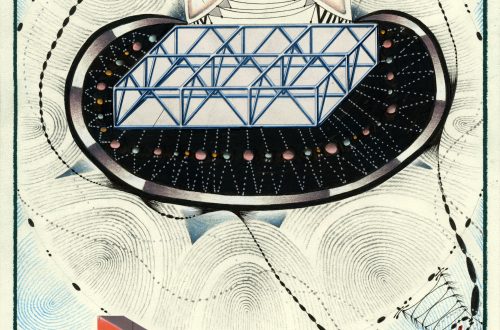
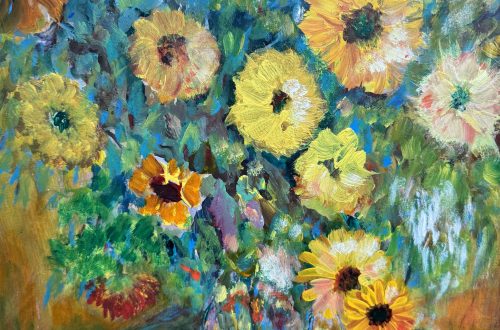
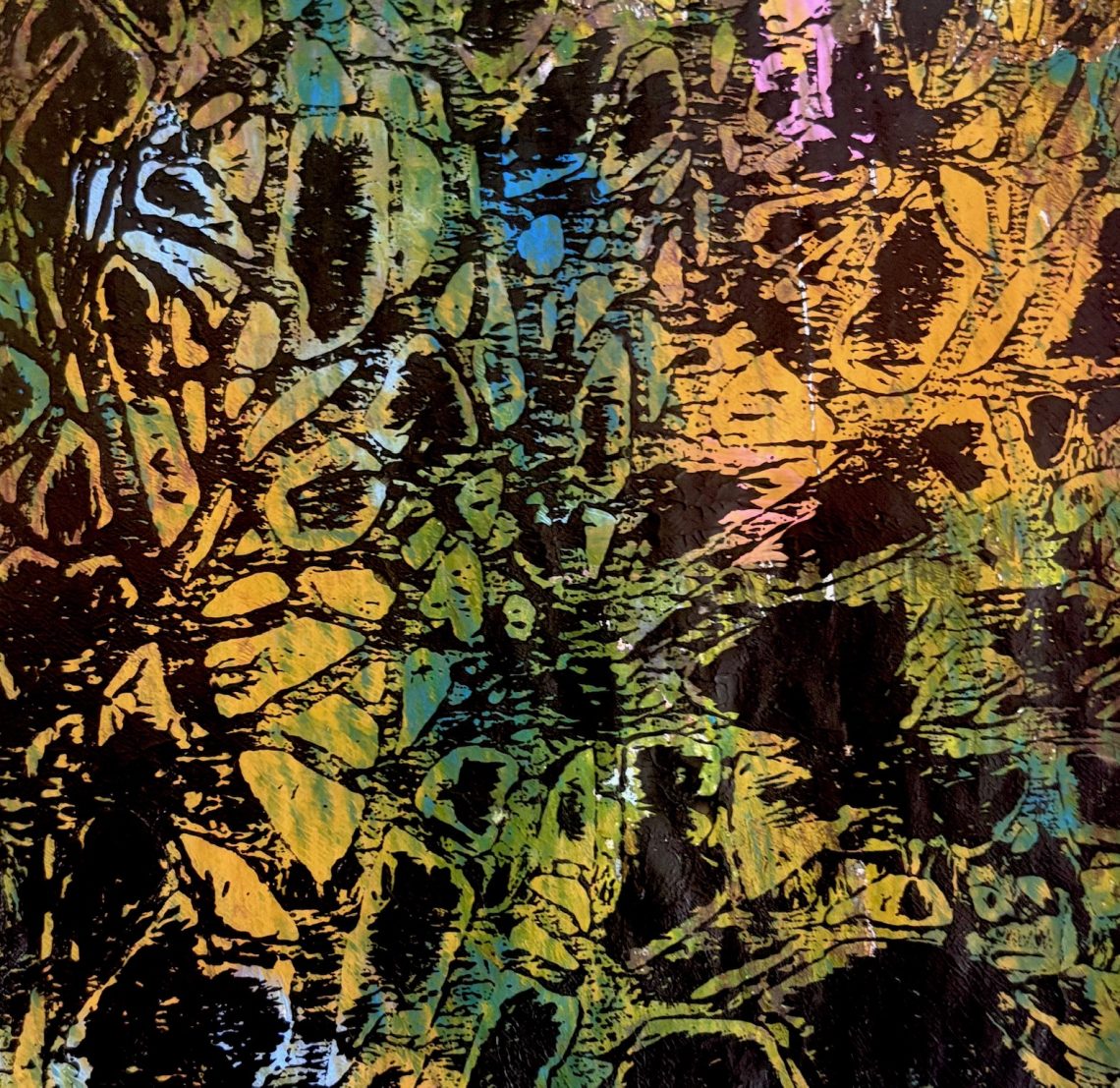
art by Cynthia Yachtman
by Terry Engel
My wife Shelley texts: “I’m going to a vigil for New Year’s Eve. It’s mostly singing readings quiet reflection peaceful. You’d really enjoy it.”
I’m paddling a kayak on the Forked Deer River a few miles away. The people in this part of Arkansas pronounce “Forked” with two syllables. The watershed drains a hundred square miles, most of it wetland, more lake than river, more swamp than lake. On the map the Forked Deer looks like the lateral veins of a leaf extending from the edges to the central vein, or the tines of a deer antler. The spindly tributaries converge into a single trunk and flow into the White river. Other than a few road crossings and isolated fishing cabins, it’s as wild as any place in the Ozarks. I come here most days after work, and Saturdays and Sundays when I can get away from the house. Great blue herons wade the shallows and belted kingfishers skim the surface and dip into the water. As dark falls beavers slap their tails and fish roil the surface. I hold a 1,200-lumen spotlight with a range of four hundred yards, powered by a twelve-volt car battery. Animals move all around me.
Shelley is following the Advent calendar for Christmas. She lights candles in a wreath, reads from the Book of Common Prayer, and attends Evensong services. Sometimes, because it means so much to her, I tag along, but what I really like is the deep grain of the oak pews and prayer benches, the filtered light through the stained glass, the reedy tones of the organ, the lilt of Father Burns’ prayers and the pomp of his robes, the spice of the incense and the oil of the wood polish, the images of Saints, the quiet anticipation of worship, the thump of the prayer benches dropping and the creak of hardwood floors as the congregation kneels to pray. I get why Shelley likes it: the ritual, the long history and tradition, the sense of permanence that has persisted for centuries. I am happy that she has found peace.
She knows that I’m looking for something out on the water, something meaningful, and even though she doesn’t know what I’m looking for, and even though I don’t know what it will mean when I find it, she is giving me the time and space that I need. Father Burns would call it grace.
* * *
In college I learned almost everything you can know about wood, down to the microscopic level. I know why a cypress tree grows in water and pine trees need dry sandy soil; why baseball bats are made from maple, ash, and birch; and why most paper is made from softwoods rather than hardwoods. I know how wood interacts with water, shrinking and swelling, and how insects and fungi decay wood. My degree in forest resources got me a job walking powerlines in Arkansas, Louisiana, and Mississippi, inspecting poles for ground-rot. I cruised powerlines across every type of terrain from mountain to field to swamp to suburb. The job didn’t pay much, so I camped behind electrical substations so that I didn’t have to spend my per diem on motels. I read a lot and stared at campfires. I was lonely but not unhappy—it was hard to find girls who wanted to date a guy who lived in his pickup. My parents and even some of my friends wondered why I didn’t take a job that lent itself to an apartment and a social life, but I liked the work and some days the job felt like the best kept secret in the world.
I stepped on a bobcat once on an overgrown right-of-way. It erupted with a sound like a woman screaming. Another time, a four-foot water moccasin with a body as thick as my calf lay across the path. I was looking for a shallow spot to cross a creek, and it clasped a bluegill four times the width of its head, partially swallowed. Flies buzzed the snake and landed on the fish. I watched it for a long time, fighting a sense of dread—the snake lay across the least snaky part of the creek—but when I skirted past, it animated, shaking the fish out and coiling to protect the pathway with a gaping white mouth. I have looked up from pole inspections to find deer, coyote, and feral pigs watching me with curiosity. Once, even, I found a bear staring at me with yellow, intelligent eyes. In Louisiana an eight-foot alligator rushed me—you can’t prepare for how fast an alligator can move—but it snapped its jaw and veered away at the last moment, and I sat and smoked a cigarette, then followed it toward the slough and watched it submerge with barely a ripple. Coyotes have ripped the night yards from my campfire. I’ve been caught in freak snowstorms and tornadoes that seemed to rise out of nowhere, swirling treetops and bending the highest branches all the way to the ground. I’ve seen the Northern Lights green and faint and pulsating. And one night, precisely at midnight on New Year’s Eve, thousands of red-winged blackbirds, startled by a fireworks display over town, tumbled dead from the tree limbs above me, plopping to the earth like fat raindrops.
* * *
Shelley’s Christmas begins four weeks before Christmas day, and it goes on another twelve days afterward. At the beginning of Advent, she fashions a wreath out of evergreen limbs and mounts four candles to the wreath. Each Sunday she reads from the Book of Common Prayer and lights another candle. She does this at the kitchen table, and I am often surprised, walking into the room, to find her gazing at the flame, worshiping.
She would like for me to join her at the kitchen table, just as she would like for me to go to church on Sunday mornings, or to go to Evensong in the middle of the week, or even to celebrate the twelve days of Christmas, which lasts until the Epiphany, in January.
A week ago, I went with her to the Christmas Eve service. Singing hymns about the wise men and Jesus in the manger reminded me of when I believed.
Father Burns is likable, though he’s young enough to be my son. He dressed in white robes and greeted us on the front steps of the church. It was hard to call him Father. He wears his hair brushed up into something like a rooster comb.
“Welcome, Jason,” Father Burns said. “Shelley tells me you’re a paddler. I’ve always thought that’s something I’d like to try.”
We chatted about boats, and the whole time I wondered what else Shelley had said to him about me. But waiting for the service, I forgot about it and thought, if God can be found in a building, He can probably be found in this one. There is real craftsmanship in that building, something that would appeal to God more than the cinderblock walls and rubber basketball floor and pep rally worship of the gym of the church where I am a member but no longer attend.
In his sermon, Father Burns spoke about the unexpected death of his father when he was a teenager. He talked about how it tested his faith—my father’s death, among other things, certainly tested my faith. But Burns is so young, and it makes me wonder just how prepared he is to shepherd his congregants through the chaos of life. His sermon sounded so positive, so certain. His Jesus is a loving shepherd and his God is a kindly grandfather. Growing up, the God I heard about on Sundays was angry, ready to send me to Hell for a toe over the line.
The day after Christmas Father Burns friended me on Facebook. I found out that he rebuilds classic sports cars, and he’s got a pretty wife and a toddler. Santa brought him an arc welder. My father had an arc welder, but I don’t remember what we did with it, now. My father died when I was thirty-six and he was only sixty-six. A late diagnosis of cancer. Either age, thirty-six or sixty-six, can be a long time or a short time to live, depending on your perspective. Sixty-six—only ten years away for me—now feels very young. I sometimes think: what if I only have ten years to live? Less than ten years. What have I done with my life, and what comes after?
After my father died, there were nights I dreamed about him. He was an electrician, a plumber, a heating and air repairman. He could do about anything. I worked for him after school and most Saturdays, and sometimes, as we drove around in his work truck, he’d reach over and give my knee a brief squeeze. That was almost the only way he ever said that he loved me. It was enough. And after he died, I looked forward to sleeping, to the chance to feel his grip again. Palpable, like so much more than a dream. But as time wore on those dreams grew farther apart, until I stopped having them.
* * *
When I was in college I looked forward to Christmas. I’d string lights in my dorm room and listen to Christmas music. It always surprised me to go into the dorm lobby and see all the guys gathered to watch Charlie Brown Christmas and Rudolph and the other once-a-year specials. There was no cynicism about Christmas in the dorm. By that point in the semester we were all ready to revert to childhood, eager to rattle presents under the tree. Maybe it was just a semester of cafeteria food and the stress of final-exam week. Shelley and I were early thirties when we married, and we spent our first Christmas together away from our families. We lit the gas logs in our apartment fireplace and listened to the rock and roll Christmas special on the radio—Bruce Springsteen’s “Santa Claus Is Coming to Town” and Mariah Carey’s just released “All I Want for Christmas Is You.” We were newlyweds and we made love on the floor in front of the fireplace. We’d just found out that Shelley was pregnant, and we knew that that first year was our only Christmas that we’d ever spend alone. Afterward, Christmas would be for our children—toys and games, waiting in line to see Santa at the mall, and visiting our parents so they could indulge the grandchildren.
* * *
When my 1,200 lumens transform a deer’s night into day, it will stare directly at the light with yellow eyes, trying to gauge the danger. Possum will stare too. Bear, deer, raccoons, and the big cats all have yellow eyes. Spiders have an almost turquoise glow, and alligators, though not usually this far north, have red eyes. Their territory is expanding. Owls have large eyes that glow red, and it’s spooky to see them staring from sixty feet up a tree. Coyotes, fox, and dogs are green; a coyote, master of survival, will give the light a glance and move away.
Shelley goes to church. I paddle. Even in winter, though the water numbs my hands. What the hiking guides call Leaf Off season is my favorite time to paddle.
Shelley’s texts are a prayer.
“Years later,” she writes, “I can look back and see how God has led me here. How everything that has happened to us has led me back to Him.”
I text back, “I love you.”
She writes back: “I can’t imagine Heaven without you.”
I stare at the screen and think that I ought to say more. Maybe I should say “I’m still searching,” but she knows that and I don’t write anything else.
As long as my phone is out, I pull up my playlist and play some Celtic music, instrumental, softly enough that I can still hear any movement on the river or the woods around us. There’s no moon and the sky is bright with stars. The water is calm and my mind wanders back to that first year with Shelley.
When I imagined my life as a father, the images were always of hiking and camping, kayaking, running with dogs, walking on beaches, and reading books. Gender didn’t matter. I imagined that my life would go on much as before: going to work in the mornings and coming home to an eager child in the evenings, playing games and reading bedtime stories. It was the first of many disappointments—a series of miscarriages and two stillbirths; news stories about people abusing and neglecting their children, leaving babies to suffocate in locked cars and babies born with drug addictions; young couples from church who seemed to get pregnant as easily as most people brush their teeth—those young, perfect couples who seemed to live a charmed life because God loved them and blessed them.
Despite that, we kept going to church. I sang the hymns and listened to the sermons and dutifully turned the pages of my Bible to keep up with the scriptures the preacher quoted, but I didn’t pray. And though I kept walking in the door every Sunday, like clockwork, it was only fair to say that I hadn’t truly believed in years.
Shelley and I grew too old to think about having kids, and we fell into a pattern of work and filling our time with things that didn’t really involve the other. I quit the church. Quit God. I think Shelley was on the verge of quitting me.
* * *
A little over a year ago I was foreman on a job replacing a wood-pole powerline with steel poles. The line crossed one of the forks of the Forked Deer River north of town. Beaver had dammed the forks and flooded the hardwood forest and farmland, and over the years the fields and forest became a watershed protected by federal law. The beaver-dammed water covered knee-deep mud dotted with skeletal trees, the bark flaked off and the trunks bleached white in the sun. We floated the crane across the swamp on a raft of lashed-together railroad crossties. The crane was mounted on a flat-bed truck, and the operator would pick up a section of raft from the front of the truck and swing it around to the back. The driver would back the crane onto the new section of raft, then we’d swing another section of raft behind the truck. We leapfrogged our way across the swamp, ten ties at a time, dragging steel poles behind us, racing to finish before winter. Every morning we’d hike to the raft on a trail of wooden planks laid across the muck, hauling our food and water and diesel.
That job was the only thing that was keeping Shelley and me together. I was stuck on a raft seven days a week, sunup to dark. It was, easy being in the swamp, easy being away from her. By the time I got home at night and microwaved a dinner and took a shower, she was in bed. Each morning I left before she woke up.
On the raft, we fell into a rhythm: back the truck between structures, a few hours of activity changing out the pole, and then hours floating the truck to the next structure. Between structures I stared at the swamp and the sky. After a couple of days, I barely noticed the rumble of the crane and the diesel exhaust, or the country music playing on the radio in the cab. The water reflected the trees growing along the edge of the swamp, which were in full fall color. Long Vs of geese stretched the sky, the point of the V shifting up and down the line as different birds took the lead. I thought about my son and daughter, our unborn children who died in the womb. We hadn’t known the genders before. We named the boy Luke, after my father, though we never told anyone. The girl’s name was Heather. They would have been early twenties about that time, finishing college maybe, going out to start a job and lives of their own.
There was another full-time crew dynamiting beaver dams, so several times a day the stillness was punctured by an airhorn and then by an explosion, and we stopped to watch the cloud of water, mud, smoke, and debris flung into the sky, where it would linger like a thought before falling back to earth. The still water around us would flow like a tide going out, leaving a plain of mud and fish flopping and snakes slithering away. But the beavers would rebuild the dams every night, and each morning we would tramp the planks back out to the crane and spend the first thirty minutes de-snaking, poking into the wheel-wells to find and kill the water moccasins that had slid aboard the raft overnight for the warmth of the tires and the engine. The thought of not finding a snake nagged at us. Despite the overtime, the rest of the crew were bored and pissed off over drawing “swamp duty.”
After a few weeks in the swamp we were miles from the nearest road. The grumbling intensified the farther we had to haul diesel, and we were still a couple of miles from the halfway point where we could hike in from another road. It was then that we suspected that something other than snakes was climbing aboard our raft at night.
The first time we noticed anything different, we found the cooler that we left on the crane bed floating in the swamp. Most likely raccoons. Strewn trash we hadn’t burned the day before—raccoons. But some nights we’d leave the crane outriggers down, only to find them retracted in the morning. Sometimes the windows of the cab were rolled down overnight, and tools in the bed rifled through or outright missing. We left the crane keys in the ignition—who could steal it? But one morning we hiked in and found the engine running and the radio playing classical music. One morning we found mud smeared across the crossties, the footprints of some large animal. We’d left the previous evening in a hard rain that washed the raft clean. That same morning the board trail had been dismantled and the boards were either pushed under the mud or floating out in the swamp.
We’d had jobs vandalized before, but this seemed extreme, given the conditions. The crew talked about quitting. They looked to me.
One day I packed in food and a sleeping bag and a 9-millimeter, and after we were done for the day and the crew gone, I laid out a place to sleep in the back of the crane and sat back to wait for dark. The gun was to make noise, to scare whoever was climbing aboard the raft at night. It was cold but the stars were sharp. The swamp came alive in the dark with animals rustling and swimming and beaver slapping tails. A shooting star burned across the sky and went out, and a few minutes later, another. Looking out across the swamp, the water was so still it was hard to tell where the sky ended and the reflected stars began. Being there reminded me of the old days when I spent every night outdoors. I thought a lot about Shelley, about how she’d brought me in from that lonely life of living out of my pickup. I imagined us all driving along in a pickup, Luke and Heather sitting between Shelley and me, maybe going out to paddle our kayaks somewhere, and I could picture how I’d lean over and clasp their knees and give them a squeeze, and I thought about how that would be enough.
I woke to Vivaldi, the one classical CD of Shelley’s that I liked. Very soft, so at first I didn’t know if I was hearing it or thinking it. The Four Seasons. I decided it was “Spring.” I could hear Spring in the music, the ice melting and water dripping, the streams filling up and flowing over from snowmelt. I listened for a long time. I don’t know if the volume increased, or if I could just pick the music out better as I focused, but it felt right, to be there in the night with the music and the stars bright and sharp like headlights on the horizon, because there was no moon and we were miles from any town.
After a few minutes I felt the crane shift. I sat up. And then the music changed to the Rolling Stones. “Dead Flowers.” I reached for the 9-millimeter and my flashlight and waited. Something big moved near the cab. I heard, then felt, heavy steps on the raft. The starlight on the water blinked as ripples spread out from the crossties bobbing under the movement. The crane mount blocked me from seeing whatever was on the raft, but the steps went to the end of the bed and stopped.
At the time this happened, I rarely looked at the internet, but when I look on there now and read the stories, there is always the godawful smell; the unearthly howls and grunts; the sounds they make banging sticks; the rocks they throw to drive off trespassers; the inevitable footprints, or pictures of footprints taken next to some recognizable object, say a pocket knife, to establish the size, which is inevitably three times the size of the largest human foot. The internet posts have them ranging over seven feet tall, powerful, with males half again as tall as females, eyes that reflect blue in artificial light, and a crested head and a face that looks more human than animal, but which could never be mistaken for human.
Video footage has been debunked. Hair samples have been found to be some other animal. Footprints have been proven to be hoaxes.
But more video comes out every year. And forensic scientists claim to have examined casts of footprints and have written about how the whorl and ridge patterns on the bottoms of the feet would be difficult, if not impossible, to fabricate.
In almost all things spiritual, believing is a matter of faith.
I didn’t turn on the flashlight. My eyes had adjusted to the dark and I didn’t want to lose my night vision.
The bed of the crane stood five feet above the raft, and a massive dark shape loomed at the end of the bed. It appeared to reach up and grab the hook at the end of the hoist cable dangling from the end of the boom, ten feet above the raft. Take the worst-smelling wet dog you’ve ever smelled and double it, quadruple it. I feel like we made eye contact, and that we stared at one another for what felt like minutes. It only occurred to me later that sometime during that moment, “Dead Flowers” ended and Tom Petty’s “Louisiana Rain” started. Shelley and I had seen Petty do it in concert when we were dating, and his death brought us back together for a few days. The figure at the end of the crane bed moved in a sort of shuffle dance, like a high-school football player who only dances when he’s had too many beers.
Petty sang in that nasally voice, and it’s hard even now, a year later, to say what I thought or what I felt, sharing that moment with whatever it was that had found a way to break the silence of the Forked Deer wilderness by figuring out how to turn on a truck radio and tune it. I surely felt something. I recognized my loneliness, and for a few minutes, I felt less lonely, and I felt the void that had deepened between Shelley and me and I missed the days when that void hadn’t existed. Thinking back on it, I try to fill in the gaps to logically explain whatever it was that I shared that moment on the raft with. Whatever it was, I had brought something alien into its home: diesel noise and fumes, the hours of idle chatter on the raft, dynamite fluctuating the water levels and driving away game. It had to feel threatened. But I had also brought it music, and with the music, a window to another world. And perhaps what the other creature was feeling was its own loneliness, its own sense of isolation, its own sense that something essential was missing, and everything that it had built its faith around was now suspect.
As Petty wound down the song, the figure moved and I heard a soft splash and watched it cross the swamp, large and rippling the starlight on the water so that the stars danced, and then it disappeared.
The smell lingered, even after the water had stilled and the stars reflected again and the night sky grayed and morning came and the crew hiked back to the crane, bringing me coffee and sausage biscuits and asking me if I had seen anyone.
I shook my head and took a sip of coffee.
Tweedy, the crane operator, climbed in the cab. “What the hell?” he yelled at me. “Something died in here.”
I didn’t even answer. I hiked out and drove straight to Shelley, and I told her that what we had together was too good to give up on. I told her that she needed to have faith in me—faith and patience—and because she is a gracious woman, she did; she does. She saw that there was something different in me, and she thought it was God at work. Maybe it was.
I never told her what happened. I never saw it again, nor found music playing on the radio, nor the boardwalk strewn apart. We finished and drove the crane out the other side of the swamp, and crews shuffled as they always do. But whenever I run into Tweedy, all he can talk about is the smell in that cab, how they never really got it out.
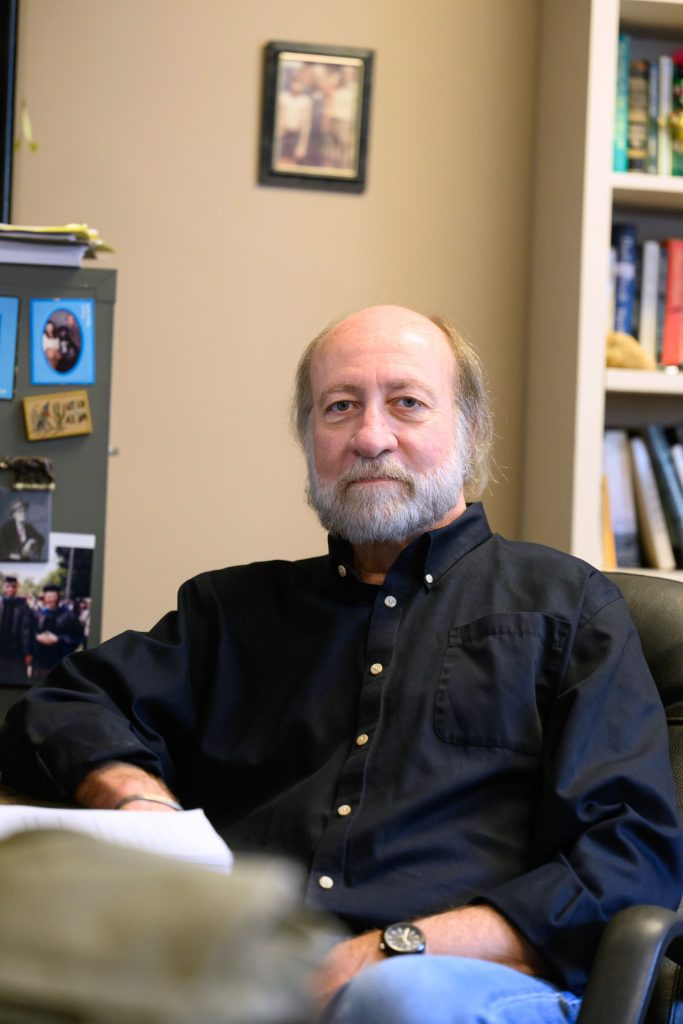
Terry Engel’s work has appeared in The Master’s Review, County Lines, American Literary Review, The Sun, Mississippi Review Online, Sixfold, Open City, Buffalo Spree, Cream City Review, Georgetown Review, and other literary journals and magazines. He won the Hemingway Days Short Story Writing Contest, and received honorable mention from Pushcart Prize. His first novel, Natchez at Sunset, was published in 2021. His second novel, Artifacts, won the Wolfson Press Prose Prize and will be published in 2026. His third novel, Union Ticket, will be published by Stillhouse Press in 2027. Engel teaches creative writing and literature at Harding University in Arkansas.

Cynthia Yatchman is a Seattle based artist. A former ceramicist, she received her B.F.A. in painting (UW). She switched from 3D to 2D and has remained there ever since. She works primarily on paintings and prints. Her art is housed in numerous public and private collections. She has exhibited on both coasts, extensively in the Northwest, including shows at Seattle University, SPU, Shoreline Community College, the Tacoma and Seattle Convention Centers and the Pacific Science Center. She is, a member of the Seattle Print Art Association,COCA, Women Painters of Washington and Puget Sound Group of Northwest Artists.