The mÖma Show & The Villa Occupation: A Celebration of the Temporary Museum of Memory Archeology
by bart plantenga with Mark Boswell
~
“The house turned out to be a magnet for objects, where things were valued for their peculiarity, instead of being consumed.”1
1 Adilkno, Cracking the Movement: Squatting Beyond the Media, Autonomedia, 1994. Adilkno (Dutch: BILWET), Foundation for the Advancement of Illegal Knowledge, was established in Amsterdam in 1983. https://thing.desk.nl/bilwet/Cracking/squatting.html.
 [Osnabrück, May 2018]
It’s not everyday you encounter a derelict building, let alone a tumbledown villa with its flaking turquoise, crumbling cement pool, half-filled with murky water located behind the town golf course, sitting there like an Andrew Wyeth painting in a field of tall grass that can be accessed with a minimum of daring. That no one ever goes there EVER – no squatters, skatepunks, vagrants or real estate developers, no one except except we two interlopers – just added to its allure and mystery. Maybe it’s haunted or maybe local curiosity just evaporates by age 29 in this region. Not since I was a kid of 10, when we made a motor hotel signaled for demolition along US 1 in New Jersey our clubhouse, had I been so excited about an empty building.
In May 2018, I traveled by train from Amsterdam to Osnabrück, Germany to help best friend, filmmaker Mark B.2 clear out the house of his in-laws, wife Susanne’s parents. The father, Otto N., had died right there in the spare bedroom, while the body went unnoticed by the mother, Inge N., for days – a likely symptom of her dementia. She was admitted into a local nursing home to her liking shortly thereafter.
I arrived at noon. Ready, as Mark observed, to steer him “into the absolute silence of the art of material disappearance. We struck a rhythm from the get go that steered us through the task at hand.”
The primary task was to prepare the house for sale, which meant removing all of the life-worn, lived-in remnants from the house that “constitutes a body of images that give mankind proofs or illusions of stability.”3 Indeed! We laid the exotically ordinary possessions out in piles in the backyard and driveway. No problem. Mark was convinced my distance from the former occupants [I’d met them twice] plus a weird organizational skill that sometimes performs beyond all expectation would allow me to be more ruthless and efficient. This was easier said than done because I quickly became as emotionally involved as Mark as we searched for meaning inside the sad biographical belongings that we’d soon either covet, deconstruct, gift or dump, hoping, in essence, to not allow the lives of two modest beings to become the victims of a total obliteration via historical amnesia. Yes, this house dismantling would frequently call into question the meaning of life. The conclusion: ordinary lives are pretty much deemed 99.5% discardable. What does that say about our short lives on this planet?
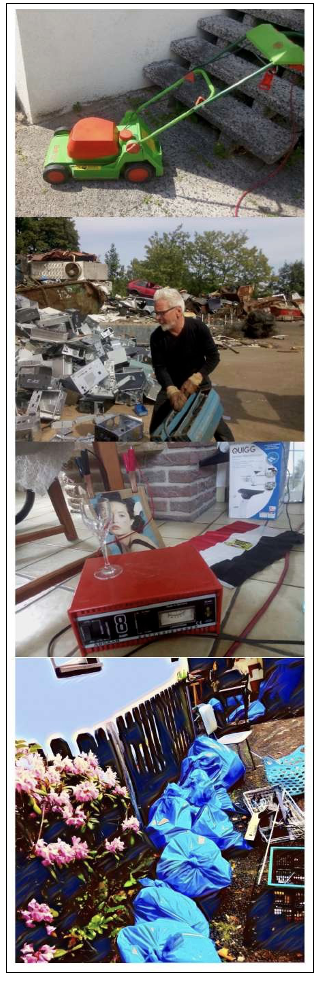
For solace, we strayed inevitably, unconsciously, toward our auxiliary task: work hard for 14 hours a day, but along the way indulge and distract ourselves from exhaustion, heat, and pain with the home’s enchanting detritus that delivered fascinating art objects and teased warm grins from our faces. As we marveled at these rescued objects: the drying rack, Buddha on a sled, a fake-leather pouch full of some 30 lockless keys, the wacky green-orange lawn mower … Mark, during our many musings, tried describing our higher goal as the infiltration-curation-transformation of “our” mysterious villa – I had yet to see it – into an exhibition space, a DIY MoMA, our mÖma.4
The fact that German law generally protects property owners over squatters led us to Hakim Bey’s question: “How can we separate the concept of space from the mechanisms of control?”5 Well, with minds set on curating a show on the cracked walls of this forsaken villa at the right moment, a few days down the line, we would simply “storm the studio” [Burroughs] and take over this under-utilized space that had long ago disappeared into the amnesiac mist of a society fixated on real estate.
2 Mark and I met in Paris, late 1988. He an upstart-golf-caddie-avant-garde-filmmaker, me a reticent DJ-wordsmith-editor-miscreant with many publications and a deep suspicion of the reigning narrative – we were outsiders in the crimped, insular Paris ex-pat scene. Our friendship was sealed early in Paris where we plotted, dreamed, speculated, flirted, wandered off the grid, somehow thrived in survival mode on a deadbeat budget, drank, wrote and performed in poetry reading situations, often staging bafling and sometimes hilarious improv events that rearranged words and deranged the status quo, living up to our motto: FUN IS THE BEST REVENGE. We’ve collaborated in Paris, Amsterdam, Heidelberg, Ösnabruk, New York and Miami Beach, on films, words and events.
3 Gaston Bachelard, The Poetics of Space, Beacon Press, Boston, 1964, p. 17.
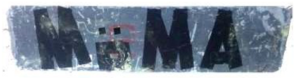
4 The name of our “museum” is a typographical play on NY’s MoMA, the umlaut & Osnabrück.
5 Hakim Bey, T.A.Z.: The Temporary Autonomous Zone, Ontological Anarchy, Poetic Terrorism, Autonomedia, NY, 1991. https:// theanarchistlibrary.org/library/hakim-bey-t-a-z-the-temporary-autonomous-zone-ontological-anarchy-poetic-terrorism.
He showed me the layout of this suburban house that had once been a home and as he dressed me in some work clothes consisting of an old dress shirt of Otto’s and a pair of pants Mark had picked up in a secondhand shop for a euro, he mentioned the vivid dream he’d had after watching The Graduate a few nights earlier on the about-to-be-donated big-screen TV, about a modern house on the edge of town that once belonged to a wealthy family that owned a ceramic tile factory. ..
The weather was rather perfect – mostly dry, actually balmy for May – for the job of 1. clearing out the home with its cheap fake-elegant molding, crammed full of decades of memorabilia and belongings, 2. recycle, 3. dump or donate, and 4. prepare it for sale.
By late that first night, after several beers, endless jokes, countless hocketed, mad-capped, rapidfire stories of ex-girlfriends and our Paris past over an ad hoc dinner of whatever was edible, we had to admit we had made significant headway and we were tired – an honest exhaustion.
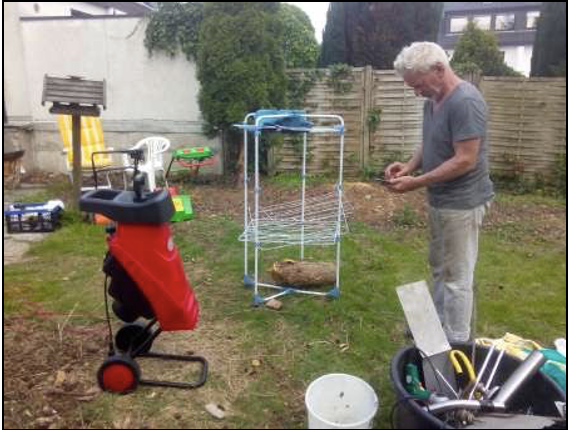
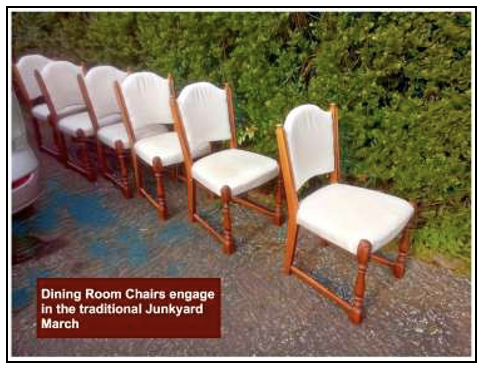
We stared out the dark window at our day’s results: The recycling had begun in earnest not only because it’s the law but because we believe in recycling: we had created distinct piles of plastic, faded fabric and sad old clothes, paper, tools to sell or give away, implements of unknown function, irretrievable junk, cheap carpet, mysterious WTF things, garden tools, unflattering furniture, poisons and toxins, heavy metals, pre-Ikea6 particle board (LDF) shelving, aluminum, in short, the sad detritus of an everyday life that doesn’t last forever … And, of course, our set-apart intriguing pile of recuperable trinkets that aroused our aesthetic interest.
The next day, driving in awed silence to the local recycling center, managed by a guy who had assumed all of the traits of a small-town tyrant, favoring those he liked who he’d permit to pluck out valuable prizes from the heap. We arrived humbly with our plastic, glass, and appliances and there he stood on a pedestal, petty-despotically pointing and nodding yes or no to each piece of plastic.
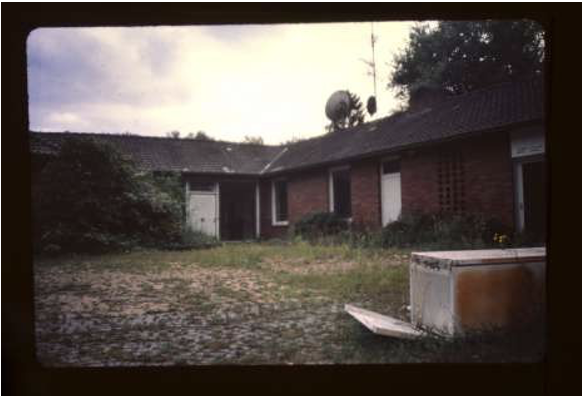
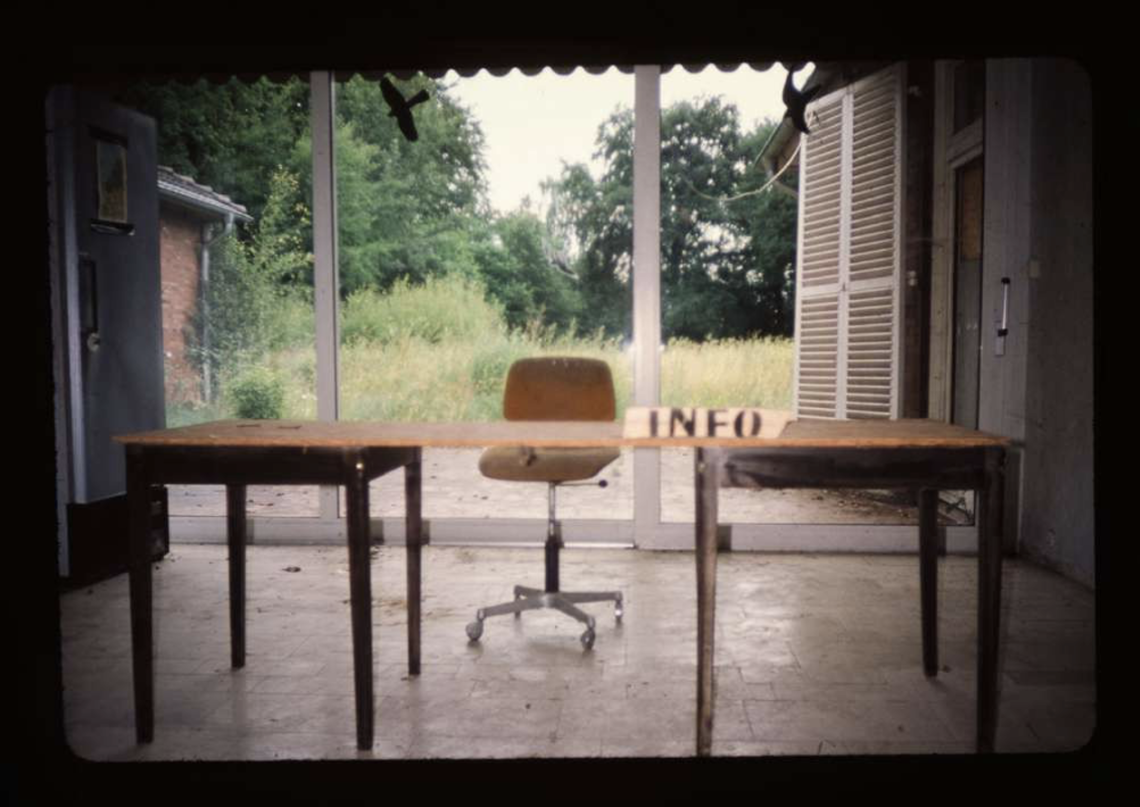
Villa of Abandoned Memory / Villa von Verlassene Speicher
The villa, it turns out, was not just a neutral, anonymous big house in decline, located in some bucolic remove somewhere. It had once been the home of the local tile factory magnate. H.H., the son of the patriarch, had inherited the business from his father and managed, despite a lack of business acumen, to maintain their status as one of the richest families in town. But his fortunes eventually fell on hard times in a most cinematic way, as he deep-sixed the business, preferring to spend his money and energy “with gold debauched flair” on his all-consuming passion – his golf course and country club, literally in the estate’s backyard, which he had designed and built. Here he hosted businessmen and celebrities with lavish affairs.
“In the middle of the golf course he left a good stretch of 10 hectares,”7 Mark explains, “where he had a state-of-the-art modern villa built with a swimming pool,
6 In Germany, these household goods were made in a giant factory in the city of Gelsenkirchen, located in the heart of the Ruhrgebeit. These goods are sarcastically referred to as “Gelsenkirchen Baroque,” as in worthless junk.
sauna, maids’ quarters, office, countless bedrooms, several dining rooms, and plenty of outdoor space.”
As fate would have it, HH’s son would become an early boyfriend of Susanne, Mark’s partner. In the 1990s, just after they married, they went “to the villa to visit him. I remember driving up a long narrow lane between beautiful pastoral golf holes and through a large swath of trees. It was all there, the bright sunlight, the swimming pool, the modernist design. Her old boyfriend was sitting in the living room watching soccer and eating sandwiches off a serving cart.”
Twenty years later, just before I arrived, he headed off to find this villa anew with only vague memories of how to get there. “I had Karl-Heinz Stockhausen’s “Helikopter Quartette” on the car stereo to pump up the mood. I parked and roamed around the periphery of the golf course, trying every dirt road to no avail.”
Mark asked a young man out walking his dog on a farmhouse road, next to the course, about the villa. “Ja, die Hinsiek Haus is da druben.” (Yes, the Hensiek house is over there.) He gave Mark directions: drive back to the entrance of the course and then take a narrow lane that ran along the golf course until you come to a giant bolder marking a split in the road.
He eventually found the correct lane through the forest (that he’d seen so vividly in his dream). It was all still there: the modernist villa with its skewed letter-H layout, pool, oddly large windows with outsized, heavy, white swinging shutters. It was all exactly how he’d left it – except now in a state of dissheveled repose. Tall weeds, grasses, brush, dust and ageing had overtaken everything.
“Nothing had been touched and obviously nobody cared. Astonishing, but true. I, in some way, now owned it,” Mark explained, “if only temporarily. In that instant I knew it needed to be occupied and converted into a temporary autonomous art-gallery-museum of the utopian, post-Beuysian kind, hidden there among the unassuming hills of Osnabrück. Maybe a museum without a future or even a past. Temporary – like most things above ground at this juncture in time.” Or, to paraphrase Hakim Bey, a space with the potential to flower as an autonomous zone that is relatively open, either through neglect or having somehow escaped notice by the mapmakers.8
Rusty appliances, bald tires, and boulders were strewn about the old tiled main approach to the villa. “I could see through the large windows in the front that the interior was in total disrepair.”
Mark remembers: “The doors were locked, so I walked around back to find a way in. The wings of the house were connected in the center by a perpendicular foyer and hallway. Here I found a boarded-up door that allowed easy entry.”
After the family fortune imploded and the factory went belly up, “HH was allowed to live in the house until profits from the sale of the factory ran out. They eventually did. He sold the house to a golf club member with the stipulation that he could continue living there.” HH was eventually fleeced by a variety of shady businessmen, until he was pfennig-less, surviving the winters without electricity, burning furniture inside the house to stay warm. In the end, no one in the family wanted to live there – bad memories and ghosts apparently.
When I first came upon this ghost town villa, its tumble from glory, the suffering, betrayal, arrogance, and melancholy were all palpable in its ambience.Mark gave me the full tour, as he described how he’d roamed around “in a euphoric stupor, fearing nothing, unable to fathom how this million-dollar villa had become a sad ghost of its former self.”
Towards the rear wing of the house he discovered a desk and filing cabinet where he had discovered a treasure trove of old black-&-white photos of the family in elegant, high-life settings. But no signs of the madness, desperation, and family’s dissipation.
8 Hakim Bey, https://theanarchistlibrary.org/library/hakim-bey-t-a-z-the-temporary-autonomous-zone-ontological-anarchy-poetic-terrorism.
“I also found a small Chinese purse in one of the drawers. In a sidepocket of the purse I found … a portrait of my wife in her late teens. I collected the photos and left in a spooked trance. I knew I’d be back, but it was like a psychedelic trip without acid. I had discovered a netherworld that had to be dealt with” and he had “to make sure no one, no police, no vandals, would disturb my idyll.”
The House Was Clean Enough To Be Toxic
Presumably it was Inge who purchased the home’s cleaning products, a cabinet full of unpronounceable poisons. While in the garage, Otto kept his stash of canisters filled with machine-related lubricants and garden toxins. We’re trained early on by advertising that to be microphobic is normal. The house was brimming with toxic products for grease, car tires, motors, plastic, carpets, car interiors, kitchen floors, ovens, bacteria, caulking, toilets, bathtubs and showers [PutzMeister], calcium, dust, shine, glass, chrome, green mold, discoloration, white washes, colored washes, hard-to-remove spots, a shampoo called Man, conditioners, hair shine spray, mice, aphids, and other garden and household pests. All told 100+ containers of toxins. Mix’m all together and …
From here we can extrapolate that this household was not unusual in its range of poisons. We can modestly estimate the average number of toxic substances at, say, 50 per household in Osnabrück, take that 50 and multiply it by all of the homes in all of the towns and cities in Germany, in Europe, in the world, and one soon realizes that we are sitting on one gigantic, collective, concealed, toxic time bomb with poisons clandestinely flushed, rinsed, applied to plants, all gradually joining the spilled oil, kerosene, diesel, benzine, gasoline, furniture stripper, and paint thinner to enter our breathing space, seeping into the soils, ground water. And to know all of this happens behind closed doors.
Luckily, towns like Osnabrück are aware of the problem and are trying to do something about it on the waste end – almost everything is recycled with sometimes aforementioned comical authoritarian verve.
Volles Haus Leer / Full House Empty
The world has changed. Heirlooms, for instance, are no longer desired; they’re just burdensome pieces of wood and plastic that no one wants and you throw your back out discarding. Most people since the 1990s buy disposable furniture that deteriorates over time as opposed to accumulating auction value or intimate value as part of a family history. Not unusual then that the family purchased a great deal of pre-Ikea, less-inspired precursors of particleboard household goods. Barely a single heirloom of craft or quality or heritage to be found. There is good and bad attached to this paradigm shift: We’re so inundated with stuff, goods, data, packaging, electronics, and convenience that we’re actually annoyed and burdened by all this plenty. But this stuff is light, breaks apart easily, can be disposed of with a minimum of effort – and you’re rid of it forever, ready to make a new start – if you’re willing or able. Discarding is done as an empowering act of emancipation.
The downside is that most Ikea-type products are neither passed down to family members nor recycled [except by a few enterprising entrepreneurs, recyclers, designers, and artists] and land curbside, filling up garbage trucks to only be added to the growing mountains of junk that only periodically turn into something enterprising like a ski resort in Michigan or Denmark.
A drive through any major city reveals the life-worn objects of evicted families: photo albums, stuffed animals, videotapes, worthless costume jewelry, everything on the curb, ready to be hauled away. Not a single family member comes along to sift through it to salvage value or memory. The only recycling is done by the homeless and retired men hunting for copper and other valuables. We wanted to avoid this debasement scenario where entire lives become disposable as if they never mattered.
And the elaborate sort-and-discard process had added some incredibly fascinating objects and fetish items to the pile that ‘told’ the story of the house or seemed to be acting more and more like art.
After six days of hard labor, we drove two 500-kilo carloads of shock-absorber-burdening heavy metal to the metal recycling site and onto a scale where the full load was weighed and then drove to the back of this distressed terrain of hunched over, hard-muscled older men who were more likely to interact with rusty junk than with humans. We emptied the car in dramatic Olympian fashion, hurling each object like we were participating in the hammer throw or discus event. Then drove back onto the scale and the weight difference was noted for our payoff. In total, we received enough to treat ourselves to a modest dinner at the Greek place down the street from the family home.
We arranged with the local sanitation crew to come by on a special round, just for us, at 6:30 AM, to pick up a truckload of large trash. We fed them chairs and bags of wallpaper and dust, the washing machine, tables, chairs – the crew took everything, pretty much filling the truck in 10 minutes. The head of the crew was proud to be able to so magnanimously accommodate us and for that we showed our gratitude with a profuse outpouring of half-genuflected “Vielen Danks.” And they were off to their next superhero appointment, leaving behind some restored faith in humankind – and very little bedding left for us to sleep on…
The mÖma9 Show, Osnabrück, May 2018: Unforgotten Kunst
We’d gathered over two dozen objects suitable for exhibition where the narrative of the occupants of the modest home would meet that of the once-grand villa, bringing together the narratives of two distinct social classes. So, late afternoon Friday we loaded the objects and headed to the outskirts of town, turning onto a double-rutted path through fields of high grass, along the golf course periphery to “our” villa, our newly christened mÖma Museum.
Two German artist-friends joined us later, contributing works constructed on-site and, with plenty of good will and wine, we hung the show. We walked past our curated collection of left-behind evidence, admiring the works the way one reads words arranged in a sentence that offered hints of illumination, suffering, survival, celebration, and families’ half-hearted attempts to transform debased routines into not fully convincing rituals. Our works seemed to engage the host space and us in lively discussion – if only for a moment – gleaning insights into the multi-layered, ideological meaning present in the space, which harbored and hinted at the memories of the two homes, two fortunes, two socioeconomic realities.
We hosted a candlelight performance by local artist Stefan McGuire, documented everything and by the end of the proceedings, in the flickering darkness, we understood that fine line between memory and amnesia, between consciousness and neglect, as we for an evening were able to embrace the past as part of the present as downpayment on the future. In effect, the villa “shelters daydreaming … protects the dreamer, allows one to dream in peace.”10
We applauded our own efforts, enchanted by the results of our occupation of this temporary autonomous zone cum pop-up museum and toasted the night sky as we stumbled in darkness toward our vehicles. Who knows how temporary it all was because, a year later, our show was still hanging there undisturbed …
9 The Museum of Memory Archaeology, or mÖma, is under-construction. It will covers social excavations that document how homes recently emptied can supply the contents for a museum show dedicated to the curated memory of the home and its former occupants. https://momosna.weebly.com/
10 Gaston Bachelard, The Poetics of Space, p. 6.
Selected artworks, May 2018
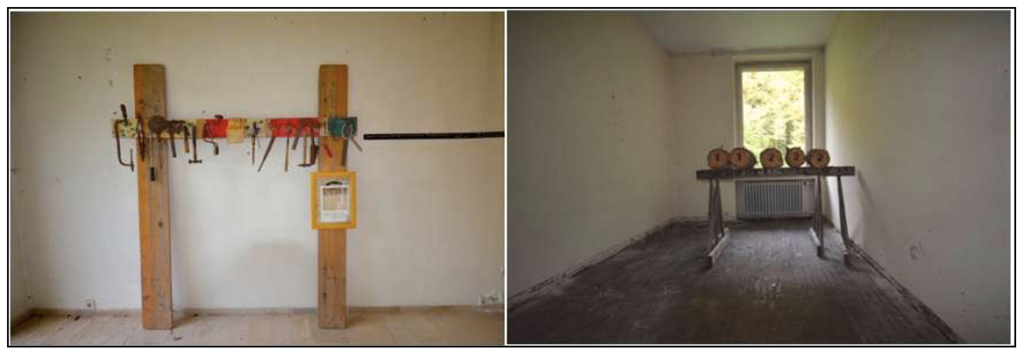
- There’s Something About Men With Rusty Tools [Reconditioning Jim Dine]: Among objects found in the home was a book from Susanne’s college studies, a Pop Art coffeetable book and, in leafing through it, the book fortuitously fell open to Jim Dine’s 1962 Five Feet of Colorful Tools. I saw immediately that I’d already been uconsciously remaking this piece in the garage.
- 12222: zip code. Greenpoint, NY, a piece Mark completed prior to my arrival
- Useless Worthless Readymade [Nutzloses Wertloses Readymade]: Windshied ice scraper with attached protective mitt
- Motor Vehicle Fuses Pretty Legs [Autosicherungen hübsches Beine]: Package of car fuses plus fashion magazine legs
- Here’s Johnny (1980): axe-tool-weapon-object
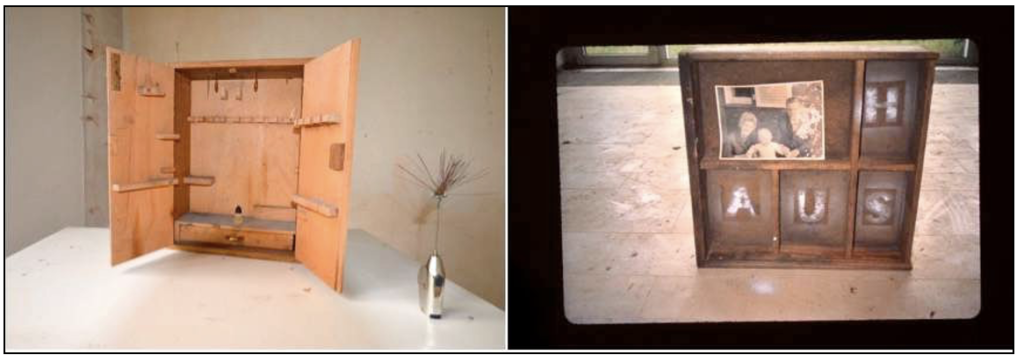
- Urine Sample Incriminates Househusband [Urineprobe belastet Hausmann]: Test tube cabinet + urine sample &
- Mosh Pit Au Lait: Battery-operated milk frother with Frazzled Coif
- Haus: Organizational tray & photo of villa family
- The Case Against Intelligent Design: If There Was A God He Would Never Allow Humans To Invent This [Der Fall Gegen Intelligentes Design: Wennes einen Gott gabe, würde er es niemals zulassen, dass menschen dies erfinden]
- Housing is a Right: Gentrification is the Reality: Chicken wire mesh + bird house front
- Otto Has Left The Building: A clothing hanger from Otto’s closet plus an ancient receipt in plastic sandwich bag
- Survival in Light Syrup [Überleben in Hellen Sirup]: Can of left-beyond pineapple with expiration date found in the back of a kitchen cabinet
- Framed Ghost Work 1: Spectral impression left on wall by removed art reproduction [round]
- Framed Ghost Work 2: Spectral impression left on wall by removed art reproduction [rectangle]
- Tire Ramp: Old car tires, ramp, side room [Shock Martin]
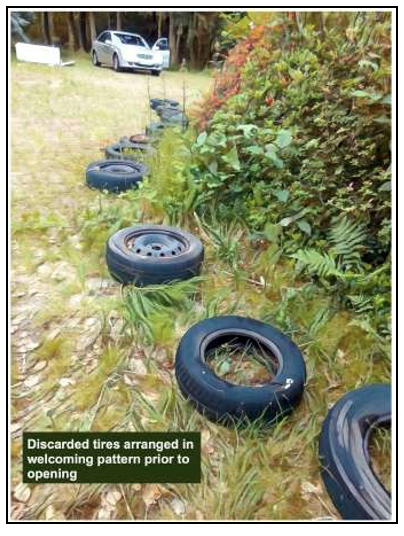
- Tires as Entrance Enhancement: Old tires rearranged to welcome and guide visitors inside
- Battery Charger + Unknown Celebrity image, Wine Glass: Assemblage work stolen from the home’s front yard by someone who assumed we were tossing it.
- Lumberton: Outdoor installation, recuperated lumber
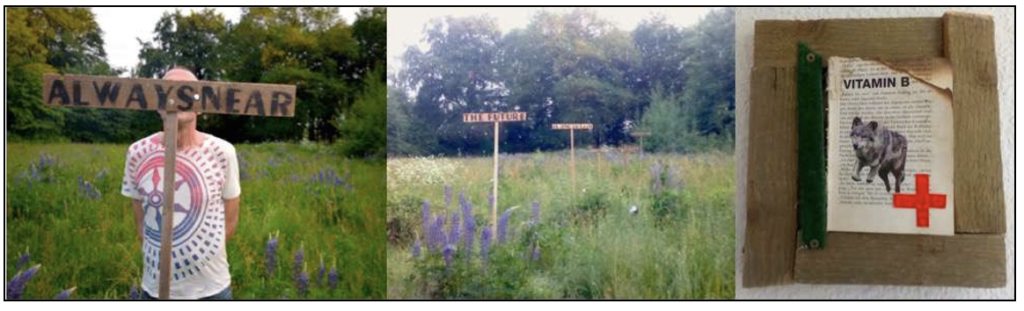
- The Future Is Uncertain and the End is Always Near: 5 signs a la roadside Burma Shave billboards
- Vitamin B+: Beuys in the next century
- Rebel without a pause: Stefan McGuire’s candlelit performance of recalling his epic journey of visiting every house that James Dean ever lived in and speaking to any remaining relatives and/or present inhabitants.
Participating artists: Mark Boswell, bart plantenga, with artwork contributions and/or assistance from Shock Martin, Stephan Maguire, and Armin Holdt.
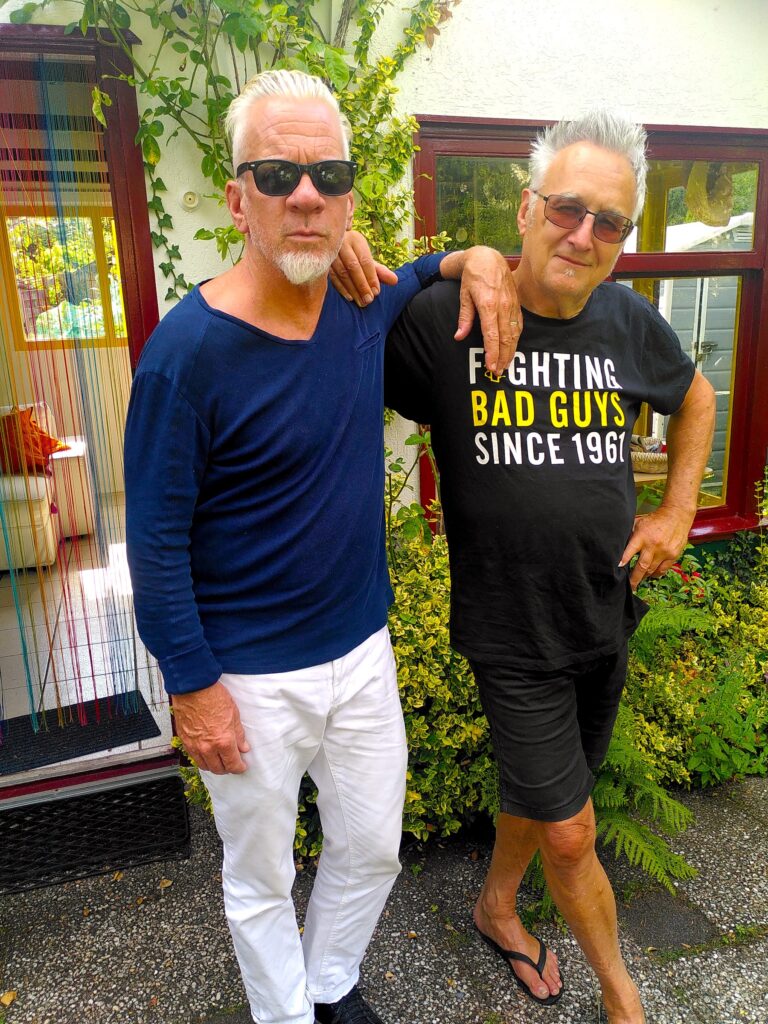
bart plantenga, is the author of numerous novels including RADIO ACTIVITY KILLS and THE DRAG QUEEN & THE FLOOD, the novella SPERMATAGONIA, THE ISLE OF MAN, 2 short story collections [Wiggling Wishbone (Autonomedia) & The Confusion Spandex], two memoirs: Paris Scratch & NY Sin Phoney in Face Flat Minor. He has also written a broad range of material: award-winning history articles, erotica, humorous faux-histories, and CD liner notes. He was one of the founding members of the NYC writer group, The Unbearables. His books YODEL-AY-EE-OOOO: The Secret History of Yodeling Around the World and Yodel in HiFi: From Kitsch Folk to Contemporary Electronica and the CD Rough Guide to Yodel received international attention and have created the misunderstanding that he’s the world’s foremost yodel expert. He produces 2 irregular podcasts: Dig•Scape & iMMERSE!. He’s also a DJ and has produced Wreck This Mess in NYC, Paris, Amsterdam, Rotterdam since forever. In July 2025, he became a regular contributor to the legendary London alternative weekly, The International Times. He also recently heard that his much-excerpted novel BEER MYSTIC is to be published by Autonomedia. After many years in the US, Paris and elsewhere, he returned to his native Amsterdam, where he now lives with his daughter & partner. This is his 3rd appearance in LIT Magazine.
Mark Boswell: Mark met bart in Paris in the early 90s where they did many readings and interventions. Born in North Carolina, bred in Tallahassee – and the world, experiences as a golf caddie to his writing and unorthodox filmmaking exploring everything including old Soviet aesthetics, secret agents, Doris Wishman, golf, etc. He was the co-founder of the Alliance Film/Video Cooperative and Anti Film Festival in South Beach. He has taught at the San Francisco Art Institute, Ringling College of Art and Design, and Pratt Institute [NYC] and has lectured on agit-prop cinema. His most popular films include Unknown Unknown(s), USSA: Secret Manual of the Soviet Politburger, Agent Orange, the seminal film The Subversion Agency and the documentary 60 Seconds of Solitude in Year Zero.